





 0 Comment
 Customer Reviews

The deck's ready. Three cloud architecture diagrams, a revenue breakdown slide, and a business model canvas that took the better part of a Tuesday to build from scratch.
And then someone in the room asks: "But what does our monetization model actually look like compared to AWS or Azure?"
That's not a bad question. It's just one that wasn't planned for. And now the whole flow depends on an answer that doesn't exist in the slides.
Cloud platform business models are genuinely complicated. Not because the concepts are obscure—subscription tiers, pay-as-you-go pricing, PaaS margins, IaaS lock-in—but because getting them onto a slide in a way that's clear to a CFO, a product lead, and a technical architect simultaneously is hard. Each person's reading different things. The CFO wants the revenue logic. The product lead wants the value exchange. The architect wants the service layer breakdown.
Most decks end up serving none of them particularly well.
The problem compounds when you're presenting to investors or new enterprise clients. You're not just explaining how cloud platforms work—you're making the case for why yours works this way, why this pricing model fits this customer segment, why the SaaS recurring revenue model beats the alternatives for retention. That's a different kind of explanation. It requires structure you can't improvise.
So templates for cloud platform business models exist. Not because the people building them don't understand cloud strategy—they usually do. They exist because the gap between understanding the model and presenting it clearly is real, and that gap costs deals.
SlideTeam's pre-designed cloud platform business model templates handle exactly this. They're built around the structures that matter—business model canvases, revenue breakdowns, IaaS vs. PaaS comparisons, platform ecosystem diagrams—so you're not reinventing the framework every time someone needs to see the logic made visual.
Here's what's in the collection.
Template 1: Cloud Platform Provider Business Model PPT Presentation
Financial clarity is often what separates a funded cloud platform pitch from a forgettable one. This PPT template is built for founders and finance leads who need to present a complete cloud provider business model — with five-year projections, break-even analysis, valuations, and payback period all structured logically. It covers the IaaS business model financials that investors actually ask about. The slide covers each component with sector-oriented precision. The template is 100% editable and customizable.
[product_image id=1280973]
Template 2: Cloud Support Model Management Platform Service Creation Business Processes
Support models and service creation processes rarely get enough slide real estate. This PPT preset gives cloud operations and product teams twelve structured slides to map service creation workflows and management platform logic. It's practical for internal reviews or client-facing capability decks. Use it to walk stakeholders through how your cloud support model handles business processes end-to-end. The template is 100% editable and customizable.
[product_image id=431157]
Template 3: Implementing Platform Business Model Company Platform Business Canvas Model
A nine-stage business canvas drives exceptional clarity for platform-centric organizations. This model captures every stakeholder dimension — consumers, partners, producers, and owners — in one compelling framework. Each building block, from Key Resources to Customer Relationships and Value Proposition, translates directly into actionable strategy. Customizable layouts give you the flexibility to tailor every element to your unique cloud platform context. Use this canvas to align teams and present your platform model with confidence. Transform your platform planning presentations today. Download this dynamic template now and unlock your business canvas potential.

Download this PowerPoint Template
Template 4: Implementing Platform Business Model in the Company Understanding Feedback Loops Drive Business Agility
Understanding feedback loops is what separates reactive platforms from truly agile ones. This template captures three critical loops — awareness, balance, and agility — across six distinct stages, giving your audience a structured view of platform dynamics. Each stage converts complex interdependencies into clear, visual narratives that resonate instantly. The focused structure empowers you to present how feedback mechanisms drive real business agility and sustained cloud scalability. Use these slides to elevate your platform strategy presentations. Download this template now and unlock your competitive edge in platform business model thinking.

Download this PowerPoint Template
Template 5: Implementing Platform Business Model in the Company PowerPoint Presentation Slides
Fifty-two slides is a lot of real estate — and this PPT uses it well. This deck is built for teams implementing a platform business model, covering everything from value exchange to operational structure. It's the kind of resource a strategy lead reaches for before a board presentation or an all-hands. Explore more platform business model templates and examples to round out your presentation toolkit. The template is 100% editable and customizable.
[product_image id=462686]
Template 6: Business Model for Cloud Computing Services Provider PPT Sample
Boardrooms don't forgive dull slides — especially when the subject is cloud computing revenue models. This template merges sharp visual design with a content structure built for cloud services provider pitches. The layout captures everything from service tiers to customer segments, ensuring your revenue logic lands clearly. Pre-designed frameworks mean you spend time on the argument, not the formatting. Deliver compelling cloud computing business model presentations with ease today. Download this template now and command every client pitch with confidence.
[product_image id=1407488]
Template 7: Business Model Cloud Infrastructure Management Platform Pitch Deck
A business model canvas for cloud infrastructure needs to show the full partner ecosystem — not just the value proposition. This template maps key partners like AWS and technology vendors alongside channels, customer relationships, and customer segments in one cohesive view. It's the right slide for a cloud infrastructure management platform pitch where the audience needs to see the whole commercial picture. See additional cloud platform business model template examples to complement this deck. Download now and present with clarity.
[product_image id=1099555]
Template 8: Implementing Platform Business Model in the Company 5 Steps to a New Platform Business Model
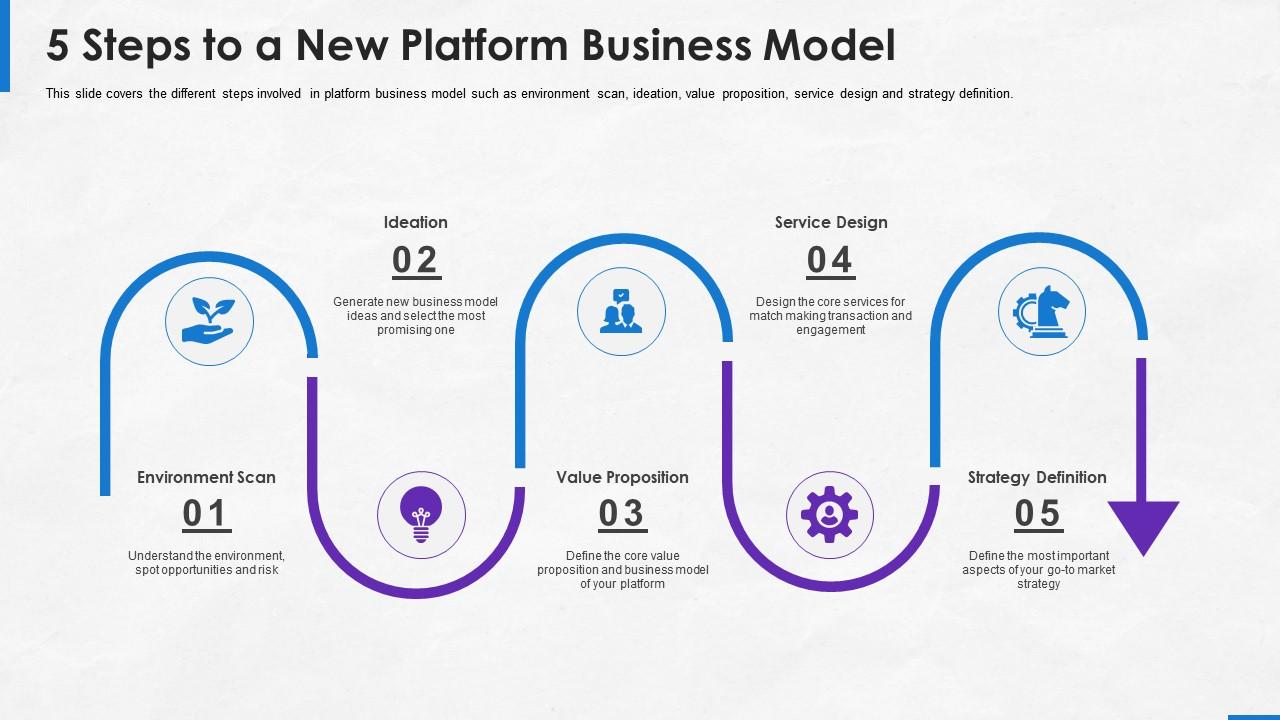
Moving from concept to a working platform business model takes more than good intentions. This PowerPoint slide walks practitioners through five concrete steps: environment scan, ideation, value proposition, service design, and strategy definition. It's particularly useful for product and strategy teams pitching a new B2B cloud platform model to leadership. Each stage is clearly separated so the audience follows the logic without getting lost. The template is 100% editable and customizable.
Download this PowerPoint Template
Template 9: Cloud Computing Services Provider Business Model PPT Presentation
Cloud computing services pitches often stall when the slide design undercuts a strong business case. This deck balances simplicity and structure, giving presenters a clean canvas to communicate their cloud computing revenue model without visual noise. It's built for practitioners who need a ready-made design that adapts quickly to specific company needs. Whether it's a client pitch or an investor meeting, the layout holds attention. The template is 100% editable and customizable.
[product_image id=1405762]
Template 10: Multi Service Platform Business Model PPT
Multi-service platform models are harder to explain than single-service ones — the revenue streams multiply, and so do the stakeholder questions. This PPT preset is built for that exact complexity. It gives product and commercial leads a structured way to present a multi-service cloud platform business model without overwhelming the audience. The deck handles the visual heavy lifting so the presenter can focus on the logic. The template is 100% editable and customizable.
[product_image id=1396425]
Template 11: Cloud Computing Software Business Model PPT Slides
Software-driven cloud business models have their own commercial rhythm — and this PPT reflects that. This deck is built for teams presenting a cloud computing software business model, whether to internal stakeholders or external investors. The design pairs clean visuals with structured content areas, making complex revenue and delivery logic easy to follow. It suits boardroom meetings and client pitches equally well. The template is 100% editable and customizable.
[product_image id=1405763]
Template 12: Platform Business Canvas Model Implementing Platform Business Model in the Company
Four-stage canvas frameworks work well when audiences need to see the platform model without drowning in detail. This template presents the platform business canvas model — covering consumers, partners, producers, and owners — with just enough structure to anchor the conversation. Product leads and business architects use it to align teams around the core platform value exchange. It's clean, direct, and built for fast comprehension. Transform your platform business presentations today. Download this dynamic template now and drive team alignment.

Download this PowerPoint Template
Template 13: E Commerce Platform Business Model PPT Example
E-commerce platform business models carry unique dynamics — marketplace revenue streams, seller relationships, and consumer acquisition costs all need explaining. This template gives presenters a visually strong, fully structured deck to capture all of it. Each slide is built for immediate audience engagement, with creative layouts that make dense commercial logic digestible. Customizable color schemes and elements ensure the deck aligns with your brand without extra effort. Elevate your e-commerce platform presentations effortlessly today. Download this template now and outshine every competitor in the room.
[product_image id=1404238]
Template 14: Google Cloud Platform for Business Growth
Google Cloud's growth story is one of the most studied examples of enterprise cloud adoption strategy in action. This PPT preset gives analysts, consultants, and business development leads a structured way to present Google Cloud platform models and growth frameworks. The deck covers the creative and analytical dimensions of cloud business strategy with visual precision. It's a solid starting point for any presentation on cloud platform competitive advantage or enterprise adoption. The template is 100% editable and customizable.
[product_image id=1457563]
Template 15: Implementing Platform Business Model in the Company Comparison of Different Types of Businesses
Comparing business types is one of the most effective ways to frame why a platform model outperforms traditional manufacturing or pipeline models. This slide is built for that comparison — it gives strategy and product teams a clean, structured way to show stakeholders the structural differences across business types. It's particularly useful in early-stage platform pitches where the audience needs context before the business model deep-dive. The template is 100% editable and customizable.

Download this PowerPoint Template
Template 16: Cloud Platform Essentials for Business Growth Strategies PPT Outline
Growth strategies for cloud platforms need more than ambition — they need a clear visual framework that stakeholders can follow. This PPT deck is built for cloud business leads presenting growth plans, whether for a hybrid cloud business strategy review or an enterprise expansion pitch. The design blends creativity with structured content, making it easy to adapt to specific business contexts. It covers the essentials without overloading the audience. The template is 100% editable and customizable.
[product_image id=1838575]
Template 17: Building Scalable Data Lakes with Cloud and on Premises PPT Structure
Data lake architecture decisions have real financial consequences — and explaining them to non-technical stakeholders is harder than it sounds. This deck is built for IT architects and cloud data leads who need to present scalable data lake models that span cloud and on-premises infrastructure. The structured slides make cloud data storage pricing logic and architecture trade-offs accessible to mixed audiences. It handles the visual complexity so the presenter doesn't have to. The template is 100% editable and customizable.
[product_image id=1850646]
Template 18: Data Sharing and Collaboration Platform Business Model PPT Example
Data sharing and collaboration platforms sit at the intersection of product design and commercial model — and that intersection is where most presentations get complicated. This PPT preset is built for product and partnership leads explaining how a data collaboration platform creates and captures value. It's the right slide for pitches where the audience needs to understand both the technical flow and the revenue logic. The design keeps both dimensions clear without cluttering the slide. The template is 100% editable and customizable.
[product_image id=1408774]
Template 19: Corporate Networking Platform Business Model PPT
Corporate networking platforms live or die by their ability to show clear value to both sides of the network. This template captures the full commercial logic of a corporate networking platform business model in a visually engaging, attention-holding deck. Each slide is built for instant comprehension, making dense network economics easy to present to senior stakeholders. Adaptable layouts mean you can align the deck to any industry vertical without starting over. Transform your networking platform presentations today. Download this dynamic template now and drive your pitch forward.
[product_image id=1404387]
Template 20: Cloud Computing Solution Business Model PPT Example
Cloud computing solution pitches need to do two things at once: explain the technology and make the business case. This template gives presenters the structure to do both without overloading any single slide. The deck covers cloud computing solution business model logic in a clean, adaptable format suited to client pitches, investor decks, and internal strategy reviews alike. Ready-made layouts mean you focus on the argument, not the design. Elevate your cloud solution presentations confidently today. Download this template now and present your cloud business model with precision.
[product_image id=1416571]
Win Every Cloud Platform Pitch with SlideTeam
SlideTeam's PowerPoint templates are the best in the industry for cloud platform business model presentations. These content-ready slides save hours of structuring time while delivering the professional clarity that investors, clients, and internal stakeholders expect. Whether you're presenting a SaaS recurring revenue model, a PaaS monetization strategy, or a full IaaS business model breakdown, these ready-made frameworks have you covered. Grab these templates and turn complex cloud strategy into compelling, winning presentations.
FAQs on Cloud Platform Business Model
How do cloud platforms balance multi-tenancy architecture with personalized service offerings to maximize revenue per user?
Cloud platforms use shared infrastructure to serve many customers but layer configuration, usage limits, and feature tiers on top. This lets them offer a personalized experience without building separate environments. Revenue per user grows through tiered plans and add-on services. The key is matching each tenant's usage pattern to the right pricing tier — usage data is the tool that makes this work.
What distinguishes a consumption-based pricing model from a subscription model in cloud platforms, and which drives higher customer lifetime value?
Consumption-based pricing charges only for what a customer uses; subscription pricing charges a flat fee regardless of usage. Subscriptions deliver more predictable revenue and tend to build higher customer lifetime value through habit and switching costs. Consumption models attract cost-sensitive customers but create revenue volatility. Most mature cloud platforms blend both — a base subscription with consumption-based overage charges.
How do hyperscalers like AWS, Azure, and Google Cloud use ecosystem lock-in as a core component of their business model strategy?
AWS, Azure, and Google Cloud build lock-in by making their proprietary services — managed databases, AI tools, IoT integrations — deeply embedded in customer workflows. The more services a customer adopts, the harder migration becomes. This isn't accidental; it's the core of their long-term retention model. Each new service adopted raises switching costs and deepens the commercial relationship.
What role does the marketplace model play in expanding a cloud platform's revenue streams beyond core infrastructure services?
A marketplace lets a cloud platform earn revenue from third-party software and services sold to its existing customer base. This extends revenue without building every product in-house. AWS Marketplace is the clearest example — it adds a transaction fee layer on top of infrastructure spend. For any cloud provider, a marketplace converts the customer base into a distribution channel.
How do cloud platforms monetize data without directly selling customer data while remaining competitive?
Cloud platforms monetize data by using it to improve their own services — better recommendations, smarter autoscaling, more accurate pricing models. They also sell analytics tools that let customers extract insight from their own data. The platform earns from the tooling, not the data itself. This keeps them compliant while still capturing commercial value from aggregated usage patterns.
What are the financial implications of the freemium model for cloud platforms targeting enterprise versus SMB segments?
Freemium works differently across segments. For SMBs, free tiers drive fast adoption and eventual paid conversion — the economics depend on conversion rate and low support cost. For enterprises, freemium is mainly a trial mechanism; procurement cycles are too formal for organic upgrade paths. Enterprise freemium only pays off if the free tier is genuinely useful enough to generate internal champions who push for a paid contract.
How does a Platform-as-a-Service (PaaS) business model differ structurally from Infrastructure-as-a-Service (IaaS) in terms of margin profile and customer dependency?
IaaS sells raw compute, storage, and networking — margins are thin and customers can switch if pricing shifts. PaaS adds a managed runtime and developer tooling layer on top, creating stronger switching costs and higher margins. PaaS customers embed the platform into their build process, making dependency deeper. The structural difference is: IaaS competes on price; PaaS competes on developer productivity and integration depth.
What strategies do cloud platforms use to reduce churn while simultaneously upselling customers to higher-tier services?
The most effective churn reduction tactic is increasing product usage depth — customers who use more features leave less often. Cloud platforms pair this with usage-based alerts that flag customers before they downgrade or leave. Upselling follows naturally when customers hit usage ceilings or request features only available in higher tiers. The sequence is: deepen usage, monitor signals, then present the upgrade case at the right moment.


