





 0 Comment
 Customer Reviews

The survey's been sent. Responses are trickling in. And now someone has to do something with them.
That's the part nobody plans for. You run a communication survey—maybe an internal one, maybe post-event, maybe across teams—and the data comes back. Numbers, ratings, open-ended answers. And then you're sitting there trying to figure out how to turn "57% of employees feel messaging is unclear" into something a leadership team will actually act on.
It's not the collecting that's hard. People will fill out a form. The hard part is what happens after. The slide deck that has to explain what the numbers mean. The meeting where HR presents findings and someone asks, "So what do we do about it?" The awkward moment when the data says one thing and the culture says another.
Communication surveys carry a specific kind of weight. They're not just performance reviews. They're not project retrospectives. They're asking people to say, out loud (or anonymously), whether they feel heard. Whether information reaches them. Whether the messages from leadership land. That's personal in a way most business surveys aren't.
And the presentation of those results? That's where things tend to fall apart. Someone exports the data into a spreadsheet. Someone else screenshots a pie chart. The slides end up looking like a first draft—because they are. There wasn't a structure ready for this. Nobody built one in advance.
That's why these templates exist. Not because the problem is new—it isn't—but because the discomfort is predictable. Every organization that runs a workplace communication survey eventually needs to show the results to someone. And that someone expects clarity, not a data dump.
SlideTeam's communication survey templates handle exactly this gap. Pre-designed layouts for everything from survey questionnaires to result analysis to post-event feedback—ready to fill in, not build from scratch. Whether you're presenting employee communication survey findings to a board or breaking down a communication effectiveness survey for department leads, the structure's already there.
Here's what's available.
Template 1: Data Visualization for Survey Results PPT Guidelines
Strong data visualization transforms raw survey numbers into clear, compelling narratives. This deck gives you a professional framework that captures audience attention instantly. Striking visuals replace cluttered tables, making communication survey results immediately understandable. Every chart and graphic drives your key findings forward with precision. You can align color schemes and elements to your brand without starting from scratch. Built for professionals who need credibility—and speed—on presentation day. Transform your communication survey results presentations today. Download this dynamic template now and unlock the full persuasive power of your data.
[product_image id=1525455]
Template 2: Customer Satisfaction Survey Client Needs Communication
Customer satisfaction doesn't sit still — it shifts with every interaction. This PPT template gives practitioners a clean structure to map client needs against communication gaps. Use it to present customer communication survey findings in a review or stakeholder briefing. It lays out the data so patterns in client feedback become immediately visible. The template is 100% editable and customizable.

Download this PowerPoint Template
Template 3: Communicating Survey Results to Drive Change PPT Outline
Survey findings only drive change when they're presented with purpose and structure. This complete deck captures your audience's attention the moment you advance to the first slide. Every layout translates complex communication survey analysis into focused, decision-ready insights. Effortless customization means you spend time on your message—not your formatting. Use this deck to present communication survey results that actually move leadership to act. Transform your change-management presentations today. Download this deck now and unlock the impact your data deserves.
[product_image id=1793965]
Template 4: Tactical Survey Questionnaire for Successful Comprehensive Communication Plan
Internal surveys fail when questions don't map to real behavior. This template provides a tactical internal communication survey questionnaire built around actual workplace scenarios. It covers platform availability, team assistance, and employee response patterns with structured clarity. Every slide translates internal communication survey data into a discussion-ready format. Use it to assess organizational communication approach and guide process improvement conversations. Transform your communication planning presentations today. Download this template now and unlock sharper insights from every survey round.
[product_image id=939105]
Template 5: Online Hotel Review and Guest Feedback Survey PPT
Guest experience hinges on how well hotels listen and respond after each stay. This PPT preset gives hospitality teams a polished format to present online review data and guest feedback survey findings. Whether it's a property-level debrief or a brand-wide communication feedback review, this deck keeps the narrative clean. It balances simplicity with enough structure to hold an executive audience. The template is 100% editable and customizable.
[product_image id=1750032]
Template 6: Survey Strategies for Post-Event Communication Organizational Strategies
Post-event communication survey design starts with asking the right people the right questions. This template covers a full set of action steps for communicating after events. It includes rating scales, general and customized questions, and segment-specific queries for attendees, VIPs, speakers, and vendors. Each slide structures your survey strategies into a clear, presentable format. The result is a communication survey sample your team can deploy immediately after any event. Transform your post-event debrief presentations today. Download this template now and unlock feedback that actually shapes future events.

Download this PowerPoint Template
Template 7: Survey Results of Company's Poor Communication Implementation of Formal Communication
Poor communication leaves a data trail—and this template helps you present it clearly. Statistical survey responses covering poor engagement, low morale, conflicts, and mistrust are structured into one compelling layout. Each data point connects directly to the communication approach under review. Audiences can immediately see the cost of communication gaps without digging through raw numbers. Use it to drive formal communication reform discussions with real evidence. Transform your internal communication presentations today. Download this template now and unlock the clarity your survey results deserve.
[product_image id=917895]
Template 8: Survey Results of Poor Communication Approach Infographic
Poor communication rarely announces itself — it shows up in morale scores and conflict rates. This PowerPoint slide presents statistical survey responses on the business impact of weak communication. It covers poor engagement, low employee morale, conflicts, and mistrust in one structured layout. HR teams and department leads use this PPT to anchor transparency discussions with real data. For anyone presenting an organizational communication survey to leadership, this slide does the heavy lifting. The template is 100% editable and customizable.
[product_image id=939103]
Template 9: Survey Strategies for Post Event Communication Enterprise Event Communication Guide
Post-event feedback is most useful when the questions are designed before the event ends. This PPT template gives event managers a ready structure for communicating after the event. It covers attendee ratings, general and customized questions, and segment-specific follow-ups for VIPs, vendors, and speakers. Use it to present your event communication survey results in a debrief or planning review. The template is 100% editable and customizable.

Download this PowerPoint Template
Template 10: Live Survey Polls Framework for Communicating during Event Corporate Event
Live polling during events only works when the questions are clear and the process is disciplined. This template covers eight actionable strategies for running live survey polls during events. It guides communicators through question simplicity, avoiding combined questions, and setting the right number of polling prompts in advance. Every slide structures a live Q&A communication approach into a format audiences can follow in real time. Use this layout to plan and present your event communication strategy with confidence. Transform your live-event communication presentations today. Download this template now and unlock engagement that lasts beyond the final session.

Download this PowerPoint Template
Template 11: Conversational Agent Survey for Brand Communication PPT Sample
Brand communication is increasingly driven by conversational agents — but few teams visualize the data well. This slide presents market trends and growth insights for conversational agents, covering email, video call, live chat, social media, and chatbots. Communication managers and brand teams use this PPT to show where automated channels are gaining ground. It supports discussions on personalized interactions and self-service communication options. The template is 100% editable and customizable.
[product_image id=1262277]
Template 12: Feedback Survey Strategies for Post Event Communication PPT
Post-event debrief quality depends on how systematically feedback was collected. This PPT preset covers five structured stages of post-event communication feedback survey design. It includes attendee rating formats, general and customized question sets, and segment-specific queries for VIPs, speakers, and vendors. Event teams and conference organizers reach for this deck when presenting feedback results to planning committees. It keeps the communication survey data readable and the takeaways actionable. The template is 100% editable and customizable.

Download this PowerPoint Template
Template 13: Upward Communication to Increase Employee Survey Results
Upward communication gaps are most visible when employee survey results are laid out honestly. This PowerPoint slide surfaces the real impact of poor communication—low morale, disengagement, conflicts, and eroded trust. It gives HR and leadership teams a structured way to present communication survey results to decision-makers. Each data point supports a case for stronger upward feedback channels. Use it to move from survey findings to concrete communication policy change. Transform your upward communication presentations today. Download this template now and unlock the organizational clarity your survey data points to.

Download this PowerPoint Template
Template 14: Survey Strategies for Post-Event Communication Plan
Post-event communication surveys lose impact when the structure isn't clear from the start. This five-stage template covers every major action step for collecting feedback after an event. Rating scales, customized questions, registration process review, and segment-specific prompts are all built in. Each slide moves your audience from raw feedback to organized insight without confusion. Use it to present a complete communication feedback survey plan to event stakeholders. Transform your event debrief presentations today. Download this template now and unlock a feedback process that improves every future event.

Download this PowerPoint Template
Template 15: Organization Internal Survey Form to Run Communication Flow Smoothly
Internal communication flow is hard to monitor without a consistent feedback mechanism. This PPT template provides a structured internal survey form for tracking employee engagement with superiors and peers. It covers organizational performance across specified areas, giving HR teams a repeatable assessment tool. Use this deck when presenting team communication survey findings to management or planning engagement reviews. The template is 100% editable and customizable.

Download this PowerPoint Template
Template 16: Tactical Survey Questionnaire for Successful Implementation of Formal Communication
Understanding how communication actually works inside a company requires asking specific questions. This PPT slide presents a tactical internal survey built around platform availability, team assistance, and employee response patterns. HR practitioners and communication leads use it to assess company communication approach across departments. It maps employee satisfaction levels against internal communication benchmarks clearly. The template is 100% editable and customizable.
[product_image id=917897]
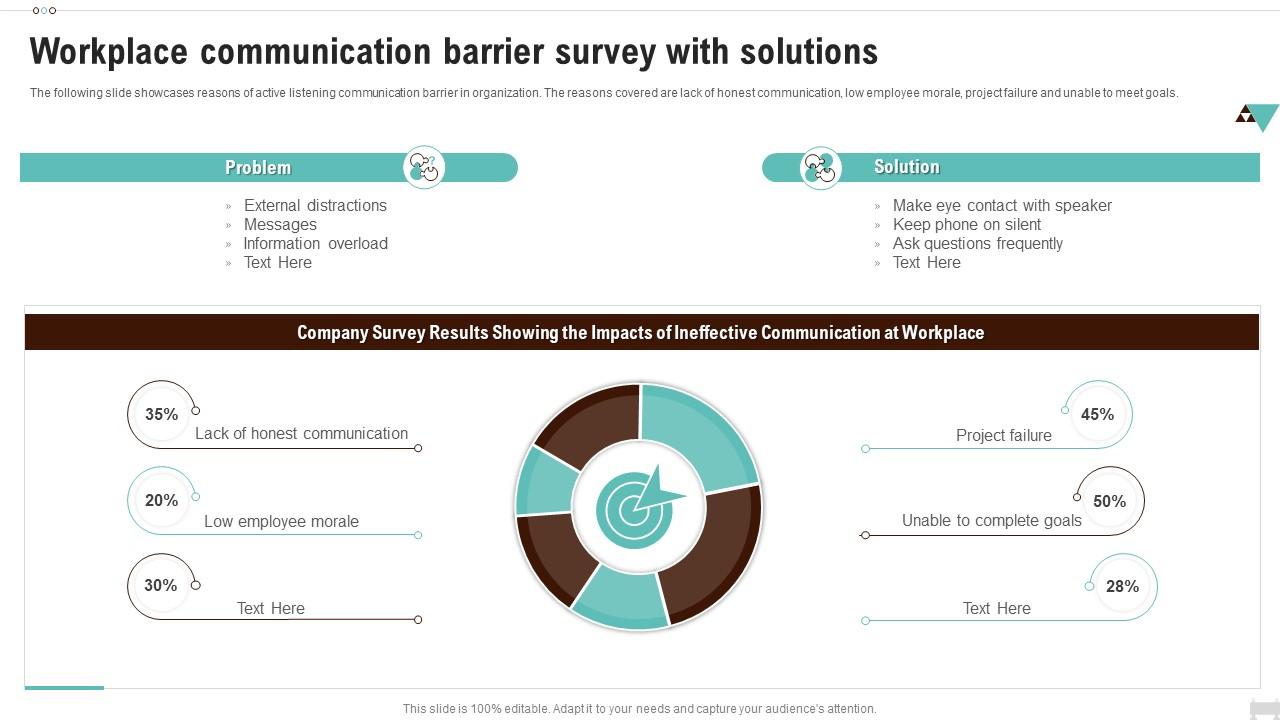
Template 17: Workplace Communication Barrier Survey with Solutions PPT Slide
Active listening barriers don't disappear until organizations name them specifically. This template surfaces the four core reasons communication breaks down: lack of honest communication, low morale, project failure, and unmet goals. Each barrier is paired with a solution in a clean two-stage layout that drives focused discussion. Audiences can immediately see both the problem and the path forward. Use it to present workplace communication survey findings and build the case for structural change. Transform your communication barrier presentations today. Download this template now and unlock conversations your organization has been avoiding.
Download this PowerPoint Template
Template 18: Workplace Communication Platform Survey Result Analysis
Workplace communication platform choices vary more than most leaders expect. This slide presents survey result data on the most-used platforms — Slack, Zoom, Google tools, email, Skype, and Microsoft Teams — side by side. IT leads and HR teams use this PPT to show where employees actually communicate versus where leadership assumes they do. It makes a clear case for platform investment decisions grounded in real usage data. The template is 100% editable and customizable.

Download this PowerPoint Template
Template 19: Manager Feedback Survey Form to Encourage Upward Communication
Anonymous feedback is the only kind that reliably reveals how managers actually communicate. This PPT slide provides a Likert-scale manager feedback survey form covering strongly disagree through strongly agree responses. HR teams and OD practitioners use it to collect and present upward communication feedback in a structured, defensible format. It supports performance reviews, communication audits, and team health assessments equally well. The template is 100% editable and customizable.

Download this PowerPoint Template
Template 20: Tactical Survey Questionnaire for Optimizing Upward Communication
Upward communication only improves when organizations ask structured, honest questions first. This template delivers a tactical survey questionnaire that maps platform availability, team assistance, and employee concern patterns. Every slide converts internal survey data into a clear communication approach assessment. Use it to present findings on organizational communication gaps and build the case for lasting change. The layout supports discussion across leadership, HR, and operations teams without requiring redesign. Transform your upward communication strategy presentations today. Download this template now and unlock the insights that move your organization forward.
[product_image id=942282]
Elevate Every Communication Survey with SlideTeam
SlideTeam's PowerPoint templates are the best in the industry for communication survey design, analysis, and presentation. These content-ready slides save hours of formatting work while delivering professional clarity that leadership teams actually respond to. Use these PowerPoint slides to present employee communication survey findings, internal audit results, or post-event feedback with confidence. Deploy these ready-made frameworks to turn raw survey data into decisions that drive real organizational change.
FAQs on Communication Survey
What are the most effective methods for collecting employee feedback on internal communication channels?
Pulse surveys sent via email or internal platforms work best for volume and speed. Anonymous digital forms on tools like Microsoft Forms or SurveyMonkey reduce response bias. One-on-one check-ins capture nuance that structured forms miss. For internal communication channels specifically, combine quantitative rating scales with at least one open-ended question. Rotating survey frequency — monthly or quarterly — keeps data fresh without causing survey fatigue.
How do organizations measure the clarity and effectiveness of their messaging across different departments?
Most organizations use a mix of survey ratings, readership metrics, and direct manager feedback. Pulse surveys measure whether messages land clearly across departments. Open-ended questions surface where clarity breaks down in specific teams. Some companies benchmark clarity scores quarter over quarter to track improvement. The simplest method: ask employees directly whether they understood the last major announcement and why or why not.
What key metrics should be included in a workplace communication survey to yield actionable insights?
Include message clarity ratings, preferred channel usage, and information timeliness scores. Add a question on whether employees feel comfortable raising communication concerns. Measure frequency satisfaction — too much or too little information are both problems. One open-ended question on what communication change employees most want gives qualitative depth. Keep the total under 12 questions to protect completion rates.
How does communication frequency impact employee engagement and productivity levels?
Too little communication leaves employees uncertain, which reduces output and morale. Too much creates noise, and important messages get ignored. The sweet spot varies by role — frontline workers typically need higher frequency than knowledge workers. Surveys consistently show that employees want regular, brief updates rather than infrequent, lengthy ones. Match frequency to the pace of change in the team's work.
What role does non-verbal communication play in survey-based assessments of team dynamics?
Non-verbal cues — eye contact, body language, tone — don't translate directly into survey form. But surveys can assess their effect indirectly. Ask whether employees feel managers listen actively in meetings, or whether feedback conversations feel genuine. Likert-scale questions on psychological safety capture non-verbal communication quality better than direct questions about gestures or facial expressions. Focus on perceived openness, not observable behavior.
How can businesses use communication survey data to identify bottlenecks in information flow?
Start by mapping which departments report the lowest information clarity scores. Cross-reference with questions on message source — does information reach employees from managers, tools, or peers? Gaps between leadership intent and employee understanding usually mark the bottleneck. A communication audit survey that asks both senders and receivers about the same message reveals where information stalls. Then fix the handoff point, not just the message.
What differences exist in communication preferences across generational groups within the workforce?
Younger workers tend to prefer digital, asynchronous channels — messaging apps and shared docs. Older employees often favor structured formats like email and scheduled meetings. Both groups want clarity; they differ on medium and timing. Avoid assuming generational preference — always validate with your own survey data. A workplace communication survey segmented by age group gives you real numbers instead of generalizations.
How should survey questions be structured to avoid bias when assessing leadership communication styles?
Use behaviorally anchored questions rather than opinion-based ones. Instead of 'Is your manager a good communicator?', ask 'How often does your manager explain the reason behind decisions?' Offer balanced response scales — avoid scales that skew positive. Keep questions specific to observable actions, not personality traits. Anonymity is non-negotiable; employees won't give honest answers about leaders unless confidentiality is guaranteed and credible.


