




 0 Comment
 Customer Reviews

The deck's almost ready. Three rounds of revisions. Two stakeholder calls. And still, somehow, nobody's agreed on what the customer actually wants.
That's the thing about customer-centric business models—everyone says they believe in them. The phrase shows up in vision statements, all-hands decks, quarterly reviews. But when it's time to build the actual framework? The slide goes blank.
It's not that the concept is unclear. Most teams understand the idea: put the customer at the center of every decision. The problem is the gap between knowing that and showing it. How do you visualize a model that accounts for demographic data, transaction behavior, journey stages, and loyalty all at once? How do you make a room full of stakeholders look at a single slide and immediately get it?
And the pressure compounds. The executive wants a high-level view. The product team wants specifics. The CX lead wants something that reflects real customer pain points. One deck, multiple audiences, zero margin for confusion.
Customer-centric thinking also isn't a single slide. It's a system—spanning customer segmentation, value propositions, relationship management, digital channels, and feedback loops. Getting all of that into a coherent, structured presentation is where most teams quietly give up and default to bullet lists.
That's why these templates exist. Not because the ideas are new, but because structuring them visually—clearly, persuasively, without losing nuance—is genuinely hard. SlideTeam's pre-designed frameworks solve the structural problem so the real conversation can happen.
What follows are 20 ready-made templates built specifically for customer-centric business model presentations. Use them as-is, or adapt them to fit your organization's language and priorities. Either way, they handle the part that usually takes the most time: the layout.
Template 1: Data Model for Organizational Customer Centricity
Three powerful data dimensions—Demographic, Financial, and Transactional—converge in this organizational customer centricity model. Each stage delivers a distinct layer of customer intelligence, building a complete picture of your audience. The structured four-stage framework drives sharper segmentation and more precise data-driven customer insights. Meaningful visual hierarchy ensures every stakeholder grasps the data architecture instantly. You can align cross-functional teams around a unified customer data model with confidence. Elevate your customer centricity presentations with this analytical, high-impact framework. Download this dynamic template now and unlock data-driven clarity for your organization.

Download this PowerPoint Template
Template 2: Customer Centricity Model with Implementation and Support
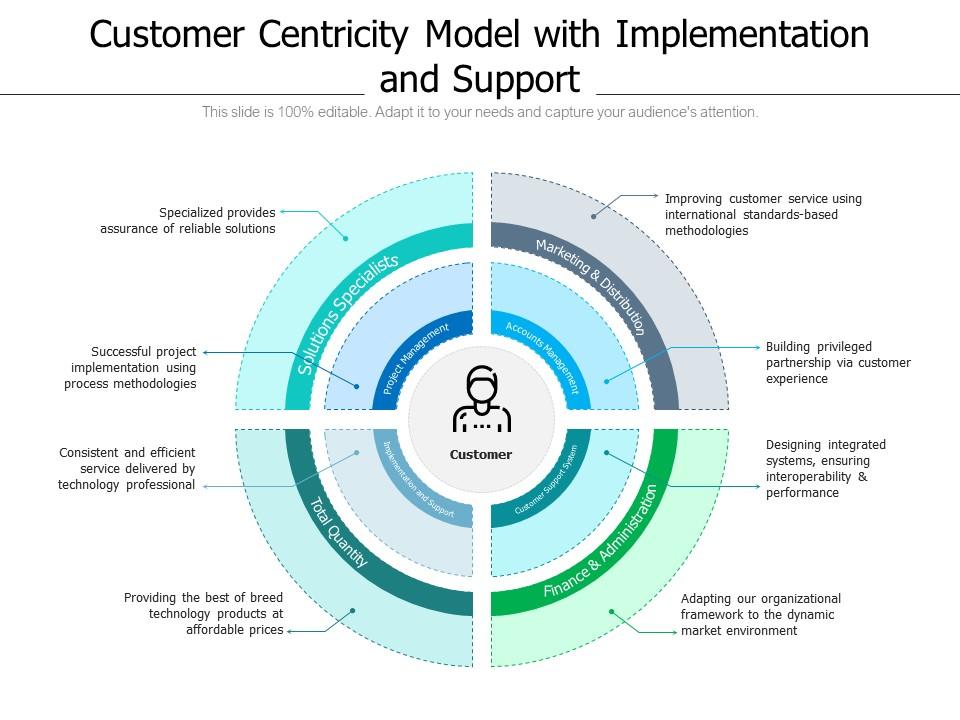
Structured around Implementation, Process, and Methodologies, this template maps customer centricity from intent to execution. The four-stage framework captures every operational layer of a successful customer-first transformation. Each stage anchors a specific aspect of your customer success management journey. Clear visual flow guides decision-makers from planning through full deployment without ambiguity. Teams can align on accountabilities and timelines across every phase simultaneously. Transform your customer centricity implementation presentations into compelling action plans. Download this dynamic template now and accelerate your organization's customer-first transformation.
Download this PowerPoint Template
Template 3: Mastering Customer Centric Business Models for Growth PPT Guidelines
Building a customer-centric business model for growth demands more than good intentions. This PPT preset is built for strategists and growth leads who need to communicate a full model—not just a concept. Use it to walk leadership through a customer experience strategy tied directly to measurable growth outcomes. It suits boardroom reviews and cross-functional planning sessions equally well. The template is 100% editable and customizable.
[product_image id=1466740]
Template 4: Designing a Customer Centric Value Proposition PPT Slides
A clear customer value proposition is the foundation of any customer-first approach. This PPT template is built for product managers and CX leads who need to present differentiated value in a structured, visual way. Use it to communicate how your offerings address specific customer pain points across segments. It works well in both internal alignment sessions and client-facing pitches. The template is 100% editable and customizable.
[product_image id=1801224]
Template 5: Building Customer Centric Business Models for Growth PPT Guidelines
A compelling customer-centric growth narrative demands both structure and visual clarity. This deck delivers a polished, ready-made framework that translates complex models into persuasive presentations. Crisp layouts let you communicate customer retention strategies and growth drivers without clutter. The balanced design ensures your key insights land with maximum authority. Adapt every element to reflect your organization's unique customer-focused culture. Transform your business model presentations with this high-impact, content-ready deck. Download this dynamic template now and drive growth conversations that convert.
[product_image id=1850622]
Template 6: Building Customer Centric Digital Business Models Effectively PPT Graphics
Digital customer centricity requires a framework that moves as fast as the channels it covers. This PPT preset is designed for digital leads and transformation teams presenting omnichannel customer experience models to senior stakeholders. Use it to show how digital touchpoints connect across the full customer journey, from acquisition through retention. It fits naturally into strategy reviews and digital roadmap sessions. The template is 100% editable and customizable.
[product_image id=1599019]
Template 7: Customer Centricity Aligning Business with Customer PPT Demonstration
Bridging the gap between business operations and customer expectations is what this deck does best. Striking visual design instantly communicates how internal alignment drives a genuinely customer-first approach. Each layout translates abstract customer relationship management concepts into clear, boardroom-ready visuals. The framework supports everything from client pitches to internal transformation roadmaps. Pre-designed slides eliminate the formatting burden, keeping your focus on the message. Transform your customer centricity alignment presentations with this standout, functional deck. Download this dynamic template now and make every audience feel the difference.
[product_image id=1682822]
Template 8: TAM SAM SOM Insights for Effective Business Planning PPT Slides
TAM, SAM, and SOM analysis sits at the heart of any honest customer segmentation strategy. This PowerPoint slide is built for business analysts and founders who need to present market sizing with precision and credibility. Use it to show investors or leadership exactly which customer segments are addressable and why. It fits naturally into pitch decks and annual business planning reviews. The template is 100% editable and customizable.
[product_image id=1648498]
Template 9: Customer Centric Business Solutions PPT Example
Delivering customer-centric business solutions becomes far more persuasive with the right visual framework. This deck merges creative design with a structured layout that highlights your core solution pillars. Every slide guides your audience through the logic of your customer-first approach with clarity. The polished aesthetic builds instant credibility in both boardrooms and client meetings. Flexible layouts accommodate a wide range of customer engagement model scenarios. Transform your solution presentations into high-impact, conversion-ready decks today. Download this dynamic template now and discover more customer-centric business model frameworks.
[product_image id=1490463]
Template 10: Pillars of Customer Centric Approach in Business
Customer centricity doesn't work without structural pillars holding it up. This PPT template is built for HR leads, CX directors, and transformation managers presenting a customer-first culture framework. Use it to show how Strategic Alignment, Customer Insights, and Employee Engagement connect in a five-stage model. It works well in leadership offsites and organizational change briefings. The template is 100% editable and customizable.

Download this PowerPoint Template
Template 11: Segment Marketing Customer Marketing Business Strategy Business Model
Three interconnected stages—Segment Marketing, Customer Marketing, and Business Model—combine for a cohesive strategic view. This graphic-led framework visually connects customer segmentation strategy to broader business planning. Clean, editable stages allow teams to slot in specific data or messaging without losing design integrity. The layout is purpose-built for communicating how targeted marketing fuels model-level growth. You can use it across strategy sessions, sales reviews, and investor presentations effortlessly. Elevate your customer marketing and business model presentations with this versatile framework. Download this dynamic template now and make your segmentation story impossible to ignore.

Download this PowerPoint Template
Template 12: Preferred Relationships Customer Centric Business Model Optimized Distribution
Preferred relationships and optimized distribution are two levers most business models underestimate. This PPT preset is built for commercial leaders and strategists presenting a customer-centric business model that balances relationship depth with distribution efficiency. Use it to map how preferred customer relationships translate into channel decisions and revenue outcomes. It fits well in sales strategy reviews and partner planning sessions. The template is 100% editable and customizable.

Download this PowerPoint Template
Template 13: Buyer Centric B2B Ecommerce Business Model Effective Strategies to Build Customer Base in B2B
B2B ecommerce success hinges on understanding the buyer before the product. This template captures the full buyer-centric B2B model—covering customer-focused leadership, experience design, and quotation workflows. Each element reinforces a practical, decision-driven approach to building a loyal B2C and B2B customer base. The structured layout makes complex ecommerce frameworks immediately accessible to any audience. Teams can use it for internal alignment, partner briefings, or sales strategy presentations. Transform your B2B ecommerce model presentations with this focused, buyer-first framework. Download this dynamic template now and build a stronger customer acquisition foundation.

Download this PowerPoint Template
Template 14: Customer Relationships Bed and Breakfast Business Model
Loyalty in hospitality is built through consistent, trust-based interactions—and this template maps exactly how. Four clear stages cover user reviews, customer support, host-guest interaction, and community forums. Each stage translates directly into measurable customer satisfaction metrics for any bed-and-breakfast operation. The structured Business Model Canvas layout makes stakeholder communication immediate and precise. Visual clarity ensures every touchpoint in the customer relationship is accounted for and visible. Elevate your hospitality business model presentations with this credibility-building, audience-ready deck. Download this dynamic template now and present your customer loyalty story with confidence.
[product_image id=1152510]
Template 15: Customer Segments Brick and Mortar Retailer Business Model PPT Example
Retail success depends on knowing exactly who walks through the door and why. This PPT template is built for retail strategists and merchandising teams presenting a brick-and-mortar customer segmentation model. Use it to map the distinct needs of families, budget-conscious shoppers, fashion-forward consumers, and tech enthusiasts. It supports assortment planning reviews and customer engagement model presentations equally well. The template is 100% editable and customizable.
[product_image id=1231276]
Template 16: Model Representing Customer Centricity Strategic Management
Strategic management of customer centricity requires a clear, repeatable model with defined stages. This PPT preset is built for organizational leaders presenting a six-stage customer-first framework covering Leadership, Continuous Improvement, and the cycles between. Use it to show how a customer-focused culture becomes embedded in governance and decision-making. It works well in transformation reviews and leadership alignment sessions. The template is 100% editable and customizable.

Download this PowerPoint Template
Template 17: Business Centric Creative Content Model
Content is the engine of a customer-centric business—and this template shows exactly how to structure it. Podcasts, blogs, short video, and infographics are mapped against the path from commodity to loyal audience. The creative content model framework helps marketing and content teams build presentations that justify every channel choice. Commodity-to-loyalty positioning gives leadership a clear view of content's business impact. Each stage connects content type to audience outcome with visual precision. Transform your content marketing business presentations with this sharp, insight-driven framework. Download this dynamic template now and make your content model impossible to overlook.
[product_image id=972167]
Template 18: Customer Centric Approach for Business Value Generation
Three concrete value-generation levers—Needs Analysis, Personalization, and Feedback and Improvement—anchor this customer-centric approach framework. Each stage directly addresses how businesses translate customer intelligence into measurable outcomes. The clean, three-stage flow makes it easy to connect personalized customer experience to operational action. Stakeholders across functions can immediately see where their work fits in the customer value chain. Innovatively designed layouts ensure the framework communicates without overexplaining. Elevate your customer value generation presentations with this direct, outcomes-focused deck. Download this dynamic template now and drive real customer-first results.
[product_image id=1171188]
Template 19: Customer Segments Business Model of IKEA
IKEA's customer segmentation success comes from precision—and this template captures that logic clearly. Students, Interior Designers, Homeowners, and Renters are each mapped as distinct segments with specific engagement implications. The three-stage layout drives an immediate understanding of how segment differences shape product and service decisions. Clean, editable design allows teams to adapt the framework to their own retail or consumer brand context. Every stage connects segmentation insight to real-world business planning with zero ambiguity. Transform your customer segmentation presentations with this audience-ready, brand-adaptable framework. Download this dynamic template now and present your customer base with precision.
[product_image id=1105466]
Template 20: Customer Segments Digital Music Platform Business Model
Digital music platforms thrive when they understand Users, Content Creators, and Advertisers as distinct audiences. This template maps each customer segment's unique needs and pain points across a three-stage visual framework. The structured layout makes it easy to tailor platform features and revenue logic to each group. Teams can use it for product strategy reviews, investor presentations, or business model workshops. Clear segment differentiation eliminates guesswork and sharpens every audience-facing decision. Transform your digital platform customer segment presentations with this precise, insight-driven framework. Download this dynamic template now and make every customer segment count.
[product_image id=1124712]
Win Every Room with a Customer-Centric Model and SlideTeam
SlideTeam's PowerPoint templates are the best in the industry for building and presenting a customer-centric business model. These content-ready slides save hours of structuring time while delivering professional quality that commands stakeholder confidence. From customer segmentation strategy to customer lifetime value frameworks, every template covers a critical layer of your model. Deploy these ready-made PowerPoint slides to present your customer-first vision with clarity and drive real organizational growth.
FAQs on Customer Centric Business Model
How does a customer-centric business model differ fundamentally from a product-centric approach in terms of revenue generation?
A product-centric model generates revenue by pushing products to the widest possible market. A customer-centric model generates revenue by deepening relationships with high-value customers. The shift means investing in retention over acquisition, and in lifetime value over single-transaction margin. Revenue becomes more predictable because it's tied to known customer behaviors, not market volume guesses.
What metrics should organizations prioritize to measure the effectiveness of a customer-centric transformation?
Start with Net Promoter Score, customer retention rate, and customer lifetime value. These three give a direct read on loyalty, stickiness, and long-term revenue impact. Add Customer Acquisition Cost to track efficiency. Once these are stable, layer in customer satisfaction scores and churn rate to catch early warning signs.
How can businesses balance personalization at scale without compromising operational efficiency?
Use data segmentation to define three to five customer clusters with shared needs. Build personalized experiences at the cluster level, not the individual level—this is operationally sustainable. Automate delivery through CRM tools and pre-built content workflows. Reserve true one-to-one personalization for your highest-value segments only.
What role does customer lifetime value play in shaping the strategic decisions of a customer-centric organization?
Customer lifetime value tells you which customers are worth acquiring and how much to spend doing it. It directly shapes budget allocation between retention and new customer acquisition. High-LTV segments justify deeper investment in service, loyalty programs, and personalization. Organizations that ignore LTV tend to over-invest in low-margin customer relationships.
How do cross-functional teams contribute to sustaining a customer-first culture within large enterprises?
Cross-functional teams remove the handoff gaps that break the customer experience. When product, sales, service, and marketing share customer data and goals, decisions become faster and more consistent. Assign a customer outcome—not a departmental KPI—as the shared measure of success. That single shift changes how teams prioritize and collaborate.
What are the most common organizational barriers that prevent companies from fully adopting a customer-centric model?
The three most common barriers are siloed data, misaligned incentives, and leadership that measures internal efficiency over customer outcomes. Siloed data prevents any team from seeing the full customer picture. Incentives tied to departmental goals rather than customer results keep teams pulling in different directions. Both require structural fixes, not just training programs.
How can B2B companies apply customer-centricity principles differently compared to B2C businesses?
B2B customer centricity focuses on a smaller number of high-value accounts with complex, multi-stakeholder buying decisions. The emphasis shifts to relationship depth, account management, and co-creating solutions with clients. B2C centricity scales across large segments using data and automation. B2B requires personal engagement where B2C relies on systems.
In what ways does data analytics drive better customer-centric decision-making across business units?
Data analytics identifies which customer behaviors predict churn, upsell potential, or dissatisfaction before they surface as complaints. It allows business units to act on customer behavior patterns rather than assumptions. Shared dashboards across units—sales, service, product—align decisions around the same customer reality. The key is acting on findings, not just reporting them.