





 0 Comment
 Customer Reviews

The alert fired at 2:47 AM. Nobody saw it until 9.
That's not unusual. Security operations centers run on volume—thousands of events, dozens of dashboards, one overworked SOC analyst staring at a screen wondering which blip matters. The reactive model works, until it doesn't. Until the attacker has been inside the network for six weeks and the only evidence is a log entry nobody thought to check.
Threat hunting is the other thing. Not waiting for the alarm. Going in before it sounds.
But that's where it gets uncomfortable. Hunting requires a hypothesis. A place to start. Some structured sense of what "normal" looks like so you can spot what isn't. Most security teams know the theory—check for lateral movement, watch for unusual process chains, track anomalous authentication patterns. Knowing it and doing it inside a presentation are two different problems.
There's a specific kind of dread that comes with being asked to present a threat hunting program to leadership. They want to see the framework. The methodology. The evidence that you're not just reacting to fires but actually looking for the ones that haven't started yet. Advanced Persistent Threats don't announce themselves. Zero-Day Exploits don't come with labels. And the gap between what a security team does daily and what leadership thinks they do is—usually—enormous.
That's why structured templates exist. Not to replace expertise, but to give it a shape someone outside the security team can follow. A threat hunting deck that shows the hypothesis-to-resolution process, the dashboard metrics, the intelligence cycle—that's not padding. That's the difference between a program that gets funded and one that gets questioned every quarter.
SlideTeam's cyber security threat hunting templates handle exactly this: the translation layer between technical reality and boardroom clarity. Pre-designed, content-ready frameworks built for security professionals who know what they're doing and just need the structure to show it.
Here's what's available.
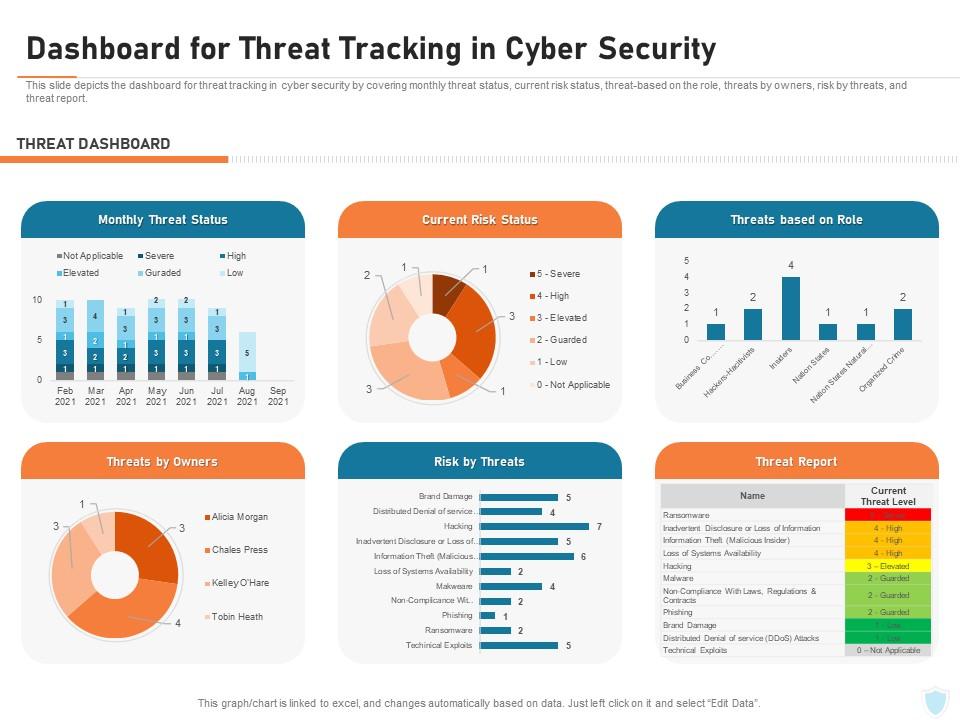
Template 1: Cyber Security IT Dashboard for Threat Tracking in Cyber Security PPT PowerPoint Tutorials
Real-time visibility into threat status is what separates reactive security from proactive defense. This PowerPoint slide consolidates monthly threat status, current risk status, and threat distribution by role into one clear view. Security leads and SOC analysts reach for this when presenting threat tracking metrics to stakeholders. It covers threats by owners, risk by threats, and a structured threat report in a single dashboard layout. The template is 100% editable and customizable.
Download this PowerPoint Template
Template 2: Cyber Threat and Security Management PowerPoint Slides
Integrated cyber threat and security management intelligence drives confident boardroom conversations. This pre-designed deck delivers a structured framework for IT managers, executives, and security researchers to present complex threat data clearly. Compelling visuals transform dense security metrics into persuasive, audience-ready narratives. Flexible layouts let you tailor every section to your organization's threat profile and branding with ease. Build authoritative cyber threat and security management presentations that align technical findings with executive priorities. Transform your security briefings today. Download this dynamic template now and unlock your team's full communication potential.

Download this PowerPoint Template
Template 3: Threat Intelligence and Hunting for Enhanced Cybersecurity
Presenting threat intelligence and hunting insights demands visuals that match the depth of the analysis. This deck combines creativity with analytical structure to make complex cybersecurity data immediately compelling. Customizable color schemes let you align every slide with your brand identity in minutes. Pre-built layouts eliminate formatting work, freeing you to focus on the intelligence itself. Present Threat Intelligence findings, hunting methodologies, and enhanced cybersecurity outcomes with professional authority. Elevate your cybersecurity presentations today. Download this dynamic deck now and unlock your team's ability to communicate threat intelligence with impact.
[product_image id=1212440]
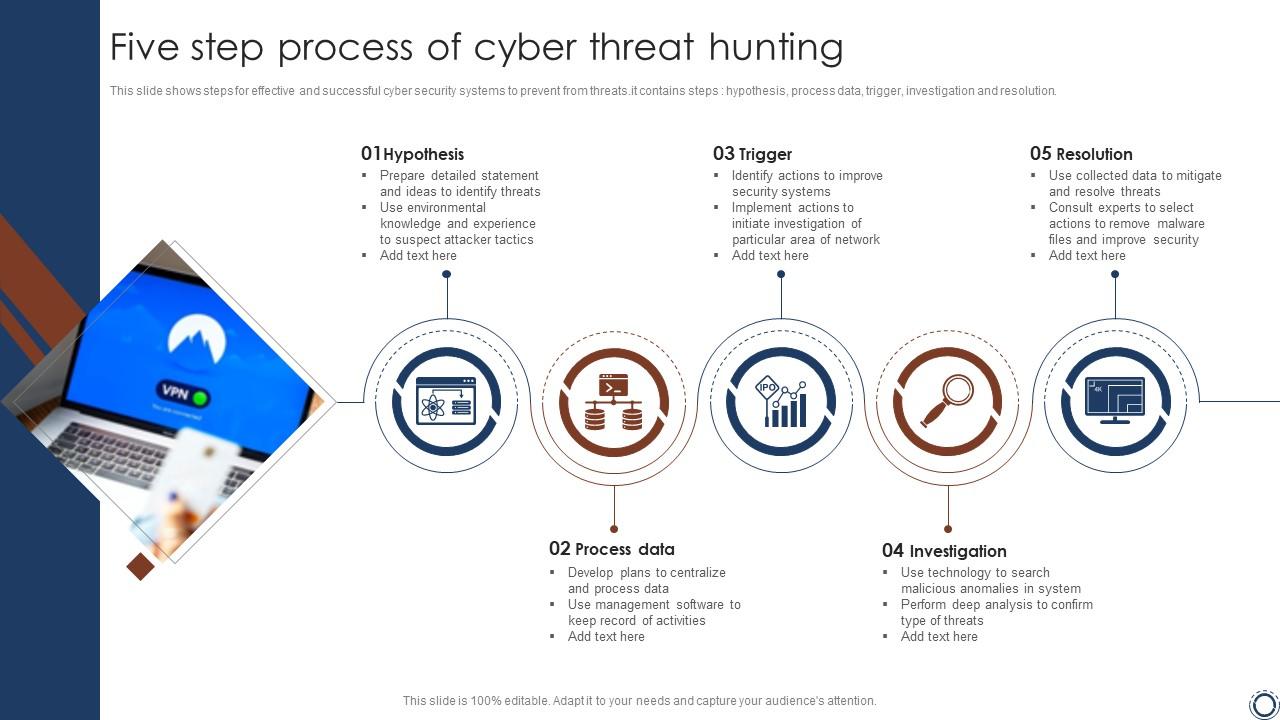
Template 4: Five Step Process of Cyber Threat Hunting
Every structured cyber threat hunting program follows a repeatable process — and this PPT makes that process visible. This slide covers the five core stages: hypothesis, trigger, process data, investigation, and resolution. Security trainers and SOC leads use it to walk teams through a complete hunting cycle clearly. It fits naturally into onboarding sessions, tabletop exercises, or operational review meetings. The template is 100% editable and customizable.
Download this PowerPoint Template
Template 5: Cyber Security Threat Activity Discovery Dashboard
Monitoring threat activity across an enterprise requires a dashboard that captures everything at once. This PPT preset surfaces remote activity security, active remote sessions, threat actions, compliance posture, software patch status, and asset alarms in one structured view. Explore more cyber security threat hunting PPT templates to build a complete discovery and response toolkit. Security operations managers use it for daily briefings and incident review sessions alike. The template is 100% editable and customizable.

Download this PowerPoint Template
Template 6: Cyber Threat Dashboard with Current Risks and Security Service
Keeping leadership informed on current risks demands a clean, structured view of the threat environment. This PowerPoint slide brings together current threats, current risks, regulation and policy coverage, security service status, and asset control issues in one dashboard. CISOs and security managers use it when presenting threat posture updates to executive teams or audit committees. It makes the connection between operational risk and business exposure immediately clear. The template is 100% editable and customizable.

Download this PowerPoint Template
Template 7: Cyber Threat Hunting Preventing Attacks before They Happen PPT Summary
Stopping attacks before they land requires more than detection — it demands a proactive, structured hunting approach. This content-ready deck captures the full cyber threat hunting lifecycle, from initial hypothesis through active prevention. Pre-designed slides let you present Phishing Attack Prevention frameworks, anomaly detection workflows, and hunting campaign outcomes with immediate visual authority. Flexible design elements adapt to any organization's security posture and communication style. Present threat hunting programs that demonstrate real defensive value to technical and executive audiences alike. Transform your proactive security presentations today. Download this dynamic template now and unlock your team's ability to prevent attacks before they happen.
[product_image id=1631047]
Template 8: Computer System Security Cyber Threat Landscape in Computer Security
Understanding who is behind a cyberattack matters as much as what they did. This PPT maps the cyber threat landscape by cybercriminal roles — organized criminals, competitors, and other actors — alongside the business impact of successful attacks. Threat Actor Profiling sessions and executive risk briefings are the natural home for this slide. It connects financial, operational, and reputational damage to specific attacker categories, making risk tangible for non-technical stakeholders. The template is 100% editable and customizable.
[product_image id=463307]
Template 9: Cyber Threat Hunting Identifying Insider and External Threats PPT Summary
Insider threats and external attacks require different detection logic — and this deck addresses both clearly. This PPT covers the identification process for both threat categories in a single, structured presentation. Security architects and HR risk teams use it to align on threat scope before a formal Incident Response plan is activated. It supports Behavioral Analytics discussions by framing how insider and external threat patterns diverge. The template is 100% editable and customizable.
[product_image id=1631046]
Template 10: Process to Perform Cyber Threat Hunting Threat Intelligence and Hunting Cybersecurity
A repeatable hunting process starts with a clear four-stage model that every team member can follow. This slide walks through hypothesis development, investigation, new pattern discovery, and response in a structured sequence. Threat intelligence leads and SOC managers use it when formalizing their Cyber Threat Intelligence workflows. It turns an often ad hoc process into a documented, auditable program. The template is 100% editable and customizable.
[product_image id=1212758]
Template 11: Cyber Threat Hunting Case Study
Real-world context transforms abstract security frameworks into credible, funded programs. This case study template presents the North Haven, Connecticut cyber threat hunting initiative — covering background, identified problems, applied solutions, and measurable impact. Security consultants and program leads use it to anchor hunting proposals in proven outcomes. Structured three-stage storytelling guides your audience from problem recognition to confident solution adoption. Present cyber threat hunting case studies that build stakeholder trust and accelerate program approval. Download this dynamic template now and unlock the power of evidence-based security storytelling.
[product_image id=1171740]
Template 12: Cyber Security Threat Intelligence Cycle
A repeatable threat intelligence cycle gives security teams a defensible structure for every investigation. This template maps six stages — direction, collection, processing, analysis, reporting, and action — into a clear, sequential visual. Threat Intelligence analysts and incident response leads use it to demonstrate program maturity to auditors and executives. Each stage connects directly to minimizing breach downtime and system recovery time. Present complete Cyber Security Threat Intelligence Cycle frameworks with professional clarity today. Download this dynamic template now and unlock your team's ability to communicate intelligence-driven security at every level.

Download this PowerPoint Template
Template 13: Cyber Security Threat Landscape with Attacks Target and Purpose
Communicating the full scope of the cyber threat landscape demands a framework that covers every attack category. This template maps Social and Phishing threats, Malware, Zero-Day Exploits, Botnets, and Passwords and Configs into a structured six-stage visual. Security architects and risk managers use it to present a comprehensive attack surface overview to leadership. Clear categorization makes it easier to prioritize Vulnerability Assessment activities and defensive investments. Build authoritative threat landscape presentations that drive informed resource allocation. Download this dynamic template now and unlock your ability to present the full attack surface with clarity.

Download this PowerPoint Template
Template 14: Cyber Security Threat Landscape Framework for Corporates
Corporate cyber defense programs need a framework that connects platform, operations, and advanced defense layers. This PPT covers Advanced Cyber Defense, Operational Security, and Platform Security in a structured three-stage model. CISOs and IT governance leads use it when presenting a security architecture roadmap to boards or compliance committees. It gives non-technical stakeholders a clear mental model of how layered defense actually works in practice. The template is 100% editable and customizable.

Download this PowerPoint Template
Template 15: Cyber Threat Hunting Challenges and Solutions
Threat hunting programs fail for predictable reasons — talent gaps, incomplete data, and poor tooling. This slide maps those challenges directly to actionable solutions: deploying expert threat hunters, collecting comprehensive data, and implementing data aggregation tools. Security operations directors use it when building the business case for dedicated hunting resources. It turns common objections into a structured problem-solution narrative that leadership can act on. The template is 100% editable and customizable.
[product_image id=1171741]
Template 16: Cyber Threats Management Managing Critical Threat Vulnerabilities and Security Threats
Executives and technical engineers need the same threat data — in completely different formats. This dashboard template bridges that gap by presenting critical threat vulnerabilities, risk levels, and security treatment status in one unified view. CISOs use it to give board-level audiences a clear picture of where organizational risk actually sits. Pre-built layout ensures no critical threat category gets lost in translation between teams. Build cyber threat management dashboards that serve both technical and executive audiences with equal clarity. Download this dynamic template now and unlock your ability to present risk posture with precision.

Download this PowerPoint Template
Template 17: Cyber Threat and Security Management PPT Outline
Security teams presenting threat management programs need decks that hold an executive audience's attention. This PPT deck blends visual clarity with structural depth for cyber threat and security management briefings. Operations managers and security leads reach for it when building quarterly reviews or annual security program updates. It handles the full scope — from threat identification through management response — in a clean, navigable format. The template is 100% editable and customizable.
[product_image id=1727449]
Template 18: Cyber Security Dashboard for Threat Tracking in Cyber Security Tutorials PPT Information
Threat tracking dashboards presented to leadership need to be immediately readable, not just technically complete. This PPT deck is built for security professionals who need a visually authoritative dashboard layout for boardroom and client-facing presentations. It handles the tracking and reporting layer — the part that turns raw log data into a narrative leadership can act on. Network Security Monitoring leads use it to present threat trends and risk status without losing the room. The template is 100% editable and customizable.
[product_image id=1469343]
Template 19: Cyber Security Roadmap PPT Outline
Communicating a cyber security roadmap requires a clear visual arc — where you are, where you're going, and why. This PPT deck gives security program managers a structured layout for presenting security maturity timelines and initiative sequencing. IT leaders and CISOs use it when presenting multi-year security investments to boards and funding committees. It handles the narrative of progress without oversimplifying the technical complexity underneath. The template is 100% editable and customizable.
[product_image id=1585498]
Template 20: Introduction to Threat Hunting in Cyber Security
Grounding a security team in threat hunting fundamentals starts with a clear, structured overview of how the process actually works. This template introduces the cyber threat hunting process across six stages — covering how threats bypass initial defenses and what a structured detection response looks like. Security trainers and program leads use it for onboarding sessions, Red Team Exercises briefings, and foundational awareness presentations. It makes the logic of proactive threat hunting accessible without oversimplifying the methodology. Present threat hunting fundamentals that build team confidence and program credibility. Download this dynamic template now and unlock a content-ready foundation for your security awareness program.
[product_image id=1171747]
Elevate Your Cyber Security Threat Hunting with SlideTeam
SlideTeam's PowerPoint templates are the best in the industry for cyber security threat hunting communication. These content-ready slides help security teams present hunting frameworks, threat dashboards, and intelligence cycles with professional clarity — saving hours of build time. Use these ready-made PowerPoint slides to translate technical findings into executive-ready narratives that drive program investment. Deploy these pre-designed templates to demonstrate proactive defense maturity and secure the resources your security program needs.
FAQs on Cyber Security Threat Hunting
What distinguishes threat hunting from traditional reactive cybersecurity approaches like SIEM-based alerting?
SIEM-based alerting waits for a rule to fire. Threat hunting starts before any alert exists. Hunters form a hypothesis, search for evidence of attacker behavior, and investigate proactively. SIEM catches known patterns; hunting finds adversaries who deliberately evade those patterns. The key difference is who moves first — the defender or the attacker.
How do threat hunters leverage the MITRE ATT&CK framework to develop targeted hunting hypotheses?
Hunters map known attacker behaviors to specific MITRE ATT&CK tactics and techniques first. They then form a hypothesis: "Is there evidence of this technique in our environment?" From there, they query logs, endpoints, or network data to test it. The framework turns vague threat suspicion into a structured, repeatable investigation with a defined starting point.
What are the key indicators of compromise (IoCs) versus indicators of attack (IoAs), and why does this distinction matter in proactive threat hunting?
IoCs are evidence that a breach already occurred — malicious IPs, file hashes, domain names. IoAs describe attacker behavior in progress — unusual process execution, privilege escalation patterns, lateral movement. In proactive threat hunting, IoAs matter more. By the time an IoC appears, the attacker may already be embedded. Behavioral signals catch the activity earlier.
How can organizations measure the effectiveness and ROI of their threat hunting programs?
Track three things: threats found before an alert fired, mean time to detect, and incidents that escalated versus those contained early. ROI comes from comparing the cost of a contained threat to the average cost of a full breach. Reduction in dwell time is the clearest measure of program impact.
What role does threat intelligence play in shaping a structured hunting campaign?
Threat intelligence tells hunters where to look. It surfaces active threat actors, their known techniques, and the targets they prefer. A structured hunting campaign uses this to prioritize hypotheses — for example, testing for techniques used by groups known to target your sector. Without intelligence, hunting is guesswork. With it, it's directed and efficient.
How do behavioral analytics differ from signature-based detection in the context of threat hunting?
Signature-based detection matches against known bad patterns — it misses new or modified malware entirely. Behavioral analytics looks at what a process or user is doing, not what it's called. In threat hunting, behavioral approaches catch attackers using legitimate tools to do malicious things — a pattern no signature database will ever flag.
What are the most common living-off-the-land (LotL) techniques that threat hunters should prioritize investigating?
LotL attacks use built-in tools — PowerShell, WMI, PsExec, certutil — so no external malware appears. Hunters should prioritize unusual PowerShell execution, WMI-based persistence, and administrative tool use outside normal hours or roles. These techniques are favored precisely because they blend in. Baseline normal behavior first; anomalies become visible quickly after that.
How should a threat hunter approach hunting for lateral movement within an enterprise network?
Start with authentication logs — look for accounts accessing systems they don't normally touch. Then check for credential dumping indicators and unusual remote desktop or SMB activity. Map findings against expected user behavior baselines. Lateral movement is rarely loud; it looks like normal admin activity performed by the wrong account at the wrong time.


