




 0 Comment
 Customer Reviews

The enrollment report's sitting in the shared drive. Has been for two weeks.
Not because nobody cares. Everybody cares—admissions directors, deans, financial aid officers, the provost's office. But caring about enrollment numbers and actually knowing what to do next are two different things. One is a feeling. The other is a plan.
There's a specific kind of discomfort that lives in higher education enrollment meetings. Someone pulls up last year's numbers. Headcount is down. Or applications are up but yield is flat. Or retention dropped half a point and nobody's sure why. The room goes quiet. Then someone says, "We need a plan."
And they're right. But what does that plan actually look like on a slide?
That's the part nobody teaches. You can train admissions staff on CRM for higher education, run enrollment forecasting models, build out a full student recruitment strategy—and still end up with a presentation that doesn't land. Because the thinking was there, but the structure wasn't.
The structure is what makes the difference between a plan that gets approved and one that generates a follow-up meeting to discuss having another meeting. Enrollment management plans need to communicate across audiences—academic leadership, finance, student services, marketing. Each group hears a different thing. A well-built deck accounts for that without anyone having to explain it out loud.
That's why these templates exist. Not because enrollment planning is new—it isn't—but because the gap between knowing what you want to do and getting everyone aligned around it is real, and it shows up every cycle.
SlideTeam's pre-designed templates for enrollment management plans handle exactly that gap. Ready-made frameworks that cover everything from admissions planning to student retention strategy, built so institutions don't have to start from a blank slide when the stakes are already high.
Here are the templates worth using.
Template 1: Scheduling Operations Management Strategies PPT Summary
Operational clarity drives every strong enrollment management plan. This deck merges scheduling and operations management into one visually compelling presentation. Striking visuals capture audience attention and communicate complex processes instantly. The pre-built layouts give you professional structure you can deploy in minutes. Each slide translates operational workflows into clear, persuasive narratives for any stakeholder room. You can anchor boardroom briefings, client pitches, or leadership reviews with equal authority. A smart icon library lets you express every scheduling milestone with precision. Transform your operations management presentations today. Download this dynamic template now and unlock your scheduling communication potential.
[product_image id=1846458]
Template 2: Choosing the Right Enterprise Content Management System PPT Information
Picking the right content management system is a real operational decision, not just an IT checklist item. This PPT preset helps department heads and CIOs walk leadership through the selection rationale clearly and credibly. Use it to compare platforms, map requirements, or justify investment to a skeptical finance team. The slide works well in vendor review sessions or internal governance meetings where the audience needs structure, not noise. The template is 100% editable and customizable.
[product_image id=1702745]
Template 3: Increasing Student Retention through Enrollment Management PPT Example
Student retention and enrollment growth are two sides of the same institutional goal. This deck captures that relationship with a design that combines visual impact and functional depth. Striking layouts help you present retention data, intervention frameworks, and enrollment targets without losing the audience. Each slide drives a specific narrative point—from at-risk student identification to re-enrollment outreach outcomes. The structure supports presentations to academic councils, student affairs teams, or board-level reviews alike. You can build compelling student retention strategy decks with clear, persuasive visual flow. Transform your enrollment management presentations today. Download this dynamic template now and unlock your retention planning potential.
[product_image id=1734244]
Template 4: Attendance Management PPT Sample
Tracking who shows up—and who doesn't—is foundational to any student success plan. This PPT sample gives administrators and faculty coordinators a clean, ready structure for attendance reporting and trend analysis. Use it in department reviews or compliance meetings where the data needs to speak clearly without visual clutter. For institutions building enrollment data analytics habits, this slide fits naturally into a recurring reporting cycle. The template is 100% editable and customizable.
[product_image id=1406271]
Template 5: Implementing Novel Management Practices for Success PPT Demonstration
Institutions that modernize their academic enrollment goals need a way to present that change credibly. This PPT deck is built for leaders walking teams through new management practices and implementation priorities. Whether the context is faculty governance, administrative restructuring, or enrollment optimization initiatives, the slide supports a clear visual argument. It pairs well with scenario planning conversations or cross-departmental alignment sessions. The template is 100% editable and customizable.
[product_image id=1583378]
Template 6: Increasing ROI Using Effective Omnichannel Marketing Approaches PPT Structure
Enrollment marketing ROI doesn't always get its own slide—but it should. This deck elevates omnichannel marketing approaches into a structured, persuasive presentation framework. Visual clarity makes complex multi-channel performance data immediately accessible to non-marketing stakeholders. The pre-built layouts turn campaign data into a compelling ROI narrative that holds the room. Each slide connects marketing activity to enrollment conversion outcomes with precision. You can anchor leadership briefings, budget reviews, or agency pitches with equal confidence. An extensive visual vocabulary lets you map every channel touchpoint with authority. Transform your enrollment marketing presentations today. Download this dynamic template now and unlock your omnichannel ROI story.
[product_image id=1734243]
Template 7: Effective Scheduling Techniques for Workforce Management Systems
Workforce scheduling in higher education operations is more complex than most slides give it credit for. This PPT demonstration helps operations managers and HR teams present scheduling frameworks clearly and without jargon. Use it when presenting shift coverage plans, staffing models, or workload distribution to institutional leadership. The slide adapts well to both frontline team briefings and executive-level workforce planning reviews. The template is 100% editable and customizable.
[product_image id=1772827]
Template 8: Data Driven Strategies for Effective Enrollment Management PPT
Enrollment decisions backed by data carry more weight in every room. This deck transforms enrollment data analytics into a clear, confident presentation for admissions directors and institutional researchers. Compelling visualizations make enrollment forecasting trends immediately persuasive to senior leadership. Each slide drives a specific analytical insight—from applicant funnel performance to yield rate patterns. The structure supports strategic planning sessions, board presentations, and accreditation reporting with equal authority. You can build rigorous, data-driven enrollment management plan presentations that move decision-makers to act. Transform your admissions planning presentations today. Download this dynamic template now and unlock your enrollment analytics potential.
[product_image id=1656604]
Template 9: Suggested Coverage Security Management Plan
Security governance is a non-negotiable part of any institutional management plan. This PPT slide covers four key areas: governance arrangements, personnel security, responsibilities, and coverage scope. Compliance officers and IT administrators use it to communicate security plan structures to institutional stakeholders. It fits naturally into risk review sessions or board-level oversight discussions where clarity on accountability matters. The template is 100% editable and customizable.

Download this PowerPoint Template
Template 10: Enrollment Management PowerPoint PPT Bundles
A complete enrollment management framework needs more than one angle. This PPT bundle gives institutions twelve thematically consistent slides covering the full enrollment planning picture. Admissions directors and enrollment strategists reach for it when building presentations for expert discussion meetings or leadership briefings. It handles institutional enrollment goals, student pipeline management, and recruitment planning in one cohesive package. For context, the visual consistency across slides makes stakeholder alignment significantly easier to achieve. The template is 100% editable and customizable.
[product_image id=1153234]
Template 11: 30 60 90 Days Plan for University Management System Services
New university system implementations rarely go smoothly without a clear time-bound plan. This one-pager gives IT leads and project managers a compact 30-60-90 day structure for university management system rollouts. Use it in kickoff meetings or progress check-ins where the audience needs a snapshot, not a full deck. It covers the planning arc from onboarding through to service delivery in a single, scannable format. The template is 100% editable and customizable.

Download this PowerPoint Template
Template 12: New Hire Enrollment Strategy Framework for New Learning Management Software
Rolling out a learning management system requires clear sequencing across planning, configuration, testing, and launch. This PPT preset helps HR leads and L&D managers communicate that implementation arc to stakeholders who need the overview without the technical detail. It works well in new hire orientation planning sessions or cross-functional alignment meetings where the audience spans IT, HR, and academic leadership. Enrollment management practices for hiring top talent connect naturally to LMS rollout planning. The template is 100% editable and customizable.
[product_image id=1112925]
Template 13: Student Enrolment Management Strategic Plan
Student enrollment targets only land when responsibility is clearly assigned. This PPT slide presents a structured strategic plan covering enrollment rates from applicants, category breakdowns, and members responsible for each goal. Enrollment managers and academic deans use it to anchor planning sessions where accountability is the central conversation. It makes institutional enrollment goals visible and trackable in a single, well-organized view. The template is 100% editable and customizable.
[product_image id=1154076]
Template 14: Integrating Learning into Performance Management for New Hire
Continuous employee growth depends on connecting learning directly to performance outcomes. This deck captures that integration with a four-stage framework covering goal setting, performance metrics, personalized learning plans, and progress feedback. The structure enables HR leaders and L&D managers to present a clear, actionable development pathway. Each slide drives a distinct step in the learning-to-performance cycle without losing the audience. The pre-built layouts translate complex performance management concepts into persuasive visual narratives. You can anchor talent reviews, leadership briefings, or department alignment sessions with precision. Transform your learning integration presentations today. Download this dynamic template now and unlock your performance management potential.
[product_image id=1112928]
Template 15: Attendance Management for Students Digital Learning Playbook
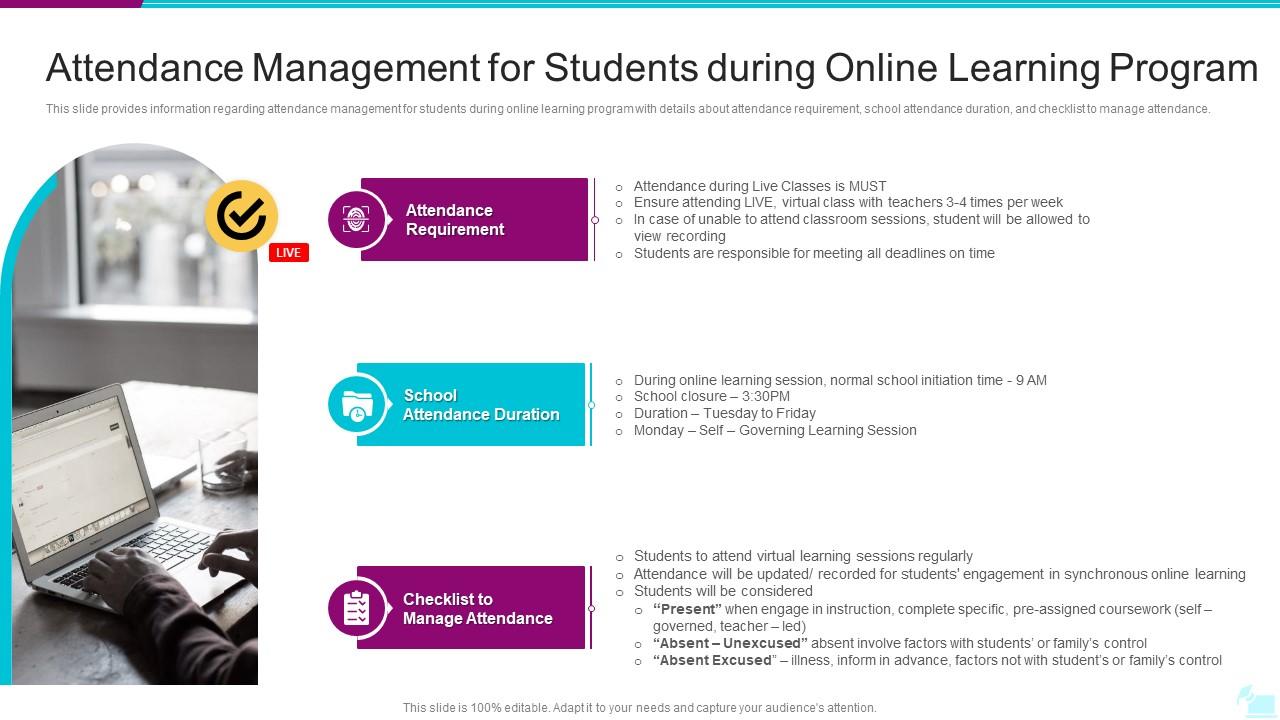
Attendance management during online learning carries real accountability requirements. This deck covers three key areas: attendance requirements, school attendance duration, and a practical checklist for managing attendance records. Academic coordinators and digital learning administrators use it to set clear expectations with students and report compliance to institutional leadership. The structure supports policy communication in virtual learning environments where consistency matters most. Transform your digital learning attendance presentations today. Download this dynamic template now and unlock your attendance management potential.
Download this PowerPoint Template
Template 16: Student Admissions and Enrolment Management Dashboard
A clear admissions dashboard removes the guesswork from enrollment decisions. This deck delivers a structured view of admission status, open enrollments, assessments, and enrollment by course—all in one focused layout. Registrars and admissions directors use it to eliminate clutter and set measurable benchmarks for institutional performance. Each slide anchors a specific data point, making stakeholder reviews faster and more decisive. The visual layout drives clarity on direct admissions, selected candidates, and course-level enrollment trends simultaneously. You can build authoritative undergraduate admissions strategy reviews that keep leadership aligned. Transform your admissions management presentations today. Download this dynamic template now and unlock your enrollment dashboard potential.
[product_image id=1154074]
Template 17: Management Information System Training Plan
MIS training rarely gets presented in a way that the whole organization can follow. This PPT slide gives training coordinators a structured plan covering introduction, components, roles, types, and the system development process. Use it in onboarding sessions or departmental training rollouts where different audiences need the same core understanding. It keeps the content organized across multiple modules without overwhelming non-technical participants. The template is 100% editable and customizable.
[product_image id=1210080]
Template 18: 100-Day Schedule Management Plan
A 100-day plan needs four things visible at once: analysis, vision, approach, and implementation. This PPT slide gives project leads and department heads exactly that structure in a clean, adaptable format. Use it in leadership onboarding, institutional change initiatives, or enrollment growth plan kick-offs where the first hundred days set the tone. It communicates priority and sequence without requiring a lengthy verbal explanation. The template is 100% editable and customizable.

Download this PowerPoint Template
Template 19: Management Plan for Customer Retention Process
Retention doesn't happen by accident—it follows a clear process. This PPT slide maps a six-stage customer retention management process for teams that need to present their approach to leadership or clients. Use it in account reviews, CX planning sessions, or cross-functional meetings where the retention logic needs to be visible and agreed upon. The structure makes each stage of the process explicit and easy to discuss. The template is 100% editable and customizable.

Download this PowerPoint Template
Template 20: Employee Retention Management Plan
Employee retention planning works best when the levers are named clearly. This PPT slide presents five stages covering encouragement, workplace respect, and growth opportunity as retention drivers. HR leaders and people managers use it in workforce planning sessions or executive briefings where retention and graduation rates in talent pipelines are under review. It gives the audience a concrete framework, not a list of aspirations. The template is 100% editable and customizable.

Download this PowerPoint Template
Elevate Your Enrollment Management Plan with SlideTeam
SlideTeam's PowerPoint templates are the best in the industry for building a credible, comprehensive enrollment management plan. These content-ready slides give admissions directors, enrollment managers, and academic leaders the structure to communicate student recruitment strategy, retention goals, and enrollment data analytics clearly. Use these ready-made PowerPoint slides to align institutional stakeholders and drive enrollment growth. Deploy these pre-designed templates today to turn planning into measurable institutional success.
FAQs on Enrollment Management Plan
What are the core components that every effective enrollment management plan should include to align with institutional goals?
Every effective enrollment management plan needs four core components: a clear target enrollment number, a student recruitment plan, a retention and graduation rates framework, and defined accountability for each goal. Add financial aid planning to support yield, and enrollment forecasting to anticipate gaps. Each component must tie directly to the institution's academic and financial goals—not exist as a separate initiative.
How can data analytics be leveraged to predict enrollment trends and improve recruitment strategies?
Start with the data you already have: application volumes, yield rates, and retention numbers by cohort. Enrollment data analytics tools can flag patterns—which programs lose students early, which recruitment channels convert best. Use predictive models to anticipate next year's numbers before the cycle starts. CRM for higher education platforms make this operationally feasible for most admissions teams without a dedicated data science unit.
What role does financial aid optimization play in shaping an institution's enrollment management plan?
Financial aid is a direct enrollment conversion tool. Institutions that model aid packages against enrollment targets—not just student need—fill seats more intentionally. Aid optimization means shifting dollars toward students most likely to enroll and persist, not spreading them evenly. Done well, it improves both headcount and retention without increasing the total aid budget significantly.
How do demographic shifts in the student population influence the development of long-term enrollment strategies?
Demographic shifts—aging populations, declining high school graduates in some regions, growth in adult learners—require institutions to revisit their student recruitment strategy regularly. A plan built for traditional 18-year-olds won't serve an increasingly diverse student population. Institutions need to track campus enrollment trends by age, geography, and income level, then adjust program mix and outreach channels accordingly.
What metrics should institutions track to measure the success of their enrollment management plan?
Track four numbers closely: application-to-enrollment yield rate, first-year retention rate, financial aid cost per enrolled student, and enrollment by degree program. These cover recruitment effectiveness, student success, cost efficiency, and program-level health. Add international student recruitment numbers if that's a growth area. Review them each term, not just annually—late signals cost a full admissions cycle to correct.
How can institutions balance diversity and inclusion goals with overall enrollment targets in their management plan?
Set specific enrollment targets by student group—first-generation, international, underrepresented—alongside the overall headcount goal. Treat them as parallel objectives, not trade-offs. Review recruitment channels and financial aid allocation to ensure they reach diverse applicant pools. Institutions that separate diversity planning from general enrollment planning consistently underperform on both.
What strategies can community colleges adopt in their enrollment management plans that differ from four-year universities?
Community colleges serve a higher share of part-time, working, and returning adult students. Their enrollment management plans need stronger emphasis on flexible scheduling, workforce-aligned programs, and local employer partnerships. Retention looks different too—stop-out and re-enrollment patterns matter more than first-year retention alone. Marketing should focus on community visibility and transfer pathways, not national recruitment reach.
How does retention planning integrate into a comprehensive enrollment management framework?
Retention planning belongs inside enrollment management from day one—not as an afterthought once students arrive. A student who leaves after one semester is a failed enrollment, not just a student affairs problem. Integrate early-alert systems, academic support triggers, and financial intervention checkpoints into the enrollment framework. Retention and graduation rates are the enrollment management plan's long-term ROI.