




 0 Comment
 Customer Reviews

The business plan's done. Investor deck, financials, market analysis—all of it.
But somewhere near the back, there's a section most founders write last, edit least, and hope nobody asks about in the room. The exit strategy.
Not because they don't have one. They probably do. Sort of. Some vague notion of "acquisition" or "IPO someday" that gets typed up quickly because the template asked for it—and then never touched again.
That's the gap. And it's not about ambition or planning ability. It's about something more uncomfortable: talking out loud about leaving something you built. Before you've built it. Before anyone's bought it. Before there's anything to sell.
Business exit planning sits in this strange middle space. It's forward-looking enough to feel speculative, but specific enough that investors will push back if it's thin. "How do you plan to exit?" sounds like a simple question. Answering it in a way that's credible—without sounding like you're already mentally checked out—takes actual structure.
And then there's the compound problem. Most founders aren't fluent in exit mechanics. The difference between a management buyout and a strategic acquisition matters. So does understanding how business valuation for exit shifts depending on timing, market conditions, and who's in the room. Getting those details wrong doesn't just affect the exit. It can unravel investor confidence before you've even hit product-market fit.
So exit strategy templates exist. Not because founders can't think—they can. But because the structure of a credible exit section isn't intuitive. It borrows from legal, finance, and M&A thinking simultaneously. And most people building companies are focused on the 18 months ahead, not the 7-year horizon.
SlideTeam's exit strategy business plan templates handle exactly this—the part where you need to look like you've thought through the endgame, because you actually have to. Pre-designed frameworks that cover every exit pathway, from IPO exit strategy to liquidation to private equity handoffs.
Here are the templates that hold the whole conversation together.
Template 1: Steps to Create a Business Exit Strategy Plan PPT Outline
Building a clear exit roadmap starts with understanding the right sequence of decisions. This PPT template is built for founders and advisors who need to walk stakeholders through each phase of business exit planning. It works well for presenting a structured exit framework to a board or investor group. The slide covers goal-setting, valuation readiness, and transition steps in a logical, visual flow. The template is 100% editable and customizable.
[product_image id=1610937]
Template 2: How to Plan a Successful Business Exit Strategy PPT Information
Successful exits don't happen by accident — they follow a documented plan built well in advance. This deck drives clarity across every stage of business exit planning, from stakeholder alignment to final handover. Compelling visuals translate complex financial and legal considerations into audience-friendly slides. You can build confident, credible exit presentations that can withstand investor scrutiny. Use these ready-made frameworks to anchor every discussion about your business exit timeline. Transform your exit planning presentations today. Download this dynamic template now and position your business for a high-value transition.
[product_image id=1610841]
Template 3: Executive Summary for Business Plan Success PPT Example
Investors read the executive summary first — and they judge the business on it. This PPT preset is built for founders who need to communicate business viability, growth potential, and exit readiness in one tight section. It suits pitch decks where the executive summary must also carry forward-looking context for acquirers or stakeholders. Explore more business exit plan examples to see how a strong executive summary anchors the whole document. The template is 100% editable and customizable.
[product_image id=1740875]
Template 4: Creating an Effective Pursuit Plan for Business Growth PPT Designs
Growth planning and exit planning are closer than most founders think. This PowerPoint slide is built for business owners who need to show structured pursuit of market expansion while laying groundwork for a future exit. It fits strategic planning sessions where the audience needs to see both near-term milestones and long-horizon outcomes. Use it to present business development priorities alongside exit-readiness benchmarks in one cohesive narrative. The template is 100% editable and customizable.
[product_image id=1709669]
Template 5: How to Develop a Successful Business Exit Strategy PPT Designs
Developing a credible exit strategy demands a clear view of the pathway from current operations to final transition. This deck captures every dimension of exit strategy development—from identifying the right exit route to preparing the business for handover. Intuitive visual frameworks break down options like acquisitions, management buyouts, and IPO exit strategy into digestible comparisons. Each slide empowers you to present your exit rationale with the confidence investors expect. Use these content-ready layouts to guide every decision in your business exit planning process. Transform your exit strategy presentations today. Download this dynamic template now and unlock a structured exit that drives maximum returns.
[product_image id=1732257]
Template 6: Exit Strategy Business Plan Risk Management Illustration
Risk is never absent from a business exit — the question is how clearly you show you've accounted for it. This PPT template is built for risk managers and founders who need to visualise exit-related risk alongside their exit strategy business plan. It suits presentations where you need to show investors that downside scenarios—market shifts, valuation gaps, timing misses—have been mapped. See more exit strategy templates with examples to understand how risk framing strengthens the full exit narrative. The template is 100% editable and customizable.

Download this PowerPoint Template
Template 7: Business Exit Plan and Its Need for Stakeholders PPT Slides
Stakeholders need more than a plan—they need to see why the exit matters to them directly. Eleven purposefully structured slides deliver a professional walkthrough of business exit planning for every stakeholder group. Each slide drives audience understanding of exit rationale, financial implications, and business succession planning options. Pre-designed layouts save hours of structuring time while maintaining a polished, credible aesthetic. Named use cases—from shareholder meetings to advisory board briefings—are handled by specific slide configurations. Transform your stakeholder exit presentations today. Download this dynamic template now and ensure every stakeholder understands the exit path.
[product_image id=665587]
Template 8: Strategic Exit Path for Goods Delivery Venture PPT Presentation
Goods delivery ventures face specific exit pressures—operational complexity, asset valuations, and route-to-market dependencies. This deck captures the full range of exit strategies for logistics and delivery businesses, including acquisitions, franchising, and strategic partnerships. Structured across three clear stages, it helps entrepreneurs communicate how and when they plan to reduce day-to-day operational exposure. Visual comparison of Venture Capitalists, Private Offerings, and Initial Public Offer options makes the trade-offs clear. Review exit strategy business plan samples to see how sector-specific plans differ in structure and scope. Transform your delivery business exit presentations today. Download this dynamic template now and present a credible, investor-ready exit path.
[product_image id=1222244]
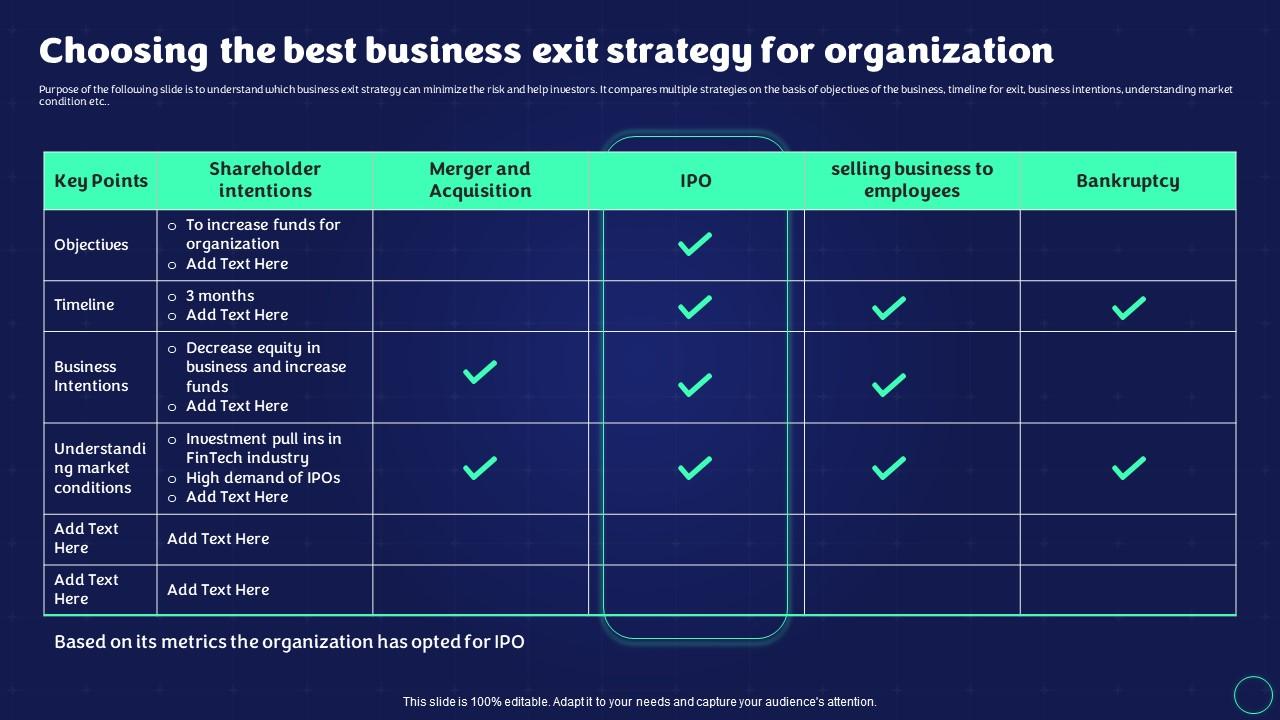
Template 9: Exit Strategy Strategic Plan Choosing Best Business Exit Strategy for Organization
Choosing the wrong exit route can erode years of built value—this deck makes the right comparison clear. Side-by-side analysis of multiple exit strategy options helps investors and owners align on the path that best fits their objectives. Coverage spans shareholder intentions, business timeline for exit, market conditions, and merger and acquisition criteria in a structured visual format. Each layout empowers you to facilitate a precise, evidence-backed discussion without leaving strategy gaps. Use these customizable slides to deliver an exit decision framework your board can act on. Transform your exit strategy selection presentations today. Download this dynamic template now and give your organization a clear route forward.
Download this PowerPoint Template
Template 10: Understanding Business Financial Ratios PowerPoint Presentation
Financial ratios don't lie — but they need the right structure to tell the right story to an exit audience. This PPT slide is built for CFOs and financial advisors presenting business valuation for exit to investors or acquirers. It covers Stock Turnover Ratio, Account Receivable Ratio, and Creditor Turnover Ratio in a format decision-makers can quickly interpret. Use it in due diligence prep or investor review meetings to demonstrate financial health before a transaction. The template is 100% editable and customizable.

Download this PowerPoint Template
Template 11: Exit Strategy for Medical Device Business Plan PPT Slide
Medical device companies exit through a narrow set of pathways — and each one requires a valuation narrative. This deck is built for founders and advisors presenting an exit strategy for medical device businesses to investors or acquirers. It covers four routes — Acquisition, IPO, Partnership or Agreement, and Strategic Alliances — with enough structure to compare them clearly. Read more on how a startup CFO can draft a concrete exit strategy for high-regulation sectors like medical devices. The template is 100% editable and customizable.
[product_image id=1263910]
Template 12: Ownership Business Formation and Exit Strategy Commercial Insurance Services Business Plan
Ownership structure and business formation choices shape every exit option that comes later. This deck brings together ownership pattern, business formation, and exit strategy into one cohesive three-stage presentation for commercial insurance services. It suits founders and advisors who need to show how legal structure affects exit route viability—whether through sale, buyout, or business succession planning. Pre-designed layouts ensure the logic flows clearly for a non-specialist board or investor audience. Transform your insurance business exit presentations today. Download this dynamic template now and present your ownership and exit structure with authority.

Download this PowerPoint Template
Template 13: Ownership Business Formation and Exit Strategy Building Insurance Agency Business Plan
Ownership structures in insurance agencies directly determine which exit paths are available and when. This PowerPoint slide is built for agency founders and advisors who need to show the relationship between business formation, ownership, and exit options in a single clear frame. It suits planning sessions where stakeholders need to align on how the agency is structured before deciding on a buy-sell agreement or succession route. The three-stage layout keeps the logic tight and the conversation grounded. The template is 100% editable and customizable.

Download this PowerPoint Template
Template 14: Exit Strategies for Hospital Business Business Plan
Hospital businesses carry complex investor relationships — and each exit route signals something different to the market. This PPT template is built for healthcare founders and investment advisors presenting exit options to hospital business stakeholders. It covers Initial Public Offering, Mergers and Acquisitions, Management Buyout, and Liquidation across four structured stages. Each option is presented with enough context for a board to weigh trade-offs against their investment horizon and risk appetite. The template is 100% editable and customizable.
[product_image id=1133485]
Template 15: Organization Exit Strategy Introduction and Overview Strategic Business Plan
Not every leadership team comes in knowing what an exit strategy actually does — this slide fixes that quickly. This PowerPoint slide is built for advisors and founders introducing business exit strategy options to an audience that needs grounding before the detail. It covers the purpose of exit planning and walks through five key options: Merger and Acquisition, Initial Public Offerings, Liquidation, and more. For teams building an exit strategy for investors, it sets the conceptual frame before any numbers appear. The template is 100% editable and customizable.

Download this PowerPoint Template
Template 16: Exit Strategy for Retail Store Business Stakeholders
Retail stakeholders need to see the exit clearly — and this PPT slide delivers exactly that structure. This deck is built for retail business owners presenting exit options to Venture Capitalists, private offering participants, and Initial Public Offer candidates. It maps three exit stages in a clean visual layout suited to investor briefings and board-level planning sessions. Use it alongside a broader business exit checklist to ensure every stakeholder group sees their specific position in the exit plan. The template is 100% editable and customizable.
[product_image id=952846]
Template 17: Possible Exit Strategies for Marketing Agency Business Plan PPT
Marketing agencies exit through sell-offs, IPOs, mergers, and acquisitions — and each path needs its own rationale. This PPT preset is built for agency founders and investors who need to present exit options with clarity and commercial logic. It covers five exit stages, helping entrepreneurs communicate how they'll reduce operational involvement and liquidate their stake at the right moment. Use it to structure exit conversations around Mergers and Acquisitions, Venture Capital, and private exit routes without leaving gaps. The template is 100% editable and customizable.
[product_image id=1032502]
Template 18: Salon Business Plan Exit Strategy for Stakeholders
Salon businesses rarely come with a formal exit plan — this slide changes that for owners who need one. This PowerPoint slide is built for salon owners and their advisors presenting exit pathways to stakeholders ahead of a planned business transition. It covers IPO, Mergers, Acquisitions, Private Offerings, and Venture Capital across four clear stages. For owners thinking through how to exit a business with maximum return, the four-stage structure makes the options concrete and comparable. The template is 100% editable and customizable.
[product_image id=1079910]
Template 19: Possible Exit Strategies for Supermarket Discount Store Business
Supermarket and discount retail exit decisions hinge on timing, market saturation, and investor appetite—all at once. This deck delivers a five-stage walkthrough of exit strategies including sell-offs, IPOs, mergers, and acquisitions for retail business owners. Each stage helps entrepreneurs articulate when and how they'll liquidate their financial position, limit operational losses, and step back from day-to-day management. Visual clarity across Private Offerings, Venture Capital, and Initial Public Offer comparisons makes stakeholder alignment faster. Use these pre-designed layouts to present a retail exit strategy your investors will take seriously. Transform your supermarket exit strategy presentations today. Download this dynamic template now and build a credible exit roadmap for every stage of your retail business.
[product_image id=1121385]
Template 20: Possible Exit Strategies for Bookselling Industry Investors
Bookselling businesses carry niche market dynamics that directly shape which exit routes are credible for investors. This deck covers five exit strategy options—sell-offs, IPOs, mergers, acquisitions, and private offerings—tailored to the bookstore industry context. Each stage supports a clear investor conversation about when and how the founder plans to reduce their operational stake. For a complementary view on internal transitions, explore employee exit plan templates that support smooth personnel handovers during business exits. Transform your bookselling exit strategy presentations today. Download this dynamic template now and give your bookstore business a structured, investor-ready exit plan.
[product_image id=1158220]
Deliver a Winning Exit Strategy Business Plan with SlideTeam
SlideTeam's PowerPoint templates are the best in the industry for building a credible exit strategy business plan. These content-ready slides cover every exit route—from mergers and acquisitions to IPO exit strategy—saving you hours of structuring time. Use these ready-made frameworks to present your business exit planning with the clarity and confidence investors demand. Grab these templates today and transform your exit strategy into a compelling, deal-ready presentation.
FAQs on Exit Strategy Business Plan
What are the most critical components that should be included in an exit strategy business plan to attract potential buyers?
A credible exit plan must cover business valuation methodology, a clear timeline for exit, and the preferred exit route—whether acquisition, IPO, or management buyout. Include financial projections showing peak value windows, a list of target acquirers or investor types, and any intellectual property or key asset documentation. Buyers want to see that the business can run without the founder and that the numbers are clean and auditable.
How does the timing of an exit strategy impact the overall valuation of a business?
Timing determines the multiple. Exits during high-growth phases typically attract higher valuations than exits during flat or declining revenue periods. Market cycles matter too — a strategic acquisition during a consolidation wave will price differently than the same deal in a fragmented market. Business owners who set a defined exit timeline and monitor valuation triggers—EBITDA thresholds, market share milestones—tend to exit at better terms than those who decide reactively.
What distinguishes a management buyout from a strategic acquisition as an exit strategy option?
In a management buyout, the existing leadership team buys the business, often using debt financing. Control stays internal; the transition is low-disruption. In a strategic acquisition, an external company buys the business—usually for market access, technology, or talent. Strategic buyers typically pay a higher premium but impose more integration demands. Choose based on who values your business most, not just who offers the highest headline number.
How can a business owner use financial projections in their exit strategy plan to maximize returns?
Financial projections serve two purposes in an exit plan: they set the valuation anchor, and they show investors the window of maximum return. Build three-to-five year forecasts showing revenue trajectory, EBITDA margins, and working capital trends. Highlight the year where growth peaks before plateau — that's usually the optimal exit window. Projections tied to specific market milestones are more credible than flat percentage growth assumptions.
What role does intellectual property play in determining the exit value of a technology-based business?
For technology businesses, IP—patents, proprietary algorithms, licensed software—often accounts for the largest share of exit value. Acquirers pay for defensible competitive advantage, not just revenue. Ensure all IP is clearly owned by the entity being sold, not by individual founders or contractors. Unresolved IP ownership issues are the most common reason technology business acquisitions stall during due diligence. Clean IP documentation directly increases exit value.
How should a startup founder align their exit strategy with their initial investor agreements?
Investor agreements typically include liquidation preferences, anti-dilution clauses, and exit approval rights. A founder who plans an early exit below expected valuation may trigger investor veto rights or receive less than expected after preference payouts. Review term sheets before committing to any exit route. Align exit timing with investor return expectations — most early-stage investors target a 5-to-7 year horizon. Misalignment here is one of the most common and costly startup exit mistakes.
What are the common mistakes entrepreneurs make when drafting an exit strategy business plan?
The most common mistakes are vagueness and bad timing. Writing 'acquisition' as an exit route without naming target acquirer profiles or valuation benchmarks tells investors nothing. Overestimating business valuation for exit without comparable market data is equally damaging. Many founders also draft the exit plan too late—after investor pressure—rather than treating it as a living document. Start early, revisit it annually, and tie every update to actual financial performance.
How does market positioning influence the choice of exit strategy for a mid-sized business?
Market positioning determines which exit routes are even available. A business with a dominant niche position and strong brand equity is an attractive acquisition target. A business with high revenue but thin margins and commodity positioning is harder to sell at a premium. Mid-sized businesses in fragmented industries often attract private equity buyers seeking consolidation plays. Know what your position signals to buyers—then choose the exit route that matches what the market will pay for.