




 0 Comment
 Customer Reviews

The model's already deployed. It's making decisions. And nobody in the room can explain why.
Not really. Not in the way the compliance team needs it explained, or the way the client expects it, or the way a regulator would accept. The data scientists know the inputs and outputs. The gap—the part between those two things—is where the trouble lives.
This is the part nobody talks about when they're excited about a new ML model. The accuracy looks great on paper. The pipeline runs clean. But then someone asks: why did the model flag this loan application? Why did it recommend this treatment? Why did it score this candidate lower? And the room goes quiet.
Black box AI models don't fail loudly. They fail quietly, in the space between decision and explanation. That silence is expensive. It erodes trust. It creates liability. It makes audits uncomfortable and accountability nearly impossible.
AI interpretability isn't just a technical nice-to-have anymore. Teams building serious products—finance, healthcare, HR, legal—are getting asked to document their models, justify their outputs, and show their work. Responsible AI development means being able to tell the story behind the number, not just the number itself.
But telling that story to a mixed room? To executives, clients, regulators, and engineers all at once? That's its own problem. The explanation that satisfies a data scientist reads like noise to a CFO. The slide that works for compliance doesn't work for a product review.
That's why these templates exist. SlideTeam's pre-designed explainable AI model templates give teams a structured way to present machine learning transparency—without rebuilding the deck every time the audience changes. They're content-ready, customizable, and built for the specific awkwardness of explaining AI decisions to people who didn't build the model.
Here's what's in the collection.
Template 1: Explainable AI Models PowerPoint Presentation Slides
Spanning fifty-three high-quality slides, this deck delivers a comprehensive bird's-eye view of explainable AI models. Every slide uses sharp visuals and graphics that translate complex AI decision-making into clear, digestible content. The adaptable layout suits any business vertical, from finance to healthcare. You can modify colors, backgrounds, and graphics to match your exact brand needs. Limitless customization makes it easy to educate any audience confidently. Build polished, informative presentations without starting from scratch. Transform your AI model presentations today. Download this dynamic deck now and unlock effortless, audience-ready explainability.
[product_image id=1066833]
Template 2: Explainable AI Bridging Complex Models and Human PPT Guidelines
Black box AI models create real accountability problems when stakeholders can't follow the reasoning. This PPT template is built for AI teams and data scientists who need to communicate explainable AI techniques and model interpretability to non-technical audiences. It covers AI decision making, SHAP values, and LIME explainability in a structured, visual format. Responsible AI development demands transparency, and this deck gives practitioners a clear framework for AI governance and model auditing conversations. The template is 100% editable and customizable.
[product_image id=1819180]
Template 3: Model-Based Reasoning PPT Example
Model-based reasoning becomes visually compelling with this striking, creativity-first PPT design. Functionality and visual appeal work together, ensuring your core content never gets lost. Compatible with Microsoft versions and Google Slides, integration into your workflow is immediate. Customize fonts, colors, and layouts freely—no design expertise required. Download in JPG, JPEG, or PNG to share your slides across any channel. From boardroom meetings to client pitches, this deck commands lasting impressions. Transform your model-based reasoning presentations today. Download this pre-designed layout now and make every slide count.
[product_image id=1412750]
Template 4: Training Program for Building Explainable AI Model PPT PowerPoint
Building an explainable AI model requires structured training, and this PPT vector delivers exactly that framework. Every slide is built to present a clear, step-by-step walkthrough of the model-building process. Personalize the content to match your organization's specific AI governance requirements. Instant download means you're ready to present without delays. Equip your team with a visual training tool that drives real understanding. Use it for internal workshops, stakeholder briefings, or compliance training sessions. Transform your AI model training presentations today. Download this adaptable vector PPT now and accelerate responsible AI development.

Download this PowerPoint Template
Template 5: Overview of Explainable Artificial Intelligence Explainable AI Models
This slide captures the full overview of explainable artificial intelligence—covering the processes and models that make ML actions understandable. It clearly maps out Procedures, Probable Outcomes, and Transparency in a structured, visual format. Non-technical stakeholders grasp the 'why' behind AI decisions quickly with this layout. Personalize content to reflect your organization's specific ML transparency goals. Instant availability means zero lag between decision and delivery. Use it to introduce explainable AI concepts to any audience, technical or not. Transform your AI overview presentations today. Download this content-ready slide now and make machine learning transparency accessible.
[product_image id=1068075]
Template 6: Explainable AI Introduction Overview of Explainable Artificial PPT
Introducing explainable artificial intelligence to a new audience starts with a clear, structured overview—and this PPT outline delivers exactly that. The slide maps how XAI allows users to understand ML model actions, covering key processes with precision. Use it as a discussion anchor or a navigational guide through a larger deck. Free-to-edit formatting means the layout bends to your organization's voice. Download instantly and adapt every element to your specific presentation context. This template works equally well for executive briefings and technical onboarding sessions. Transform your XAI introduction presentations today. Download this editable outline now and set the foundation for transparent AI communication.

Download this PowerPoint Template
Template 7: Explainable AI Introduction How Does XAI Serve AI Ethics PPT
AI ethics and explainability finally come together in one focused, visual PPT slide. This design maps how XAI serves ethics goals—explainability, transparency, human-centric design, fairness, security, and accountability. Each principle is presented with clarity, making AI fairness and accountability tangible for any audience. Customize goals and content to reflect your organization's specific ethical AI commitments. Instant download removes every barrier between you and a polished presentation. Use it for regulatory reviews, stakeholder alignment sessions, or internal AI governance briefings. Transform your AI ethics presentations today. Download this model-inspiration PPT now and communicate responsible AI development with confidence.

Download this PowerPoint Template
Template 8: Explainability versus Interpretability in AI Explainable AI Models
Understanding the difference between explainability and interpretability is foundational to AI model auditing—and this slide makes that distinction crystal clear. A focused two-stage layout compares both concepts side by side, showing how each interacts with ML models. Visual contrast helps non-technical audiences grasp nuanced differences immediately. Fully editable design lets you tailor every element to your audience's expectations. Use it in training sessions, client reviews, or academic presentations. The clean layout keeps focus on the content, not the formatting. Transform your AI interpretability presentations today. Download this editable comparison slide now and bring clarity to complex concepts.
[product_image id=1068061]
Template 9: Explainable AI in Healthcare Organizations PPT PowerPoint Presentation
Explainable AI in healthcare has real stakes—faster diagnoses, sharper image analysis, smarter resource optimization. This six-stage slide captures all three application areas with structured, audience-ready visuals. Decision-making workflows in clinical settings become transparent and defensible with this layout. Dispense precise information on Image Analysis, Resource Optimization, and Decision Making without information overload. The design adapts to hospital briefings, medical AI demos, or health-tech investor pitches. See top explainable AI model templates with examples for more sector-specific presentation options. Transform your healthcare AI presentations today. Download this powerful PPT model now and present interpretable AI systems with authority.

Download this PowerPoint Template
Template 10: Considerations for Explainable AI Models
Deploying AI responsibly means addressing debiasing, model drift, risk management, and lifecycle automation. This slide covers all four explainable AI considerations in a clean, structured visual format. Each consideration is presented as an actionable point, not abstract theory. Mitigating model risk becomes a clearer conversation when the slide does the heavy lifting. Fully customizable elements let you tailor the content to your organization's AI governance framework. Instant download means you're briefing decision-makers within minutes. Transform your AI risk and governance presentations today. Download this content-ready slide now and drive accountable, transparent AI deployment.
[product_image id=1068060]
Template 11: Use Cases of Explainable AI
Five sectors, one clear visual—this slide maps the real-world use cases of explainable AI across healthcare, financial services, and HR. Transparency and accountability become concrete when grounded in specific industry applications. The five-stage adaptable design communicates how AI explanations function differently across contexts. Customize the sector examples to match your organization's deployment priorities. Use it for cross-functional briefings where audiences span multiple departments. The premium slide set ensures every use case lands with visual impact. Transform your explainable AI use-case presentations today. Download this fully adaptable PowerPoint template now and drive AI trust across every sector.
[product_image id=1181551]
Template 12: Challenges of Explainable AI PPT Model Image
Three critical challenges—poor performance, difficulty to train and modify, and hard-to-implement systems—are mapped clearly in this five-stage PPT. Honest presentation of AI limitations builds credibility with technical and non-technical audiences alike. Each challenge is visualized for immediate comprehension, not buried in dense text. This template equips teams to address AI bias detection and model risk in open, structured discussions. Customize stage labels and visuals to reflect your organization's specific deployment barriers. Instant download keeps your preparation timeline tight. Transform your AI challenge presentations today. Download this model-image PPT now and turn difficult conversations into productive ones.

Download this PowerPoint Template
Template 13: Techniques for Explainable AI Models PowerPoint
Four proven techniques for building better explainable AI models are laid out in this focused, four-stage PPT. Starting with data, balancing explainability against accuracy, centering the user, and applying KPIs for AI risk—each technique translates directly into action. Audiences walk away with a clear, applicable framework rather than abstract theory. Customize stage content to match your team's current AI development priorities. Use it for internal tech reviews, AI governance workshops, or client transparency briefings. The design keeps complex explainable AI techniques accessible and memorable. Transform your AI technique presentations today. Download this Microsoft-compatible PPT now and build smarter, more interpretable models.

Download this PowerPoint Template
Template 14: Relationship between Explainable AI and Responsible AI Explainable AI Models
Explainable AI and responsible AI aren't the same thing—and this four-stage slide maps the relationship with precision. Each stage clarifies the distinct functions of both frameworks and shows how they work together. Distinctions between explainability, accountability, and responsibility become clear and actionable for any audience. Full editability lets you align the slide content with your organization's AI ethics policy. Use it in governance reviews, compliance briefings, or AI strategy sessions. Download this editable design now and align your team on what transparent, accountable AI really means.
[product_image id=1068077]
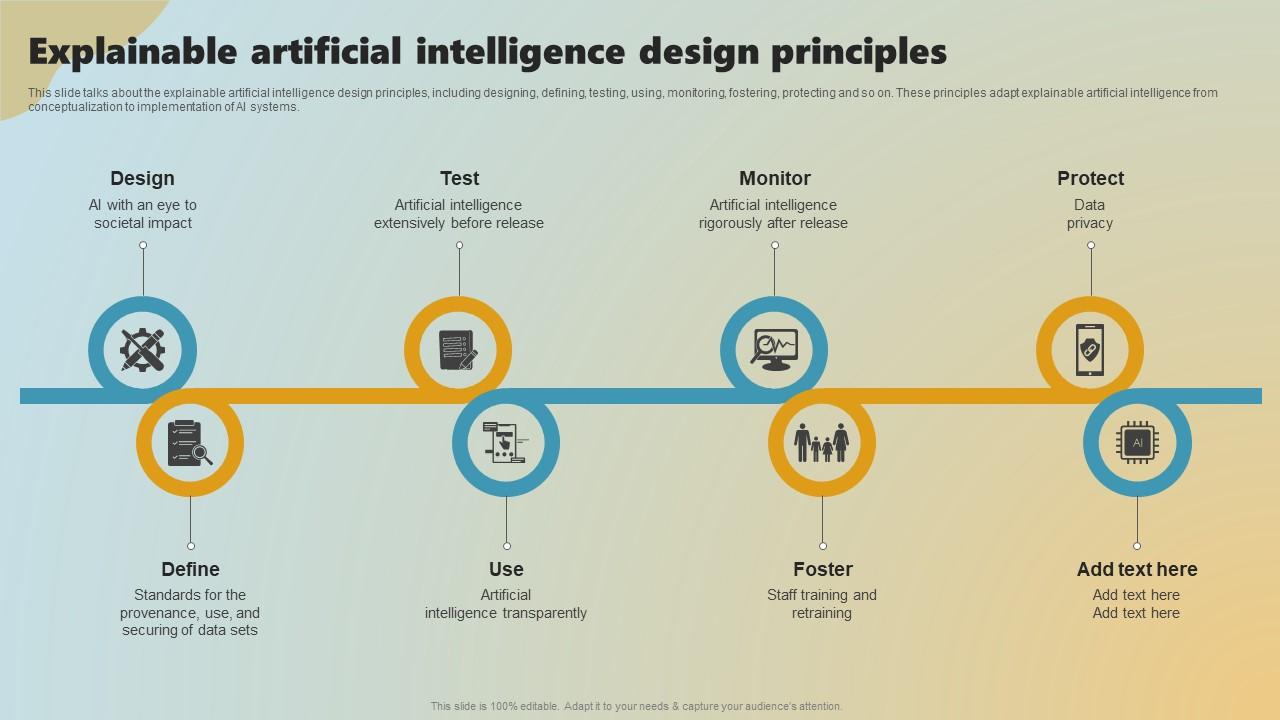
Template 15: Explainable Artificial Intelligence Design Principles Applications
Eight design principles—from conceptualization through deployment—are structured clearly in this comprehensive XAI applications slide. Designing, defining, testing, using, monitoring, fostering, and protecting all appear as distinct, visual stages. Each principle maps directly to a phase of responsible AI development, making abstract governance tangible. Customize stage labels and descriptions to match your organization's actual AI lifecycle. This eight-stage layout works equally well for board presentations and technical team reviews. Dispense focused information on Design, Monitor, and Protect without overwhelming your audience. Transform your AI design-principles presentations today. Download this premium PPT now and implement explainable AI from concept to production.
Download this PowerPoint Template
Template 16: Roadmap for Explainable AI Models PPT
A clear roadmap makes the difference between an AI model that gets built and one that gets deployed responsibly. This five-stage slide maps every key task across the explainable AI model-building process in sequence. Audiences see the full picture—from initial scoping to final deployment—without missing a step. Full editability means you can adapt the roadmap to reflect your team's actual timeline and milestones. Use it for project kickoffs, stakeholder updates, or AI governance check-ins. The visual sequencing drives alignment across technical and non-technical teams. Transform your AI roadmap presentations today. Download this fully editable PPT example now and move from planning to execution with clarity.

Download this PowerPoint Template
Template 17: Comparison between AI and XAI Explainable AI Models
The gap between AI and XAI becomes immediately visible in this sharp, two-stage comparison slide. Accountability, auditability, and correctness-checking challenges in traditional AI models are laid out against XAI's transparent approach. Non-technical stakeholders immediately grasp why black box AI models create governance risk. Fully editable layout lets you annotate the comparison with your organization's real-world examples. Use it to open AI governance discussions or support compliance audit preparations. The clean two-stage structure keeps the argument tight and persuasive. Transform your AI-versus-XAI presentations today. Download this editable comparison PPT now and make the case for transparent machine learning.
[product_image id=1068059]
Template 18: Explainable AI Frameworks for Transparency in AI Explainable AI Models
LIME explainability, DeepLIFT, the What-If Tool, and Skater—four leading XAI frameworks are presented in one structured, four-stage slide. Each framework's role in driving AI transparency is communicated clearly, without technical jargon overload. Interpretable outputs and positive model behavior become tangible when framed through these tools. Customize framework descriptions to reflect the tools your team actually uses. Use it in developer briefings, AI governance workshops, or client transparency presentations. The visual stage design keeps complex framework comparisons digestible. Transform your AI frameworks presentations today. Download this four-stage PPT now and show stakeholders exactly how transparency gets built.
[product_image id=1068062]
Template 19: Explainable AI in Financial Institutions PowerPoint Model Gridlines
Transparent loan approvals and credit decisions are no longer a regulatory aspiration—this six-stage slide shows exactly how explainable AI delivers them. Risk, services, investment, pricing, and product applications in financial institutions are all covered in structured visual form. Client experience improvements become concrete when connected to specific XAI workflows. Customize stage content to reflect your institution's actual AI-driven financial processes. Use it for regulatory submissions, investor briefings, or internal compliance reviews. The gridline layout maintains visual precision across all six application areas. Transform your financial AI presentations today. Download this PPT model now and build stakeholder confidence in transparent, accountable credit and loan systems.

Download this PowerPoint Template
Template 20: Challenges of Explainable AI PPT Infographics
Accuracy trade-offs, audience engagement barriers, and explainability gaps are the three core challenges mapped in this five-stage infographic PPT. Visual infographic formatting makes each challenge immediately scannable for busy decision-makers. The five-stage structure keeps the narrative tight without sacrificing depth. Customize stage labels to reflect your organization's specific AI deployment pain points. Use it to open honest conversations about where explainable AI still falls short. This slide works as a standalone discussion prompt or as part of a larger AI governance deck. Transform your AI challenges presentations today. Download this infographic PPT now and make the hard conversations about AI limitations productive.
[product_image id=1068058]
Elevate Every AI Explanation with SlideTeam
SlideTeam's PowerPoint templates are the best in the industry for communicating explainable AI models to any audience. These content-ready slides save hours of formatting time while delivering the professional clarity that AI transparency and accountability demand. Use these ready-made frameworks to present machine learning interpretability, governance roadmaps, and responsible AI principles with confidence. Deploy these custom-made PowerPoint slides and turn complex AI decisions into stories every stakeholder understands.
FAQs on Explainable AI Model
What distinguishes explainable AI from traditional black-box machine learning models?
Traditional black-box AI models produce outputs without revealing the reasoning behind them. Explainable AI adds a transparency layer, showing which inputs drove which outputs. This matters for audits, compliance, and user trust. Black-box models prioritize raw accuracy; explainable AI balances accuracy with human interpretability, making decisions reviewable and defensible.
How do LIME and SHAP differ in their approaches to generating model explanations?
LIME approximates a complex model locally—it perturbs individual data points and builds a simpler, readable model around each prediction. SHAP uses game-theory-based Shapley values to assign each feature a consistent contribution score across all predictions. LIME is faster but less stable across runs. SHAP values in machine learning are more mathematically consistent but computationally heavier.
Which industries stand to benefit most from deploying explainable AI systems and why?
Healthcare, financial services, and HR benefit most. In healthcare, clinicians need to understand diagnostic recommendations before acting on them. In finance, regulators require transparent loan and credit decisions. In HR, explainability prevents discriminatory hiring outcomes. All three sectors face legal accountability, making AI interpretability not optional but required.
How does explainability trade off against model accuracy in deep learning architectures?
Deep learning models gain accuracy by stacking many non-linear layers, which makes them harder to interpret. Simpler models—decision trees, linear regression—are more transparent but less accurate on complex tasks. The trade-off is real: adding explainability constraints often reduces performance slightly. Most teams manage this by applying post-hoc explanation tools like SHAP rather than simplifying the model itself.
What role does feature importance play in communicating AI decisions to non-technical stakeholders?
Feature importance ranks which input variables most influenced a model's output. For non-technical stakeholders, it translates a model's behavior into plain language—'income level drove this decision more than any other factor.' It makes AI decision-making reviewable without requiring data science knowledge. Most governance and compliance discussions rely on feature importance as the primary communication tool.
How can explainable AI frameworks help organizations comply with GDPR and other data privacy regulations?
GDPR requires that automated decisions affecting individuals be explainable on request. Explainable AI frameworks—like LIME, SHAP, and model cards—generate the documentation needed to satisfy that requirement. They also support data minimization by identifying which features are actually necessary. Organizations using XAI frameworks can respond to regulatory inquiries faster and with auditable evidence.
What are the key visualization techniques used to interpret neural network decision-making processes?
Saliency maps highlight which input pixels or features most activated a neural network's output. Activation maximization shows what input pattern maximally triggers a given neuron. t-SNE visualizations map high-dimensional layer outputs into readable 2D clusters. These three techniques cover most neural network explainability needs across image, text, and tabular data models.
How do attention mechanisms in transformer models contribute to interpretability?
Attention mechanisms show which input tokens a transformer model weighted most heavily when producing an output. This creates a built-in, lightweight interpretability signal—you can see what the model 'focused on.' However, attention weights don't always correlate perfectly with feature importance. They are a useful starting point for deep learning interpretability, not a complete explanation on their own.