




 0 Comment
 Customer Reviews

The model's been running for six months. Nobody's questioned it yet.
That's the quiet danger with predictive analytics in financial services. The math looks clean. The outputs feel authoritative. And somewhere between the training data and the boardroom, the actual assumptions get buried—confident on the surface, uncertain underneath.
Finance teams know this. Risk officers know this. They've sat through enough post-mortems to understand that the model didn't fail loudly. It failed quietly, in ways that only became obvious after the fact. A credit decision that seemed sound. A fraud pattern that looked like noise. A churn prediction that was accurate on paper, wrong in practice.
And yet the pressure doesn't go away. Institutions have to make calls—on loans, on customers, on capital allocation. They need something more defensible than instinct and faster than a committee. That's the actual job predictive analytics is doing in financial services right now. Not magic. Just structured inference at scale.
The hard part isn't the data. Most institutions have plenty of it. The hard part is turning that data into something a risk committee can act on, a regulator can scrutinize, and a customer can trust. That gap—between raw model output and a decision someone's willing to sign off on—is where most of the real work happens.
That's why these templates exist. Not because predictive analytics is new, but because presenting it clearly—to an executive team, a compliance board, a client—remains genuinely difficult. SlideTeam's pre-designed frameworks handle the structural part: how to show a fraud detection workflow, how to visualize a credit scoring model, how to lay out an AI risk assessment summary without it looking like a research paper.
Here's what's available across SlideTeam's collection of predictive analytics in financial services templates.
Template 1: Predictive Analytics in Financial Services PPT Slides
Predictive analytics presentations often carry heavy content. This PPT preset helps that content land with clarity and precision. Built for analysts and finance leads, this deck covers the full scope of data-driven financial decisions. It structures complex model outputs into audience-ready visuals. The template is 100% editable and customizable.
[product_image id=1404465]
Template 2: Predictive Analytics in Banking and Financial Services
Banks depend on predictive analytics to manage risk before it becomes a problem. This PowerPoint slide maps that dependency clearly across four core areas: credit scoring, budgeting, risk prevention, and finance management. It suits compliance reviews and internal risk briefings alike. Practitioners can walk a leadership team through fraud monitoring or credit risk exposure in one clean flow. The template is 100% editable and customizable.

Download this PowerPoint Template
Template 3: Analytics in Financial Services Industry PPT Presentation
Captivate your audience from the first slide with this Analytics in Financial Services Industry presentation. The balanced design merges innovation with clarity, giving your financial data immediate visual authority. Engage stakeholders with structured layouts that highlight critical trends and institutional insights. Deliver compelling banking analytics narratives that drive decisions and command boardroom confidence. Transform your financial services presentations today. Download this dynamic deck now and elevate every analytics briefing.
[product_image id=1385849]
Template 4: Analytics Trends in Financial Services Industry PPT Demonstration
Staying current on analytics shifts in financial services is a real leadership need. This PPT template gives practitioners a clean structure to present emerging trends to boards and clients. It works for annual planning sessions, investor briefings, and internal strategy reviews. Btw, the visual design keeps the audience focused on the insight rather than the slide. The template is 100% editable and customizable.
[product_image id=1388799]
Template 5: Predictive Analytics in Marketing Campaigns PPT Example
Marketing teams in finance increasingly depend on predictive customer analytics to allocate budgets and target segments. This PowerPoint slide is built for campaign planners who need to show the logic behind audience decisions. A real scenario: presenting a customer churn prediction model to justify a retention campaign spend. The deck makes that case clearly, without the slide getting in the way. The template is 100% editable and customizable.
[product_image id=1742123]
Template 6: Harnessing Predictive Analytics for Financial Forecasting Success PPT Example
Financial forecasting conversations require precision and visual structure. This PPT template is built for finance leads who need to present revenue and cash flow projections to leadership teams. It suits predictive revenue forecasting reviews, quarterly planning decks, and investor updates. For context, the design keeps the focus on the numbers rather than the layout. The template is 100% editable and customizable.
[product_image id=1447966]
Template 7: Harnessing Predictive Analytics for Strategic Financial Management PPT Summary
Strategic financial management depends on turning model outputs into clear decisions. This PowerPoint slide helps CFOs and planning teams present their predictive frameworks to boards and stakeholders. It works well for financial risk management discussions and annual planning reviews. The structure lets the audience follow the logic from data to decision without getting lost. The template is 100% editable and customizable.
[product_image id=1458539]
Template 8: Predictive Analytics Techniques for Financial Forecasting and Planning PPT Mockup
Financial forecasting and planning presentations need to show method as much as outcome. This PPT preset is designed for analysts who present their modeling approach to senior stakeholders. It covers the arc from data inputs to projected outputs in a format that non-technical audiences can follow. So yeah, it bridges the gap between the model room and the boardroom. The template is 100% editable and customizable.
[product_image id=1783990]
Template 9: Predictive Analytics the Future of Financial Forecasting PPT Graphics
The future of financial forecasting is being shaped by real-time data and AI-powered financial insights. This PowerPoint slide helps practitioners communicate that shift to audiences who set institutional direction. It suits keynote sessions, client presentations, and executive briefings on where analytics is heading. Explore more predictive analytics in financial services PPT templates with curated examples and samples to build a complete narrative. The template is 100% editable and customizable.
[product_image id=1447404]
Template 10: Leveraging Predictive Analytics to Drive Financial Decisions PPT Information
Data-driven financial decisions require more than good models—they require clear communication. This deck is built for finance teams that need to present their analytical reasoning to decision-makers who don't live in the data. It covers how predictive insights translate into lending, investment, and risk choices. The structure moves from evidence to recommendation without losing the audience. The template is 100% editable and customizable.
[product_image id=1447899]
Template 11: Predictive Analytics in Banking and Finance Industry Predictive Modeling Methodologies
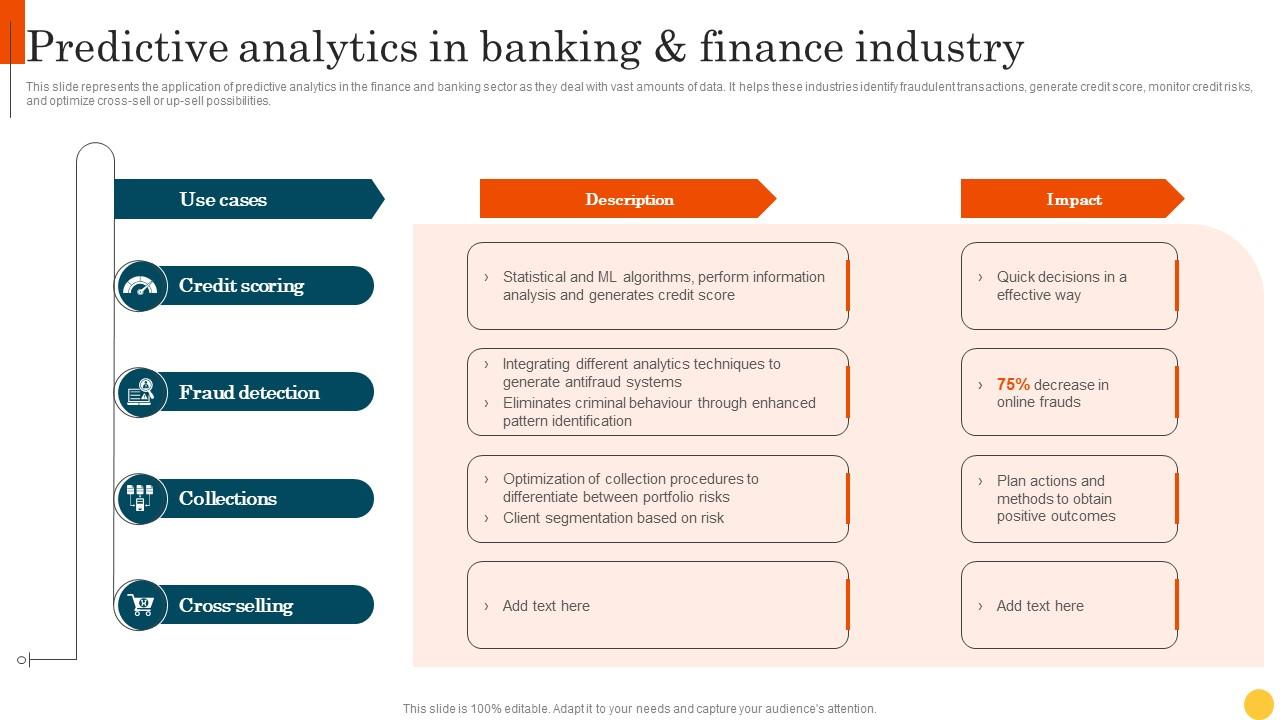
Banking and finance institutions handle enormous volumes of data daily. This PPT template translates that scale into a focused discussion on four practical applications: credit scoring, fraud detection, collections, and cross-sell optimization. It is the right slide for a product or risk team presenting their predictive modeling roadmap to leadership. The layout surfaces what the data actually does for the business. The template is 100% editable and customizable.
Download this PowerPoint Template
Template 12: Predictive Analytics in Banking and Finance Industry PPT Sample
Credit risk and fraud detection are the two places where predictive analytics pays off fastest in banking. This PowerPoint slide lays out both in a four-stage structure that is easy for a mixed audience to follow. It is built for practitioners who need to brief senior leaders or compliance teams. The slide moves from problem to application without requiring the audience to understand the underlying model. The template is 100% editable and customizable.

Download this PowerPoint Template
Template 13: Predictive Analytics in Banking and Finance Industry PPT Infographics Slideshow
Drive boardroom clarity with this Predictive Analytics in Banking and Finance Industry infographic slideshow. The four-stage visual structure transforms complex fraud detection analytics and credit scoring data into compelling, scannable insights. Present cross-selling opportunities and collection strategies with visual precision that commands executive attention. Accelerate understanding and deliver banking analytics solutions that persuade stakeholders to act. Transform your financial presentations today. Download this infographic deck now and make every data point count.

Download this PowerPoint Template
Template 14: Use Cases of Predictive Analytics in Finance Industry
Elevate your financial risk presentations with this Use Cases of Predictive Analytics in Finance Industry slide deck. The five-stage structure drives immediate clarity around cost reduction, prediction risk management, and political risk signals. Each layout empowers you to anchor complex analytics use cases in actionable business language. Deliver persuasive, insight-rich decks that capture executive attention from the first slide. Transform your analytics presentations today. Download this powerful template now and demonstrate the full value of financial data science.
[product_image id=1044441]
Template 15: Predictive Analytics Model in Banking Management
Banking management teams regularly deal with questions of retention, cross-sell, and account growth. This PowerPoint slide maps a predictive analytics model across those six decision points in a format that suits both strategy and operations reviews. It is practical for product managers and relationship banking leaders who present to executive committees. The structure makes the model's application visible without exposing its complexity. The template is 100% editable and customizable.
[product_image id=1044438]
Template 16: Predictive Analytics Use Cases in Finance
Cash flow visibility is a persistent problem for finance teams, and predictive analytics is changing that. This PPT preset covers four real use cases: flow forecasting, credit risk management, customer payment predictions, and broader risk management. It is built for treasury and FP&A practitioners presenting to CFOs or board audit committees. The slide keeps the focus on outcomes rather than methodology. The template is 100% editable and customizable.
[product_image id=1208607]
Template 17: Artificial Intelligence and Machine Learning in Financial Services
AI and ML are reshaping financial services at the process level, not just the strategy level. This PowerPoint slide maps that shift across sub-processes, pain areas, usage contexts, and potential benefits—with payments as a concrete anchor. It is built for technology and operations leads presenting a digital transformation case to executive or investor audiences. The layout surfaces what AI-powered financial insights actually mean for day-to-day banking. The template is 100% editable and customizable.
[product_image id=1192244]
Template 18: Predictive Analytics in Business and Finance Icon
Anchor your analytics presentations with a clean, professional visual identity using this business and finance icon slide. The three-stage layout gives structure to any predictive analytics framework without overwhelming the audience. Streamline complex financial data narratives with icons that create instant visual context. Accelerate comprehension and deliver financial data presentations that resonate with every stakeholder group. Transform your analytics decks today. Download this versatile template now and give your financial insights a sharper visual voice.
[product_image id=1044436]
Template 19: Applications of Predictive Analytics in Finance Industry Use of Predictive Analytics in Modern Data Analytics
Maximise stakeholder buy-in with this Applications of Predictive Analytics in Finance Industry presentation. The five-stage framework drives clarity across fraud prevention, customer journey optimisation, political risk signals, credit card default risk, and budget cost reduction. Each layout translates complex algorithmic trading analytics and risk data into persuasive visual narratives. Deliver data-driven financial decisions with professional precision that commands attention. Transform your financial analytics presentations today. Download this compelling deck now and demonstrate the full power of predictive modeling.
[product_image id=1174875]
Template 20: Applications of Predictive Analytics in Banking Industry Use of Predictive Analytics in Modern Data Analytics
Banking operations benefit most from predictive analytics when the application is specific. This PPT template covers four of those specific applications: credit scoring, fraud detection, collections, and cross-selling. It is the right deck for a banking analytics team presenting their use-case roadmap to product leadership or a risk committee. The four-stage structure makes a complex capability map look manageable. The template is 100% editable and customizable.
[product_image id=1174874]
Win Every Financial Analytics Presentation with SlideTeam
SlideTeam's PowerPoint templates are the best in the industry for predictive analytics in financial services. These content-ready slides give your team the professional structure to present credit scoring models, fraud detection workflows, and AI risk assessment frameworks with authority. Use these ready-made PowerPoint slides to turn complex data outputs into clear, boardroom-ready narratives. Deploy these templates now and drive the data-driven financial decisions your institution depends on.
FAQs on Predictive Analytics in Financial Services
How does predictive analytics differentiate between correlation and causation when assessing credit risk in lending decisions?
Predictive models find patterns—they do not confirm causes. In credit risk, a high correlation (say, between zip code and default) does not mean location causes defaults. Lenders must test variables using controlled methods or domain knowledge before acting on them. The safest practice: flag correlations as signals, then validate causation through credit policy and human review before embedding them in loan decisions.
What are the key machine learning algorithms financial institutions rely on to forecast customer churn and lifetime value?
Logistic regression remains a baseline for churn prediction due to its interpretability. Gradient boosting models—XGBoost, LightGBM—perform better on large, mixed datasets. For customer lifetime value, survival models and recurrent neural networks handle time-based patterns well. Most institutions run an ensemble of two or three of these, then validate outputs against actual customer behavior on a rolling basis.
How do banks balance model interpretability with predictive accuracy when deploying black-box algorithms for loan approvals?
This is a live tension. Black-box models—gradient boosting, deep learning—often outperform simpler ones on accuracy. But regulators and applicants can demand explanations for adverse decisions. Banks typically apply explainability tools like SHAP values on top of complex models. Some use a two-tier approach: a transparent scorecard for the decision, and a black-box model to flag edge cases for human review.
In what ways does real-time predictive analytics transform fraud detection compared to traditional rule-based systems?
Rule-based systems check transactions against fixed thresholds—slow to adapt, easy to game. Real-time predictive models score every transaction as it happens, learning from new fraud patterns continuously. They catch anomalies a rules engine would miss and generate far fewer false positives. The practical gain: faster blocks on genuine fraud, fewer legitimate transactions declined, and a model that improves with each new case.
How can financial institutions ensure their predictive models remain compliant with regulations like GDPR and the Fair Credit Reporting Act?
GDPR requires that automated decisions affecting individuals be explainable and contestable. The Fair Credit Reporting Act demands adverse action notices with specific reasons. Institutions must document model inputs, audit for bias regularly, and maintain the ability to explain any output. In practice: build model governance into the development process, not as a post-deployment check. Regular bias audits and model re-validation are non-negotiable.
What role does alternative data play in improving the predictive power of credit scoring models for underbanked populations?
Traditional credit scoring ignores people with thin or no credit files. Alternative data—rent payments, utility bills, mobile money usage, and even e-commerce transaction history—fills that gap. Lenders using this data can build credit scoring models for previously unscorable applicants. The key constraint is consent and data quality; not all alternative data sources are reliable or legally permissible in every jurisdiction.
How do ensemble methods outperform single models in predicting market volatility and asset price movements?
Single models overfit to specific patterns in training data. Ensemble methods—random forests, gradient boosting, stacking—combine multiple models, which reduces that overfitting. In volatile markets, no one model captures every signal. Ensembles spread the prediction across different assumptions, making them more stable when conditions shift. The trade-off is added complexity in validation and a harder explainability story for regulators.
What are the most significant data quality challenges that undermine predictive model performance in retail banking?
Retail banking data is fragmented across legacy systems, often inconsistently labelled, and riddled with missing values. The three most damaging issues are: duplicated customer records across products, outdated contact and income data, and inconsistent transaction categorization. Models trained on dirty data produce unreliable outputs regardless of algorithm sophistication. A data quality audit before model development is not optional—it determines whether the model can be trusted at all.