





 0 Comment
 Customer Reviews

The deck's been sent. Three departments signed off. And yet the process that produced it looked nothing like the process from last quarter.
That's the thing about process maturity—not the theory of it, but the actual day-to-day reality. Someone runs a project brilliantly because they happened to know what to do. Then they leave, or move teams, and the next person starts from scratch. The knowledge was never in the system. It was in one person's head.
Most organizations already know this is happening. They can feel it—the repeated fire drills, the inconsistent outputs, the meetings that relitigate decisions that should've been made permanent months ago. But knowing there's a problem and being able to show it, frame it, and get leadership to act on it? That's a completely different ask.
Process maturity models exist because this gap is everywhere. Not in one industry. Not in companies below a certain size. Everywhere. The model gives teams a common language—a way to say "we're here, we want to be there, and here's what the path looks like." Without that framing, maturity conversations tend to collapse into opinions. With it, they become plans.
What makes it harder is that process maturity spans everything—IT governance, manufacturing automation, risk controls, software delivery, sales and operations. Each domain has its own vocabulary, its own benchmarks, its own version of what "defined" or "optimized" actually means in practice. Building a presentation that communicates maturity across even one of these domains from a blank slide is a significant lift.
SlideTeam's pre-designed process maturity model templates handle the structural part—so you're not reinventing the framework before you've even started the conversation. Content-ready layouts for CMMI levels, Business Process Management stages, vulnerability management flows, IT capability assessments—they're already built for the context you're working in.
Here's what's available.
Template 1: MLOps Process Lifecycle Maturity Model
MLOps maturity sits at the intersection of software delivery and data science operations. This PPT template is built for ML engineers and data platform leads who need to communicate where their MLOps environment stands today. It maps five progression levels—from no MLOps through DevOps-only, training automation, model deployment, and full MLOps automation. Use this deck to anchor discussions on process maturity model stages in a machine learning context. The template is 100% editable and customizable.

Download this PowerPoint Template
Template 2: Defining BPM Maturity Model Introducing Business Process Management Methodology
Clarity on where your business processes stand drives every meaningful improvement conversation. This template merges BPM maturity phases into a single, structured visual arc. It captures progression from acknowledging operational inefficiencies through to achieving an agile business structure. Enterprise valuation control and process-aware operations are mapped clearly across each phase. Use it to anchor Business Process Management methodology discussions with leadership or cross-functional teams. Transform your process improvement framework presentations today. Download this dynamic template now and unlock structured BPM communication.

Download this PowerPoint Template
Template 3: PMO Maturity Model Assessment Process Levels
Directing PMO strategy without a clear maturity baseline is guesswork. This template delivers a structured PMO maturity model across five levels: initial, developing, defined, managed, and mastered. Each level maps directly to business benefit, resource allocation, and strategic direction. You gain instant visual clarity on where your PMO stands and where it needs to go. Use it to set concrete objectives and pinpoint improvement areas across your organization. Transform your organizational maturity assessment presentations today. Download this dynamic template now and unlock focused PMO growth.

Download this PowerPoint Template
Template 4: Business Process Management Maturity Model Business Process Management System
Five-stage BPM maturity frameworks are only useful when every stage is clearly defined. This template captures the full journey—from identifying operational inefficiencies through process awareness, intra-process automation, and beyond. Roles under each stage are explicitly defined, giving your audience actionable context. It enables teams to pinpoint exactly where current processes fall short. Use it to present Business Process Management maturity with structure and authority. Transform your BPM presentations today. Download this dynamic template now and unlock a sharper process communication tool.

Download this PowerPoint Template
Template 5: Operations Maturity Model with People and Process
People and process don't mature at the same rate—and that gap shows up in operations. This template captures the Operations Maturity Model across both dimensions simultaneously. It drives clarity on how process improvement and people development interact at each stage. You can present current-state versus target-state maturity with a single, organized visual. Use it to frame operational excellence conversations across HR, operations, and leadership audiences. Transform your operations presentations today. Download this dynamic template now and unlock a unified maturity communication tool.

Download this PowerPoint Template
Template 6: Maturity Model for Intelligent Automation Process
Intelligent automation maturity isn't just about technology—it's about objectives, solutions, and management readiness. This template maps the Intelligent Automation maturity journey across all three dimensions clearly. Each stage connects automation capability to organizational management capacity. You gain a framework that aligns technical progress with business outcomes at every level. Use it to present automation roadmaps to leadership, operations, or IT governance stakeholders. Transform your automation maturity presentations today. Download this dynamic template now and unlock a structured intelligent automation narrative.
[product_image id=464912]
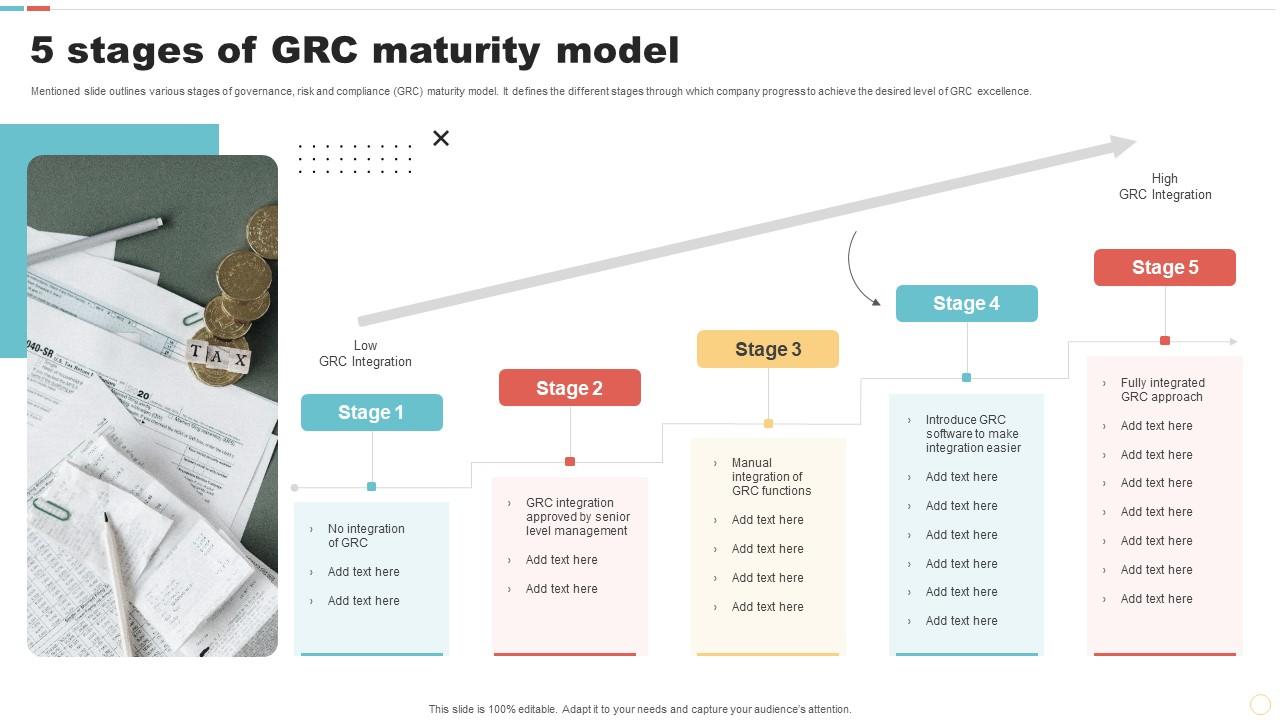
Template 7: 5 Stages of Grc Maturity Model
GRC maturity isn't static—organizations move through distinct stages before reaching genuine governance excellence. This template outlines five stages of Governance, Risk, and Compliance maturity, from low GRC integration to high GRC integration. Each stage is clearly defined, giving audiences a precise picture of where controls stand today. It enables compliance and risk teams to communicate progress and gaps with authority. Use it to frame GRC maturity discussions with boards, auditors, or senior leadership. Transform your risk management maturity presentations today. Download this dynamic template now and unlock a complete GRC communication tool.
Download this PowerPoint Template
Template 8: Test Process Improvement Maturity Model
Software quality conversations need a clear progression model, not just a test report. This PPT template maps test process improvement across five levels—initial phase, define phase, integration, management review, and optimization. It's built for QA leads and test managers presenting software development maturity to stakeholders. The structure distinguishes general test activities from organized, optimized ones. Use this slide to show exactly where testing discipline stands and where it needs to go. The template is 100% editable and customizable.

Download this PowerPoint Template
Template 9: Capability Maturity Model Integration Process
CMMI levels become far easier to communicate when each stage has a concrete structure behind it. This PPT preset maps the Capability Maturity Model Integration process across five project management stages—initiation, managed, project-defined process, quantitatively managed, and optimizing. It covers enterprise training, decision analysis, and project integration management in a single visual. For program managers and process leads, this deck anchors Capability Maturity Model Integration discussions with precision. The template is 100% editable and customizable.

Download this PowerPoint Template
Template 10: Manufacturing Process Automation Maturity Model
Manufacturing productivity conversations often stall without a clear automation maturity map. This PowerPoint slide covers the full manufacturing process automation maturity model—from IT process automation and business process automation through co-physical and robotic automation. It's designed for operations leaders and plant managers presenting digital transformation maturity to leadership. The stages move from simple automation to transformed automation, with business value outcomes clearly linked. This deck gives manufacturing teams a credible, structured baseline for continuous improvement planning. The template is 100% editable and customizable.

Download this PowerPoint Template
Template 11: Business Process Management Maturity Model
Presenting a BPM maturity roadmap requires a visual that can carry complexity without losing the audience. This template delivers a clean Business Process Management maturity framework. It gives you the structural backbone to present process standardization stages with professional authority. Each stage is clearly framed to support cross-functional discussion and leadership alignment. Use it to communicate process benchmarking progress and improvement targets with precision. Transform your business process management presentations today. Download this dynamic template now and unlock a polished BPM communication tool.

Download this PowerPoint Template
Template 12: Vulnerability Management Maturity Model Process Flow
Vulnerability handling rarely gets a clear visual model—and that gap costs security teams credibility in the boardroom. This PPT template maps a five-stage vulnerability management maturity flow: scanning, assessment, analysis and prioritization, business-risk management, and attack management. It's built for CISOs and IT process maturity leads who need to show security posture progression clearly. Each stage connects to a real operational outcome, not just a label. Use this slide to present risk control maturity to leadership or audit committees. The template is 100% editable and customizable.

Download this PowerPoint Template
Template 13: Multi Stage S and Op Process Maturity Model
Sales and operations planning only works when process maturity keeps pace with business complexity. This template delivers a multi-stage S&OP process maturity model across five levels: react, anticipate, integrate, collaborate, and orchestrate. Each stage maps to specific structural characteristics—from single-function focus to complete internal supply chain integration. It gives supply chain and operations leaders a precise framework for maturity assessment conversations. Use it to align cross-functional teams on where S&OP processes stand and where they must go. Transform your operations planning presentations today. Download this dynamic template now and unlock a structured S&OP maturity tool.

Download this PowerPoint Template
Template 14: Maturity Model Levels of ITSM Process
IT service management effectiveness is hard to measure without a defined progression model. This PPT slide maps ITSM process maturity across five levels—nothing in place, reactive, proactive, service value, and business value. It's built for IT service managers and CIOs evaluating where current disciplines sit and what to build next. The structure makes performance gaps visible and turns maturity discussions into actionable planning. For context, it works well in service management maturity reviews alongside capability benchmarking sessions. The template is 100% editable and customizable.
[product_image id=971770]
Template 15: Infrastructure Management Process Maturity Model PowerPoint Presentation Slides
Infrastructure management is complex to present without a structured maturity lens. This PPT template gives IT infrastructure leads a clear model for mapping process capability across management stages. It supports IT governance framework conversations with a visual that stakeholders can follow without technical background. Use this deck to present infrastructure maturity assessments to leadership or audit teams clearly. The template is 100% editable and customizable.
[product_image id=402495]
Template 16: Business Process Maturity Model PPT PowerPoint Presentation Show Design Ideas
Business process maturity conversations need a model that speaks to every audience—not just process specialists. This PPT preset covers five stages: initial, managed, standardised, predictable, and innovating. The progression arc is clear enough for executive review and detailed enough for operational planning. It gives process owners and operations leads a reliable backbone for continuous improvement model discussions. Use this slide to present where business processes stand and what the next stage demands. The template is 100% editable and customizable.

Download this PowerPoint Template
Template 17: Five Process Level of Capability Maturity Model Integration
CMMI levels get misunderstood when they're explained without a clear visual reference. This PPT template maps all five Capability Maturity Model Integration process levels—initial, managed, defined, quantitatively managed, and optimizing—in a single structured view. It's built for process leads and program managers who need to orient stakeholders quickly. The visual makes level-by-level progression concrete rather than abstract. Use this slide to anchor CMMI level discussions in strategy reviews or process benchmarking sessions. The template is 100% editable and customizable.

Download this PowerPoint Template
Template 18: IT Capability Maturity Model for Software Development Process PowerPoint Presentation Slides
Software development maturity is one of the hardest things to communicate to non-technical leadership. This PowerPoint slide maps IT capability maturity across the full software development process in a structured, accessible visual. It's built for CTOs, IT leads, and delivery managers who need to frame where engineering practices stand today. The model supports conversations on software development maturity, team capability gaps, and improvement investment decisions. Use this deck to present IT process maturity clearly across leadership, delivery, and governance audiences. The template is 100% editable and customizable.
[product_image id=395663]
Template 19: Data Maturity Model Assessment Process
Data maturity assessments lose credibility fast without a clear, repeatable process behind them. This template maps the Data Maturity Model Assessment Process across four stages: evaluate, validate, ideate, and report. It gives data leads and analytics teams a structured framework for communicating where data capabilities stand. Each stage connects directly to maximum utilization of available datasets. Use it to present data capability assessments to leadership, governance committees, or enterprise architecture teams. Transform your data maturity presentations today. Download this dynamic template now and unlock a rigorous data assessment communication tool.

Download this PowerPoint Template
Template 20: Risk Management Process Maturity Model
Risk management maturity is best shown through procedures, controls, and metrics—not just labels. This PPT template maps risk management maturity stages with explicit columns for procedures, controls, KPIs, and improvement mechanisms. Comprehensive KPIs and performance assessment are built directly into the model structure. It's designed for risk officers and compliance leads who need to present maturity progression with measurable credibility. Use this slide in board-level risk reviews or enterprise maturity model planning sessions. The template is 100% editable and customizable.

Download this PowerPoint Template
Elevate Every Process Maturity Conversation with SlideTeam
SlideTeam's PowerPoint templates are the best in the industry for communicating process maturity model frameworks with clarity and authority. These content-ready slides cover every domain—from CMMI levels and BPM maturity to risk controls and IT governance frameworks—saving you hours of structural work. Use these ready-made PowerPoint slides to present maturity assessments, capability gaps, and improvement roadmaps with professional precision. Deploy these templates today and turn complex process conversations into decisions that drive real organizational progress.
FAQs on Process Maturity Model
What distinguishes a Level 2 organization from a Level 3 organization in the Capability Maturity Model Integration framework?
A Level 2 organization manages projects repeatably but relies on individual project-level controls. Processes succeed largely due to skilled people, not documented systems. A Level 3 organization standardizes processes across the enterprise, not just within individual projects. Defined processes are documented, understood organization-wide, and applied consistently—shifting reliance from people to institutional systems.
How can a company accurately assess its current process maturity level without internal bias skewing the results?
Use an external assessor or a structured third-party audit against a recognized framework such as CMMI or ISO process standards. Internally, run cross-functional process interviews—not just manager reviews. Collect evidence from actual process outputs, not self-reported scores. Benchmark results against industry peers to check for inflation. Combining external perspective with documented evidence reduces bias significantly.
What are the most common pitfalls organizations face when attempting to move from an ad-hoc process culture to a defined one?
The three most common pitfalls are: documenting processes without enforcing them, training people once without reinforcing behavior, and treating process definition as a project rather than ongoing work. Teams often confuse writing a process down with implementing it. Without measurement and accountability built in, ad-hoc behavior simply continues alongside the new documentation.
How does process maturity differ across industries such as healthcare, manufacturing, and software development?
Healthcare prioritizes compliance and safety protocols, making process standardization critical but slow due to regulation. Manufacturing focuses on physical process capability and defect reduction, often applying Lean or Six Sigma maturity models. Software development moves faster and centers on delivery repeatability and Agile maturity. Each industry defines maturity against different outcomes, so the benchmarks and timelines for progression differ substantially.
Why do some organizations plateau at maturity Level 3 and struggle to advance toward optimization?
Level 3 requires defined processes—but reaching Level 4 demands quantitative measurement, which most organizations underinvest in. Without solid KPIs tied to process performance, there is no data to drive optimization. Many organizations also lack the statistical capabilities needed to interpret process data meaningfully. The jump from defined to managed is a measurement problem as much as a process one.
What role does leadership commitment play in sustaining long-term process maturity improvements?
Leadership commitment determines whether process maturity improvements survive beyond the initial project. Without visible sponsorship, teams revert to familiar shortcuts under pressure. Leaders must allocate resources, remove blockers, and hold teams accountable to new process standards. More practically, leadership needs to stop rewarding heroic individual effort—which signals that defined processes are optional.
How can small and medium-sized enterprises apply process maturity models without the resources available to large corporations?
SMEs should start with one high-impact process rather than attempting enterprise-wide maturity assessment. Lightweight frameworks—such as basic process documentation and simple KPI tracking—deliver value without large consulting budgets. Use freely available CMMI or ISO process standards as reference points, adapting only what is relevant. Progress matters more than perfect framework compliance at smaller scale.
What metrics should organizations track to objectively measure progress between maturity levels?
Track process adherence rate, defect or error frequency, cycle time per process step, and rework volume. These four give a factual baseline. As maturity increases, add KPIs for predictability—variance in cycle time shrinks at higher levels. Avoid tracking activity metrics like number of documented processes; track outcomes instead. Measure the same indicators consistently across review periods to show real movement.