



 0 Comment
 Customer Reviews

The deck's sitting there. Forty slides. Someone's about to present a "product innovation model" to a room of people who've seen fifteen of these in the last quarter alone.
The problem isn't the idea. Most teams actually have decent ideas. The problem is the structure. How do you show a three-horizon model without it looking like a clipart project? How do you walk a leadership team through a stage-gate process without losing them at slide three? How do you present a business model canvas that doesn't feel like you copied it off a whiteboard photo?
The gap isn't between having a process and not having one. Most organizations have some version of a new product development process. The gap is between the process existing and the process being communicated clearly enough that everyone in the room actually acts on it.
That's where the presentation matters more than people admit. A bad visual framework makes a good idea look unfinished. It signals that the thinking isn't done. And in product reviews, that's enough for someone to say "let's revisit next quarter."
There's also this: most people building these decks aren't designers. They're product managers, innovation leads, R&D heads — people who understand the model but don't want to spend three hours arguing with PowerPoint about alignment and color consistency. The design thinking methodology behind a good slide is its own skill set, and most of us don't have time to develop it mid-deadline.
So templates exist. Not because the ideas are generic — they're not — but because the structure is often the same. Three horizons. Nine steps. Building blocks. Roadmaps. Someone already figured out what that looks like on a slide, and that's worth something.
SlideTeam's product innovation model templates are built for exactly this moment. Pre-designed, content-ready frameworks that handle the visual heavy lifting so you can focus on the actual thinking. Whether you're presenting a disruptive innovation framework to the board or walking a product team through an agile product development cycle, these templates give you a starting point that doesn't look like a starting point.
Here's what's in the collection.
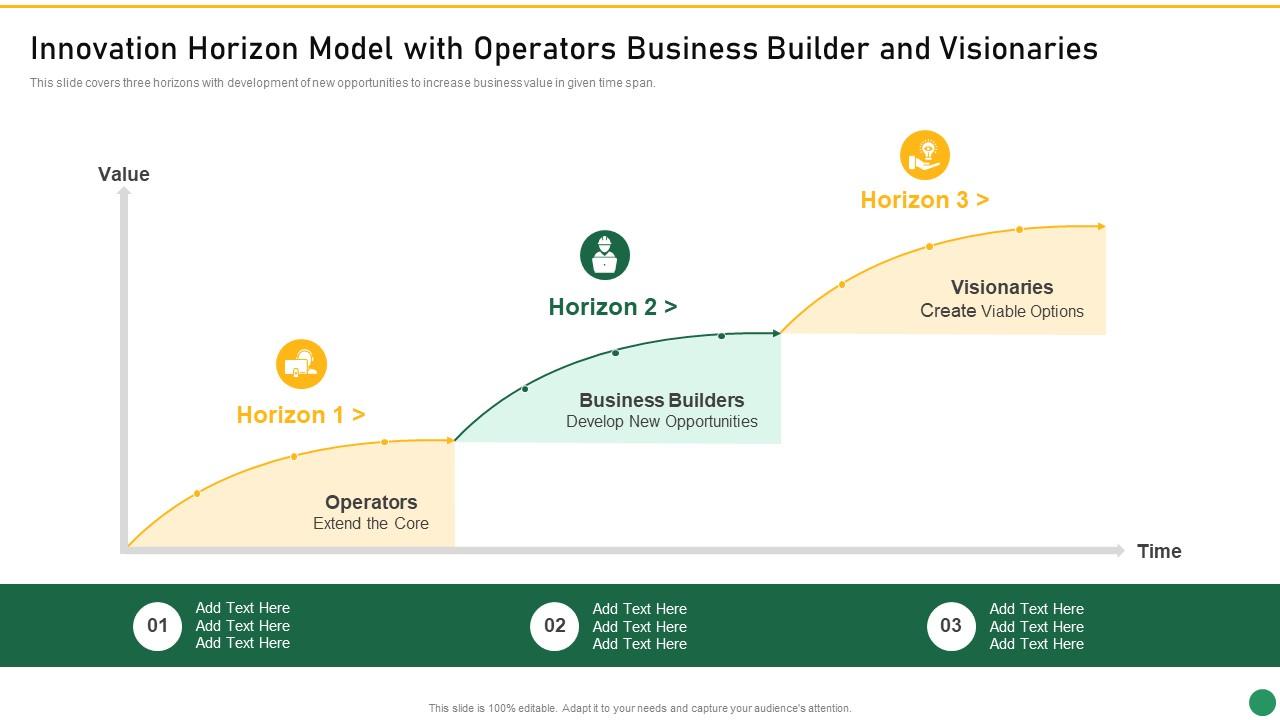
Template 1: Innovation Horizon Model with Operators Business Builder Visionaries
Horizon planning works best when roles are clear from the start. This PowerPoint slide maps three distinct innovation horizons — Operators, Business Builders, and Visionaries — against time and business value creation. It gives product leads a structured way to show where current efforts sit and where new opportunities must grow. Strategy reviews and portfolio planning sessions both benefit from this level of clarity. The template is 100% editable and customizable.
Download this PowerPoint Template
Template 2: Business Model Canvas with Value Proposition and Revenue Streams
This PPT merges a fully structured Business Model Canvas with Value Proposition and Revenue Streams into one cohesive visual. The layout captures key partners, customer segments, and B2B revenue channels with immediate clarity. Color-coded sections drive instant comprehension of how each business unit connects to income generation. You can anchor Go-To-Market Strategy discussions around cloud services, embedded software, online sales, and product distribution channels with precision. Transform your business model presentations today. Download this dynamic template now and unlock the clarity your stakeholders need.

Download this PowerPoint Template
Template 3: Innovation Model Technological Product Process Development Analysis PPT
Delivers a twelve-slide complete deck built around technological product process development and business strategic analysis. Each slide integrates Innovation Management Strategy frameworks with sharp visual cues that guide audience decision-making. The structured flow across twelve ready-to-use layouts accelerates your presentation build without sacrificing analytical depth. You can tailor every layout to fit any industry vertical, from manufacturing to digital services, with ease. Transform your innovation analysis presentations today. Download this dynamic deck now and explore more product innovation model templates to drive strategic clarity.
[product_image id=393896]
Template 4: Four Steps of Product Innovation in Building Blocks
Product teams often need a clean, four-step visual to move from problem to solution without losing the room. This PPT template maps Observing Problems, Developing Solutions, Product Testing, and Implementation as distinct building blocks. It suits rapid prototyping process reviews and customer-centric innovation workshops equally well. The visual structure keeps cross-functional teams aligned on what comes next. The template is 100% editable and customizable.

Download this PowerPoint Template
Template 5: Business Model Canvas to Revenue Streams with Cost Structure
Drives a comprehensive presentation connecting key activities, resources, and channels to revenue streams and cost structure. This layout captures every operational layer — from R&D and manufacturing to marketing, licensing, and regulatory approval — in one visual. Audience members grasp how customer relationships translate directly into revenue generation without digging through dense text. Use this to anchor Business Model Innovation conversations with executives who need the full picture fast. Transform your business model presentations today. Download this dynamic template now and unlock actionable revenue clarity for your stakeholders.

Download this PowerPoint Template
Template 6: IT Product Innovation Icon
Captures the intersection of Product Innovation, Technology, and Marketing across four distinct visual stages. Each stage anchors a specific IT-driven innovation touchpoint, giving your audience a clear progression to follow. The clean icon-driven design makes complex technology-to-market relationships instantly readable in any presentation setting. Use this to illustrate how IT product cycles connect innovation inputs to commercial outputs efficiently. Transform your IT innovation presentations today. Download this dynamic template now and unlock sharper visual communication for your product teams.

Download this PowerPoint Template
Template 7: Innovation Roadmap for New Product Development
Innovation Roadmap Planning fails when the path from concept to market isn't visible. This PPT preset covers five stages of an integrated approach, from Collecting Knowledge through to full Development, designed to grow potential market share. Program managers and innovation leads use it to show how ideas move through an open innovation framework without losing momentum. It anchors portfolio review conversations where timelines and concept maturity both matter. The template is 100% editable and customizable.

Download this PowerPoint Template
Template 8: Innovation Model with Nine Steps
Structures a nine-step innovation model into two clear visual stages for maximum audience comprehension. Each step maps directly to an Innovation Framework or Innovation Management decision point, keeping discussions grounded. The layout suits product roadmap planning sessions where teams need to see the full process arc at once. Presenting a nine-step cycle has never looked this organized or this easy to walk through. Transform your innovation management presentations today. Download this dynamic template now and unlock a structured framework your teams will actually follow.

Download this PowerPoint Template
Template 9: Mountain Roadmap Showing Stages of Product Innovation
Few visuals communicate a product journey as intuitively as a mountain roadmap. This PPT slide uses that metaphor to map five stages — from Idea Generation through Commercialization to Implementation — in a way that resonates immediately. Innovation leads and product managers reach for this when presenting to mixed audiences who need narrative clarity alongside process detail. It works particularly well for Go-To-Market Strategy reviews where the path to launch must feel achievable. The template is 100% editable and customizable.
[product_image id=465290]
Template 10: Three Innovation Model Curve with Disruptions Product Development
Captures the classic three-horizon innovation curve — Core Business, Promising New Strands, and Horizon Ideas of the Future — in one sharp visual. Disruptions are plotted against each horizon, giving leadership teams an immediate view of where investment and risk intersect. Product portfolio management conversations benefit from this kind of time-bound clarity. The design makes a complex Disruptive Innovation Theory accessible without oversimplifying the underlying tension between horizons. Transform your innovation portfolio presentations today. Download this dynamic template now and unlock strategic clarity across all three business horizons.

Download this PowerPoint Template
Template 11: Innovation Product Development PPT Outline
Product development pipeline reviews need visual variety to hold attention across multiple agenda items. This deck gives practitioners a full outline structure purpose-built for innovation product development presentations. Whether walking a team through an Agile Product Development cycle or a stage-gate review, the slide variety keeps the narrative moving. It suits teams who need a ready-made framework that covers the full product development arc without building from scratch. The template is 100% editable and customizable.
[product_image id=1495119]
Template 12: Product Innovation across Industries PPT Sample
Cross-industry innovation comparisons are genuinely hard to present without losing specificity. This PPT preset gives practitioners a structured way to show how product innovation plays out differently across sectors — from FMCG to tech to manufacturing. It suits consultants and corporate strategists presenting Incremental Innovation benchmarks or market-driven innovation patterns to senior stakeholders. The deck keeps industry-specific nuance intact while maintaining a coherent visual narrative. The template is 100% editable and customizable.
[product_image id=1784033]
Template 13: SCAMPER Structured Model for Innovative Learning
The SCAMPER model is one of the most practical structured creativity tools available, and this PPT preset presents all seven elements cleanly. Substitute, Combine, Adapt, Modify, Put to another use, Eliminate, and Rearrange are each given dedicated visual space for employee learning and team ideation sessions. Innovation managers use this during Design Thinking Methodology workshops to move teams from abstract brainstorming to concrete product modifications. The seven-stage layout keeps the process sequential and easy to facilitate. The template is 100% editable and customizable.

Download this PowerPoint Template
Template 14: Product Innovation Icon
Anchor Product Innovation, Technology, and Marketing into a four-stage visual framework that communicates the full innovation cycle with this PPTT. Each stage icon reinforces a distinct phase of the product-to-market journey, reducing ambiguity in cross-functional discussions. The clean layout suits product managers presenting innovation pipeline milestones to mixed technical and commercial audiences. Use this to drive clarity at the point where technology decisions and marketing priorities need to align. Transform your product innovation presentations today. Download this dynamic template now and unlock a sharper visual language for your innovation cycle.

Download this PowerPoint Template
Template 15: Innovation Horizon Model for Business Growth with Profit Set 1 Innovation Product Development
Connecting business growth to profit across three distinct horizons is the core business challenge this PPT slide addresses. It distinguishes clearly between core business identity, high-growth ventures with potential to become core, and embryonic portfolio initiatives — each with its own profit generation status. CFOs and innovation leads use this when presenting organization-wide growth initiatives that require horizon-based budget allocation. The visual separation of profit-generating and pre-profit stages makes board-level conversations significantly more productive. The template is 100% editable and customizable.

Download this PowerPoint Template
Template 16: Product Innovation Roadmap PPT Example
Product Roadmap Planning presentations need to show both direction and sequence without overwhelming the audience. This PPT preset delivers a clean innovation roadmap structure that balances simplicity with enough detail to drive real planning conversations. Product managers and R&D leads use it to communicate the path from concept to launch across defined time horizons. It adapts well to both Technology Commercialization Strategy reviews and internal product prioritization sessions. The template is 100% editable and customizable.
[product_image id=1488746]
Template 17: Two Stage for Product Innovation
Distills product innovation cycle into two clear, visually distinct stages that any audience can follow. The stripped-back layout forces presenters to focus on what matters most — the transition between Innovation and Product — without visual noise. Use this when clarity is more important than comprehensiveness, such as executive briefings or rapid alignment sessions. The minimal design makes it adaptable across industries and presentation contexts with minimal effort. Transform your product innovation presentations today. Download now and unlock crisp, two-stage clarity for any innovation discussion.

Download this PowerPoint Template
Template 18: Product Innovation Process Made Simple PPT Graphics
Making a product innovation process simple enough for a broad audience is harder than it looks. This PPT deck is built for practitioners who need to present a lean innovation process without losing the steps that actually matter. It works for R&D teams walking non-technical stakeholders through a development cycle, or for consultants presenting a Minimum Viable Product approach to a first-time founder audience. The visual structure keeps the process readable at every stage. The template is 100% editable and customizable.
[product_image id=1784038]
Template 19: Product Innovation and Development in FMCG PPT Slides
FMCG product innovation moves fast and the presentation needs to keep up. This PPT slide is built for brand managers and product development leads who need to show innovation and development cycles specific to fast-moving consumer goods. Category managers use it during new product development process reviews to show how ideas move from consumer insight to shelf. The visual structure holds the narrative together across the full development arc without losing industry specificity. The template is 100% editable and customizable.
[product_image id=1516591]
Template 20: Product Innovation Model with Competitive Advantage
Competitive advantage claims need structural backing, and this layout delivers exactly that. Two core themes — Product Innovation and Market Dynamism — are presented as interconnected drivers within a single visual framework. Business strategists and product leads use this when presenting innovation positioning to boards or investors who need to see the link between product decisions and market outcomes clearly. Transform your competitive strategy presentations today. Download this dynamic template now and unlock a sharper narrative around your innovation advantage.

Download this PowerPoint Template
Elevate Every Innovation Pitch with SlideTeam
SlideTeam's PowerPoint templates are the best in the industry for presenting any product innovation model with clarity and speed. These content-ready slides save hours of design work while delivering the professional structure that leadership teams and investors expect. Use these PowerPoint slides to communicate your new product development process, stage-gate reviews, or horizon planning frameworks with confidence. Grab these templates today and turn your innovation thinking into presentations that actually drive decisions.
FAQs on Product Innovation Model
How does the stage-gate model differ from agile innovation frameworks in managing product development pipelines?
The stage-gate model runs sequentially — each gate is a checkpoint before the next phase begins. Agile frameworks run in short cycles, with continuous feedback and course correction built in. Stage-gate suits regulated industries where sign-off at each phase is non-negotiable. Agile suits markets where speed and customer learning matter more than upfront certainty. Most mature organizations now blend both — stage-gate for governance, agile for execution within each stage.
What role does customer co-creation play in modern product innovation models, and how can companies effectively integrate it?
Customer co-creation means customers actively shape the product, not just validate it after the fact. Companies integrate it through early-stage concept testing, beta programs, and structured feedback loops during prototyping. The practical move is to identify a small, engaged customer segment and involve them at the problem definition stage — before solutions are fixed. This reduces the risk of building something technically correct but commercially irrelevant.
Which product innovation model best supports disruptive innovation versus incremental improvement, and why?
Disruptive innovation needs a separate, loosely governed innovation unit — closer to a lean startup model than a stage-gate process. Incremental improvement fits cleanly inside existing product development frameworks with defined gates and KPIs. The core reason is that disruptive efforts require tolerance for ambiguity and different success metrics. Mixing both inside one model usually means the incremental work crowds out the disruptive bets every time.
How do organizations balance the tension between exploration and exploitation within a dual innovation model?
Exploration and exploitation require different resource pools, timelines, and success metrics. The practical fix is structural separation — dedicated teams for each, with different reporting lines and funding logic. Most organizations fail by asking the same team to do both. A dual innovation model only works when leadership actively protects exploration budgets from being redirected to core business pressures during planning cycles.
What metrics should companies track to evaluate the effectiveness of their chosen product innovation model?
Track three things: pipeline velocity (how fast ideas move from concept to launch), success rate per stage, and post-launch revenue contribution per innovation cohort. Time-to-market and kill rate — how quickly bad ideas are exited — are equally telling. Avoid tracking activity metrics like number of ideas submitted. What matters is how many ideas become products that generate real revenue within a defined window.
How does the lean startup methodology redefine traditional product innovation models for early-stage ventures?
The lean startup approach replaces lengthy upfront planning with a Build-Measure-Learn cycle. Instead of a full product, teams launch a Minimum Viable Product to test one core assumption at a time. This shifts the definition of success from launching on plan to learning faster than competitors. For early-stage ventures, it reduces wasted development spend and forces customer validation before scale commitments are made.
In what ways does open innovation challenge the assumptions of closed, internally driven product development models?
Closed models assume all valuable ideas come from inside the organization. Open innovation challenges this by pulling in knowledge from partners, startups, universities, and customers. The practical shift is in IP policy and collaboration structures — companies must be willing to co-develop and share outcomes. The biggest assumption it overturns is that internal R&D alone can generate sufficient innovation speed to match market demands.
How can companies adapt their product innovation model when transitioning from a product-centric to a platform-based business?
A platform shift changes what the company is actually innovating — from a product to an ecosystem. The innovation model must expand to include third-party developers, API governance, and network effect metrics. Success is no longer measured by individual product performance but by platform adoption and partner activity. Companies typically need to add open innovation practices and adjust their product roadmap planning to reflect ecosystem dependencies rather than internal feature cycles only.