





 0 Comment
 Customer Reviews

The risk register's been sitting in the shared drive for two weeks. Nobody's touched it.
Not because the risks aren't real. They probably are. But somewhere between identifying the risks and actually doing something with them, the whole process gets murky. Who owns this? What's the threshold? What do we present to the steering committee without causing unnecessary alarm?
Risk analysis in project management is one of those things that everyone agrees is important—and almost nobody does well. It's not the methodology that's the problem. Most teams know roughly what a risk matrix looks like, can name the difference between qualitative and quantitative analysis if pressed. The gap is in making that knowledge actionable when the project's already moving and the timeline's already tight.
There's a specific kind of discomfort that sets in when a project manager has to present risks to stakeholders who don't want to hear about risks. They want confidence. They want green dashboards. So the presentation gets softened—risks become "considerations," red becomes amber, and the whole thing lands with a kind of polished vagueness that doesn't actually help anyone decide anything.
And that's before you factor in the genuinely hard parts. Building a risk breakdown structure from scratch. Running a probability and impact assessment without it looking like guesswork. Making a risk response plan that doesn't get ignored the moment the project hits its first real obstacle.
So templates exist. Not because project managers can't think through risk—they can. But because the structure itself takes time, and when the structure isn't there, the thinking gets loose. Pre-designed frameworks keep the analysis honest. They force the right questions into the right format before the meeting, not during it.
SlideTeam's risk analysis project management templates are built for exactly this. Content-ready slides that handle the structure—risk registers, bow tie diagrams, quantitative analysis frameworks, mitigation plans—so the work goes into the thinking, not the formatting.
Here's what's in the collection.
Template 1: Questionnaires and Surveys in Project Management Quantitative Risk Analysis
Survey data is only useful when it's structured to reveal patterns. This PPT template is built for project analysts who need to present risk perception data gathered from teams or stakeholders. Whether you're running a project risk analysis across departments or consolidating survey results for a risk review, this slide surfaces what respondents actually said — clearly. The template is 100% editable and customizable.

Download this PowerPoint Template
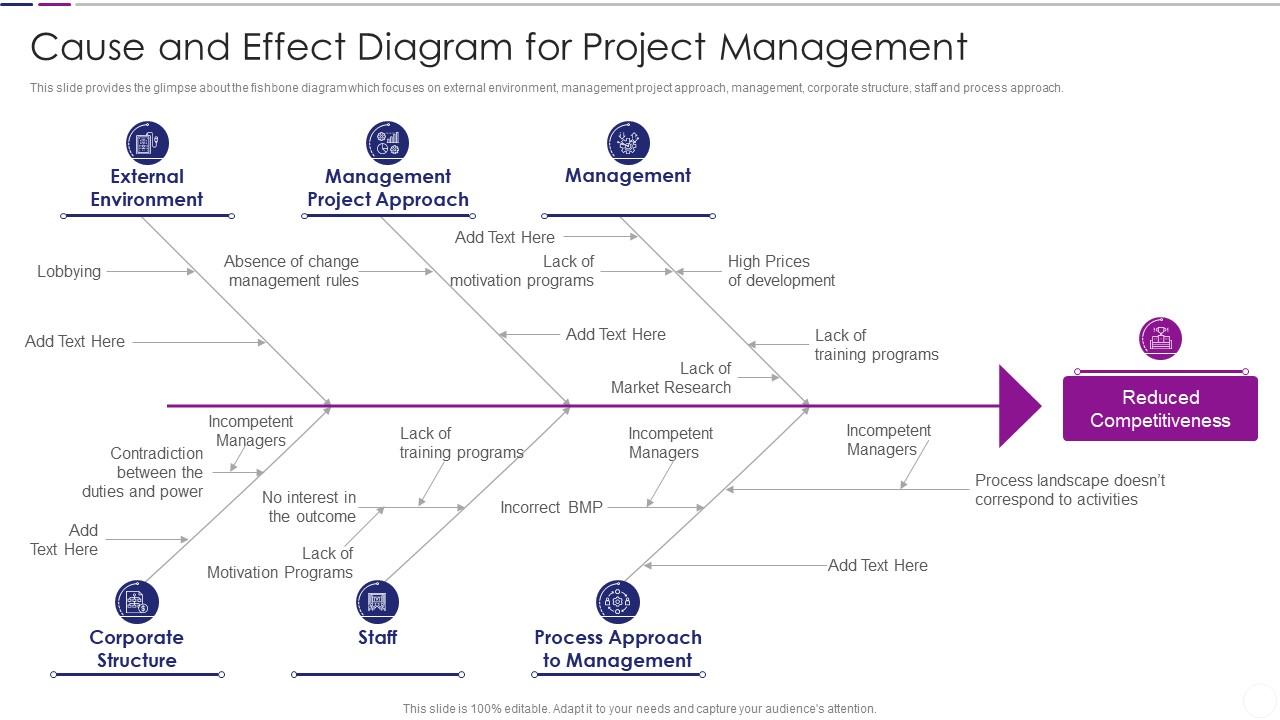
Template 2: Cause and Effect Diagram for Project Management Quantitative Risk Analysis
Cause-and-effect mapping drives sharper risk identification across complex projects. This fishbone diagram captures six critical risk dimensions: external environment, management project approach, corporate structure, process approach, staff, and management. Each branch gives your team a structured lens to trace root causes before they become project failures. Extensive visual framing turns abstract risk factors into clear, actionable discussion points. You can build compelling qualitative risk analysis presentations with precise causal clarity and structured stakeholder alignment. Transform your risk identification presentations today. Download this dynamic template now and unlock deeper project risk insight.
Download this PowerPoint Template
Template 3: Risk Management Review of Project
Structured risk oversight starts with a clear, repeatable review process. This five-stage framework walks through risk analysis, risk evaluation, and risk treatment in a single cohesive flow. Each stage connects logically, giving stakeholders a complete picture of your risk management process. Polished design builds immediate credibility when presenting to leadership or project boards. You can deliver thorough risk management plan reviews with professional visual clarity and structured stage progression. Transform your risk review presentations today. Download this dynamic template now and unlock systematic project risk control.

Download this PowerPoint Template
Template 4: Bow Tie Technique for Project Risk Analysis Project
The bow tie method gives risk managers a direct visual link between threats and consequences. This PPT slide is built for practitioners who need to communicate both prevention and recovery controls in one frame. Whether you're presenting a risk mitigation plan to a project board or walking a team through contingency planning, this deck makes the logic visible. It covers threats, prevention barriers, the risk event, recovery actions, and downstream consequences cleanly. The template is 100% editable and customizable.

Download this PowerPoint Template
Template 5: Fundamentals of Risk Analysis in Project Management PPT Structure
A complete foundation for risk analysis project management belongs in every project leader's toolkit. This full-deck presentation covers the core fundamentals — from risk identification techniques to probability assessment and response frameworks. Structured layouts guide your audience through each concept without losing momentum. Compelling visual hierarchy ensures complex risk management methodology lands clearly with any audience. You can build authoritative project risk management framework presentations with precise structure and consistent professional quality. Transform your risk analysis fundamentals presentations today. Download this dynamic template now and unlock project risk mastery.
[product_image id=1490659]
Template 6: Quantitative Risk Analysis in Project Management PPT Summary
Quantitative risk analysis is where numbers meet decisions, and clarity matters most. This PPT preset is built for project managers and analysts who need to present probability-weighted risk data to leadership teams. It's the kind of deck that works equally well for a Monte Carlo simulation walkthrough or a risk probability and impact summary. The structure keeps complex data readable without oversimplifying the findings. The template is 100% editable and customizable.
[product_image id=1812012]
Template 7: Risk Analysis for Project Management PPT Information
Risk data that can't be communicated clearly doesn't drive decisions. This PPT template is built for project leads who need a polished, structured deck to present risk analysis findings across stakeholder groups. It works well for IT project risk management reviews or cross-functional risk reporting sessions where the audience varies in technical depth. So yeah — the slide does the heavy lifting on layout, leaving you to focus on the analysis itself. The template is 100% editable and customizable.
[product_image id=1526712]
Template 8: Project Risk Management Best Practices
Good risk management practice is mostly about habits, not tools. This PPT preset covers four core best practices: involving team members in plan development, conducting both qualitative and quantitative analysis, assigning risk owners, and running continuous reviews. It's the kind of project risk management reference slide that belongs in any onboarding or team alignment session. For context, the risk owner accountability piece alone tends to shift how teams handle escalation. The template is 100% editable and customizable.

Download this PowerPoint Template
Template 9: Quantitative Risk Analysis for Cost and Schedule PPT Outline
Cost and schedule risks are where most projects feel real pressure. This PPT slide is built for project managers who need to present quantitative risk analysis across both dimensions in a single, coherent frame. It suits senior stakeholder reviews where budget exposure and timeline variance need to be shown together — not separately. The layout keeps financial and scheduling risk data readable without requiring the audience to cross-reference slides. The template is 100% editable and customizable.
[product_image id=1812011]
Template 10: Risk Analysis for New Product Development PPT
New product launches carry a distinct risk profile — technical, commercial, and operational risks often surface at the same time. This PPT deck is built for product managers and project leads who need to present a structured risk assessment for a development initiative. Whether the review is at gate approval or mid-project, this slide organises risks by category so decision-makers can respond, not just react. The template is 100% editable and customizable.
[product_image id=1526711]
Template 11: Risk Evaluation in Software Engineering Project Management
Software engineering projects carry risk patterns that general frameworks often miss. This deck captures the specific risk categories—technical debt, integration failures, scope creep—in formats built for engineering and IT project risk management discussions. Striking visual design ensures your risk evaluation findings hold attention through complex review cycles. Structured layouts guide stakeholders from risk identification through treatment without losing the thread. You can deliver sharp software project risk assessments with clear visual hierarchy and precise analytical framing. Transform your risk evaluation presentations today. Download this dynamic template now and unlock stronger engineering project control.
[product_image id=1650305]
Template 12: Bowtie Technique for Project Risk Analysis Strategies
The bow tie technique is one of the cleaner ways to show both sides of a risk event — what stops it happening and what limits damage if it does. This PowerPoint slide is built for project managers who need to address risk communication gaps, particularly around project management software failures or component-level risks. It's structured around threats, prevention, recovery, and consequences — four dimensions that a project risk assessment typically needs to cover. The template is 100% editable and customizable.

Download this PowerPoint Template
Template 13: Risk Assessment Techniques for Determining Project Viability
Deciding whether a project is worth doing requires more than instinct. This PPT deck is built for analysts and project sponsors who need to present risk assessment techniques in the context of project viability decisions. It suits pre-approval reviews where the audience needs to weigh risk appetite and tolerance against expected outcomes before committing resources. The layout moves from identification through analysis to a clear viability judgement. The template is 100% editable and customizable.
[product_image id=1677569]
Template 14: Quantitative Data Collection Tools and Techniques PPT Presentation
Reliable risk data starts with reliable data collection. This deck surfaces the quantitative tools and techniques used to gather project risk inputs — from structured interviews to statistical sampling methods. Clean visual design keeps complex methodological content approachable for mixed audiences. Structured layouts guide stakeholders from collection method to analytical output without unnecessary detours. You can build authoritative quantitative risk analysis presentations with precise tool framing and consistent methodological clarity. Transform your data collection presentations today. Download this dynamic template now and unlock sharper project risk intelligence.
[product_image id=1794779]
Template 15: Risk Categories Framework Identification Analysis and Mitigation Steps
Risk categories matter because not all risks respond to the same controls. This PPT slide is built for risk managers who need to walk a project team or steering committee through a full identification-to-mitigation arc across distinct risk types. It works well in a risk dashboard conversation where category-level visibility drives ownership decisions. For context, a clear risk breakdown structure at the front end saves significant rework later. The template is 100% editable and customizable.
[product_image id=1591633]
Template 16: Managing Project Risks Strategies for Success PPT Outline
Project risk mitigation without clear strategy leads to reactive firefighting. This complete deck delivers structured, stage-by-stage frameworks for identifying, assessing, and responding to project risks throughout the project lifecycle. Bold visual design ensures your risk response planning arguments land with authority and precision. Flexible layouts adapt your risk mitigation strategies messaging across industries and project types without losing coherence. You can present comprehensive project risk management plans with professional clarity and compelling stakeholder-ready visuals. Transform your risk management presentations today. Download this dynamic template now and unlock project success.
[product_image id=1664722]
Template 17: Managing Risks through Effective Project Charters PPT Outline
Project charters are often the first place risk gets defined — or ignored. This PPT template is built for project managers who need to show how upfront charter clarity reduces downstream risk exposure. It's a natural fit for project kick-off presentations or governance reviews where risk appetite is still being set. The deck connects charter elements to specific risk outcomes, making the case without overstating it. The template is 100% editable and customizable.
[product_image id=1635805]
Template 18: Managing Project Risks and Resources Effectively PPT Structure
Resource constraints and project risks don't exist in separate conversations. This PowerPoint slide is built for project leads who need to present risk and resource management together — not as parallel tracks, but as one integrated view. It suits programme-level reviews where the audience needs to see how risk monitoring and control decisions affect team capacity and vice versa. The layout keeps both dimensions visible without crowding either. The template is 100% editable and customizable.
[product_image id=1483764]
Template 19: Managing Risks in Project Estimation PPT Information
Estimation risk is real, and it compounds. This PPT preset is built for project managers who need to surface the gap between planned and likely outcomes during project estimation phases. Whether the review covers cost estimation, timeline assumptions, or scope creep risk, this deck presents the risk exposure clearly to decision-makers. It's a practical fit for risk analysis project management conversations where estimation assumptions need to be stress-tested. The template is 100% editable and customizable.
[product_image id=1487942]
Template 20: Risk Mitigation and Management Plan Bow Tie Technique
Eight-stage bow tie analysis gives project risk mitigation the depth it often lacks. This template maps threats like low performance, lack of technology, and team productivity issues through prevention and recovery controls to downstream consequences. Precise visual staging ensures every risk pathway is traceable from cause to outcome. Structured eight-layer framing builds a compelling risk mitigation narrative for leadership and project boards. You can present comprehensive bow tie risk mitigation plans with sharp causal logic and complete stakeholder-ready clarity. Transform your risk mitigation presentations today. Download this dynamic template now and unlock airtight project risk control.

Download this PowerPoint Template
Elevate Your Risk Analysis Project Management with SlideTeam
SlideTeam's PowerPoint templates are the best in the industry for risk analysis project management. These content-ready slides give project managers a professional structure for everything from qualitative risk analysis to full risk response planning — without building from scratch. Use these PowerPoint slides to present risk findings with authority and drive faster, better-informed decisions. Deploy these ready-made frameworks to keep your projects on track and your stakeholders aligned.
FAQs on Risk Analysis Project Management
What are the most effective frameworks for conducting risk analysis in large-scale project management?
The most widely used frameworks are ISO 31000, PMI's PMBOK risk management process, and PRINCE2. Each provides a structured path from risk identification through monitoring. For large-scale projects, combine a risk breakdown structure with a probability and impact matrix. Assign risk owners early. Review the register at every major milestone, not just at the start.
How does qualitative risk analysis differ from quantitative risk analysis in project planning?
Qualitative risk analysis ranks risks by likelihood and impact using judgment — no numbers required. Quantitative risk analysis applies numerical data: probabilities, cost estimates, Monte Carlo simulations. Qualitative is faster and works well for prioritisation. Quantitative is more precise and suits high-stakes decisions where budget or schedule variance needs to be measured, not just described.
What role does a risk register play in ongoing project management decisions?
A risk register is the central record of identified risks, their owners, status, and agreed responses. Project managers use it to track whether mitigation actions are happening and whether risk levels are changing. Without it, risk decisions become informal and inconsistent. Update it regularly — a stale register is as dangerous as no register at all.
How can project managers prioritize risks when resources for mitigation are limited?
Score each risk on probability and impact. Focus mitigation resources on high-probability, high-impact risks first. Use the risk matrix to draw a clear cut-off line. Accept low-scoring risks explicitly — don't ignore them silently. Assign one owner per risk so accountability doesn't diffuse across the team.
What is the difference between risk tolerance and risk appetite in a project management context?
Risk appetite is how much risk an organisation is willing to accept to achieve its goals. Risk tolerance is the acceptable variance around that appetite in practice. Appetite is a policy decision made before the project starts. Tolerance is an operational boundary applied during execution. Both need to be defined explicitly — otherwise every threshold debate restarts from scratch.
How do Monte Carlo simulations enhance quantitative risk analysis for complex projects?
Monte Carlo simulation runs thousands of project scenarios using probability distributions for cost and schedule inputs. It produces a range of likely outcomes rather than a single estimate. Project managers use it to show the probability of hitting budget or deadline targets. It's most useful when input data is uncertain and stakeholders need to understand exposure, not just a point estimate.
What are the common cognitive biases that undermine effective risk identification in project teams?
The most common are optimism bias (underestimating the likelihood of bad outcomes), groupthink (teams converging on the same risk list without challenge), and availability bias (overweighting recent incidents). Counter these by using structured risk identification techniques, bringing in outside reviewers, and separating the identification session from the assessment session.
How should project managers communicate risk findings to non-technical stakeholders?
Translate risk findings into business language: cost exposure, schedule impact, and decision required. Avoid technical scoring terms without explanation. Use a simple visual — a risk matrix or a summary table — rather than a full register. Lead with the top three risks and what action is needed. Non-technical stakeholders need to know what to decide, not how the analysis was done.