

 0 Comment
 Customer Reviews

The deck's been shared. The incident report's filed. Now someone has to stand in front of the operations team and explain what happens next.
Not what happened. What happens next.
That's the part service businesses get wrong. The crisis hits—a flood, a server outage, a sudden labor walkout—and everyone knows something must be done. The plan, though. The actual documented plan of what role does what, in what order, with what backup. That's usually somewhere between "mostly finished" and "we talked about it last quarter."
Service companies aren't factories. There's no production line to restart. The product is the interaction—the call answered, the room cleaned, the transaction processed, the guest checked in. When that stops, the damage isn't just operational. It's relational. Customers don't wait. They leave. And in service businesses, once trust breaks, it doesn't come back quietly.
That's what makes business continuity management uniquely uncomfortable for service operators. You can't just restart a machine. You're restarting confidence. And confidence requires communication, clarity, visible structure—none of which exist in a blank slide.
Service industry disaster recovery plans fail not because companies don't care, but because the document that's supposed to guide everyone in a crisis looks like something assembled in a panic. Which it often was. Vague language, missing escalation paths, no clear ownership. Someone built it once, it got filed, and nobody touched it again until the fire drill that wasn't actually a drill.
The templates exist because this problem is universal. Every service company, from a regional hotel chain to a professional services firm to a janitorial franchise, eventually faces the same gap: they know what resilience should look like, but not how to show it to the people who need to act.
SlideTeam's service industry business continuity plan templates handle the structural part—the part that's hardest to get right under pressure. Pre-designed frameworks that organize your operational resilience thinking before the incident, not during it.
Here's what's available.
Template 1: Business Continuity Plan for Service Industry PPT Presentation
Commanding attention from the first slide, this deck delivers structured service industry business continuity planning with clarity. A clean, innovative layout lets you frame every recovery scenario with precision. Visual balance between simplicity and detail keeps stakeholders focused on what matters most. Tailor each section to reflect your organization's specific crisis protocols and risk priorities. The deck anchors boardroom discussions on operational resilience for service businesses with professional authority. You'll present contingency plans, escalation paths, and recovery timelines without scrambling for structure. Transform your business continuity presentations with a framework that works when the stakes are highest. Download this dynamic template now and give your team the clarity they need to act fast.
[product_image id=1464512]
Template 2: Crafting a Tailored Business Continuity Plan for Your Industry PPT Outline
Sound business continuity management requires a plan that fits the organization, not a generic checklist. This PPT preset is built for practitioners who need to craft industry-specific recovery frameworks. A consultant walking leadership through a tailored continuity planning process reaches for this deck—it brings coherence to complex, multi-layered scenarios. The structure guides audiences from risk identification to response protocols without losing the thread. The template is 100% editable and customizable.
[product_image id=1453655]
Template 3: Service Continuity Aligning Business Continuity Plans PPT Summary
Aligning continuity efforts across business units is one of the harder problems in service operations risk management. This deck elevates that conversation by giving teams a shared visual language for continuity planning. Color-coded layouts deliver instant clarity on interdependencies, recovery priorities, and service-level commitments. Built-in flexibility lets you map multiple service lines against a single coherent continuity framework. Use this PowerPoint template to present business interruption recovery plans that align leadership, IT, and operations in one room. Transform your service continuity presentations with a structure that removes ambiguity. Download this dynamic template now and unify your continuity planning across every function.
[product_image id=1689494]
Template 4: Intermittent Reinforcement in Service Industry Business Models PPT Outline
Customer behavior in service businesses is rarely linear, and neither are the disruptions that affect it. This PPT template is useful for practitioners presenting behavioral dynamics within service industry business models. A strategy or operations lead exploring intermittent reinforcement patterns—how inconsistent service creates loyalty or attrition—reaches for a deck like this. It's a credible visual framework for discussions on service design, customer retention, and risk in high-variability environments. The template is 100% editable and customizable.
[product_image id=1403787]
Template 5: Service Industry Competitive Analysis Overview PPT Guidelines
Understanding where your service business stands against competitors is foundational to any service company risk assessment. This PPT preset gives analysts and leaders a structured way to map competitive positioning with visual impact. Whether it's a market-entry review or a quarterly strategy briefing, the deck holds complex data clearly. Real business scenarios—pricing gaps, service differentiation, market share movements—land with more weight when the structure is tight. The template is 100% editable and customizable.
[product_image id=1852016]
Template 6: Key Aspects of Business Continuity Planning Process
Most business continuity planning stalls at the team-formation stage because nobody has mapped the full process visually. This slide makes that six-stage process clear: from forming the crisis management team to identifying critical resources. Operations leads and risk officers use this PPT to walk executives through the planning sequence without lengthy documentation. It's a practical anchor for any service industry business continuity plan kickoff. The template is 100% editable and customizable.

Download this PowerPoint Template
Template 7: Key Components of Service Continuity Management Framework PPT Graphics
Service continuity management frameworks need more than good intentions—they need visible structure that teams can actually follow. This PPT preset maps the key components of a continuity management system in one coherent visual. IT managers, risk leads, and operations directors reach for this deck when presenting governance layers, recovery tiers, and service dependencies. For any IT business continuity strategy briefing, the framework holds up under scrutiny. The template is 100% editable and customizable.
[product_image id=1668824]
Template 8: Service Continuity Planning PPT Information
Getting a service continuity plan onto paper is one thing. Presenting it persuasively to stakeholders is another problem entirely. This deck closes that gap with layouts designed to carry planning detail without overwhelming the audience. Clear visual organization lets you walk through recovery phases, resource allocation, and communication protocols in sequence. Each section empowers teams to internalize and act on the plan rather than just file it. The deck drives confident presentations for operational resilience reviews across any service sector. Transform your service continuity planning presentations today. Download this dynamic template now and give your response planning the structure it deserves.
[product_image id=1504716]
Template 9: Business Continuity Planning Essentials PPT Demonstration
Getting the essentials of business continuity planning in front of decision-makers requires more than a checklist. This deck captures planning fundamentals—risk identification, critical process mapping, recovery sequencing—in a visually engaging framework. Every slide is designed to hold complex continuity logic without losing the audience. Customizable layouts let you adapt the structure to your specific service environment and risk profile. Use this PowerPoint template to anchor business continuity planning best practices discussions across HR, IT, and operations. Transform your planning presentations with a framework built for service business resilience. Download this dynamic template now and make your continuity essentials impossible to overlook.
[product_image id=1836830]
Template 10: Business Continuity Planning Framework PPT Guidelines
A continuity planning framework without clear visual logic is just a document. This PPT template turns the planning architecture into something a leadership team can actually navigate. Risk managers and continuity planners presenting workforce continuity planning or recovery sequencing find that the framework's structure does the persuasion work. Whether it's a boardroom briefing or a client risk review, the deck holds together. The template is 100% editable and customizable.
[product_image id=1836831]
Template 11: Framework to Develop Business Operations Continuity Plan
Building a business operations continuity plan that teams will actually use starts with a clear, phased framework. This PPT preset walks practitioners through the full build: identifying operational workflows, running a business impact analysis, and documenting recovery paths. Operations leads and continuity planners use this deck when moving from planning theory to documented, executable recovery steps. For any service operations backup plan discussion, this is the structured starting point. The template is 100% editable and customizable.
[product_image id=1150356]
Template 12: Roadmap to Develop Business Operations Continuity Plan
Continuity planning without a sequenced roadmap tends to collapse under pressure. This slide maps the full development path—risk assessment, business impact analysis, continuity plan testing, and communication planning—in a four-stage visual. Program leads and risk officers reach for this PPT when presenting the planning timeline to boards or steering committees. It makes the process legible without oversimplifying the dependencies. The template is 100% editable and customizable.
[product_image id=1150369]
Template 13: Possible Exit Strategies for Cleaning Service Industry Janitorial Service Business
Exit planning for cleaning service businesses requires communicating complex financial events simply. This PowerPoint slide maps five exit pathways—IPOs, mergers, acquisitions, private offerings, and more—in a format that investors and business owners can follow. A founder or advisor presenting liquidation options to stakeholders reaches for a deck like this. It brings structure to high-stakes conversations where clarity directly affects outcome. The template is 100% editable and customizable.
[product_image id=1105715]
Template 14: Cleaning Services Business Plan Possible Exit Strategies for Cleaning Service Industry
Sell-offs, mergers, and IPOs all look cleaner on paper than they are in a boardroom conversation. This slide brings discipline to those discussions for cleaning service businesses. It captures five exit routes—including venture capital and acquisitions—alongside the conditions that trigger each. Business owners and advisors presenting exit options to investors or boards reach for this structured PPT to keep the conversation grounded. The template is 100% editable and customizable.
[product_image id=1059521]
Template 15: Addressing Major Challenges Catered by Cleaning Service Industry Janitorial Service Business
Four major challenges consistently erode cleaning service businesses: labor shortages, competitive pressure, rising costs, and safety liability. This deck names each one directly and gives presenters a structured frame for addressing them with stakeholders. Visual clarity across four stages ensures the audience tracks both the problem and the response without losing focus. Operations leaders and pitch teams use this template to anchor planning and investor conversations. Drive honest discussions about cleaning industry risk by deploying a slide that doesn't soften the challenge. Download this dynamic template now and walk into your next presentation ready to address the hard questions.
[product_image id=1105689]
Template 16: Key Market Trends Shaping Cleaning Service Industry Janitorial Service Business
Market trends in the cleaning service sector—sustainability demands, post-pandemic protocols, cost-saving pressures—are moving faster than most business plans account for. This PPT preset gives market analysts and business developers a five-stage framework for presenting trend impact and competitive response. A GM or sales lead briefing ownership on how the company stays ahead of competitors reaches for this deck. It turns trend data into a conversation with direction. The template is 100% editable and customizable.
[product_image id=1105710]
Template 17: Auto Repair Industry Market Gap Car Service Center Business
Market gaps in the auto repair industry are real, and communicating them clearly is what separates funded ventures from stalled pitches. This deck maps the gap between current offerings and unmet customer needs across warranty, customer service, and specialized repair. Founders and analysts use it to show stakeholders exactly where the opportunity sits and why it hasn't been captured. Strong visual structure ensures the problem-solution narrative lands without requiring the audience to work for it. Transform your auto repair market gap presentations with a framework built for investor clarity. Download this dynamic template now and make your service solution impossible to ignore.
[product_image id=1145457]
Template 18: Global Cleaning Service Industry Outlook Janitorial Service Business
Global cleaning service industry data—market size in 2021, the 2029 forecast, and CAGR trajectory—is only useful when it's presented with context. This PPT preset gives strategists and business developers the visual structure to connect macro market trends to company-level decisions. An investor brief or market entry presentation gains credibility when the numbers have a clean framework around them. The deck also covers the global cleaning products market outlook alongside service industry data. The template is 100% editable and customizable.
[product_image id=1105704]
Template 19: Growth Drivers for Cleaning Service Industry Janitorial Service Business
Sustainable cleaning demand, healthcare sector growth, and rising home cleaning uptake are reshaping industry trajectories. This deck captures four major growth drivers for the cleaning service industry and presents them in a format stakeholders can act on. Business owners and pitch teams use it to build confidence in market timing and organizational direction. Each stage connects macro trend to business opportunity without overstating the case. Deploy this template to anchor your growth narrative with data-backed, visual conviction. Download this dynamic template now and give your cleaning industry pitch the momentum it needs.
[product_image id=1105705]
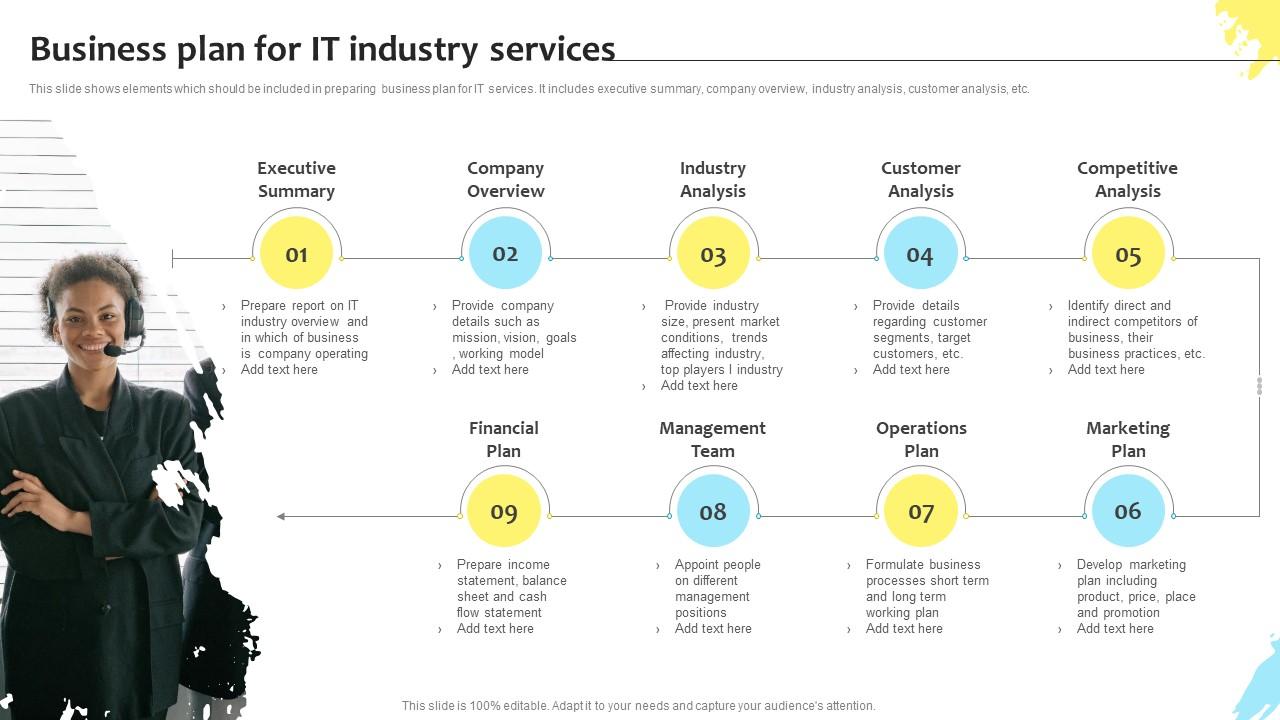
Template 20: Business Plan for IT Industry Services
A business plan for IT industry services must cover a lot of ground—executive summary, industry analysis, customer segmentation, competitive positioning. This deck organizes all nine components into a clean, logical flow that keeps leadership and investors oriented. IT service leads and consultants use this template to present company direction without losing the audience in complexity. Each section creates a clear handoff from context to analysis to action. Transform your IT services business planning presentations with a structure that commands credibility. Download this dynamic template now and give your IT business plan the professional weight it deserves.
Download this PowerPoint Template
Deliver Operational Resilience with SlideTeam
SlideTeam's PowerPoint templates are the best in the industry for service industry business continuity planning. These content-ready slides help you present risk assessments, recovery workflows, and crisis communication plans with professional clarity and speed. Use these ready-made frameworks to structure your contingency planning for service companies before disruption strikes. Deploy these PowerPoint slides to protect operations, retain customer trust, and recover faster when it matters most.
FAQs on Service Industry Business Continuity Plan
What are the critical differences between a business continuity plan for service industries versus manufacturing sectors?
Service industry BCPs center on people, processes, and customer relationships—not equipment or supply chains. Manufacturing plans focus on restarting physical production lines. Service BCPs must address workforce availability, digital access, and customer communication. The recovery sequence is faster-paced: customer-facing operations can't stay down for days. Service companies also face higher reputational risk during disruptions, making crisis communication a core BCP component, not an afterthought.
How should a hotel chain structure its BCP to address simultaneous operational disruptions across multiple locations?
A hotel chain's BCP needs a centralized command structure with location-level response teams. Each property should have its own incident lead, but decisions affecting multiple sites must escalate to one coordination point. Pre-assigned roles, guest communication templates, and cross-property staff redeployment protocols should be documented before any disruption occurs. Test the plan across at least two locations simultaneously once per year to surface coordination gaps.
What role does digital infrastructure redundancy play in maintaining service delivery during a crisis?
Digital infrastructure redundancy is the difference between a temporary outage and a full service failure. For service businesses, that means backup servers, cloud failover, and redundant internet connections at minimum. Remote work continuity also depends on VPN access and cloud-based CRM tools staying operational. Without documented IT disaster recovery protocols tied to specific recovery time objectives, digital redundancy is just hardware—not a plan.
How can service businesses effectively calculate the maximum tolerable downtime for customer-facing operations?
Start by identifying which customer-facing processes generate the most revenue or carry the highest contractual obligation. Then ask: how long before customers defect or penalties trigger? That window is your maximum tolerable downtime. Map it against each process separately—a call center and an online transaction system have different tolerances. Validate those numbers with finance and customer success leads, not just IT.
What staffing contingencies should be built into a BCP for industries with high employee turnover rates?
High-turnover industries need BCPs built around roles, not individuals. Document responsibilities at the position level, not by name. Cross-train at least two people for every critical function. Build a pre-vetted temporary staffing contact into the plan—agreed rates, notice periods, and onboarding steps included. Workforce continuity planning in these environments also requires simplified SOPs so new staff can get operational quickly without extended ramp-up time.
How do service businesses balance cost-effective continuity planning with maintaining premium customer experience standards?
Cost and experience don't have to conflict if you tier your continuity investments. Protect the highest-visibility, highest-revenue customer touchpoints first—those warrant premium backup resources. Lower-tier processes can rely on manual workarounds or delayed recovery. The key is being explicit about what degrades and for how long, so customer expectations can be set proactively. Document service-level commitments per customer segment and build the BCP around those tiers.
What are the most overlooked vulnerabilities in a service industry BCP that organizations typically fail to address?
The most overlooked gaps are vendor dependencies and internal communication failures. Most BCPs map internal processes but ignore what happens when a key third-party supplier—software, logistics, facilities—goes down. Another common miss is the absence of a tested crisis communication plan for businesses; staff often don't know who to contact or what to say. Single points of failure in leadership succession are also routinely underdocumented until they become visible during an actual incident.
How should a financial services firm document and test its recovery time objectives for regulatory compliance purposes?
Recovery time objectives must be formally documented, approved by senior leadership, and tied to specific systems and processes. For regulatory purposes, test them at least annually—and record the results. A tabletop exercise isn't enough; simulate an actual system failure and measure real recovery times against stated objectives. Keep an audit trail of every test, gap identified, and remediation taken. Regulators want evidence of an active, maintained plan—not a filed document.