

 0 Comment
 Customer Reviews

The vendor list keeps growing. Three years ago it was two providers. Now it's seven, maybe eight if you count the cloud platform nobody officially owns.
And somewhere in that tangle, a service goes down. Tickets get filed. Each vendor points to the one before it. Nobody owns the end-to-end. Nobody can.
That's the real problem with multi-vendor IT environments—not the contracts, not the SLAs, not even the governance gaps. It's the space between providers. The space where accountability goes to disappear quietly. Where one vendor's "resolved" becomes another vendor's "not our issue."
IT teams know this feeling well. You've got your ITIL framework, your service desk, your escalation paths. But none of that was designed for a world where eight suppliers share a single service chain. The ITIL framework was built when one organization ran its own stack. It didn't anticipate this.
So the coordination problem compounds. Each new vendor adds capability and adds friction. Integration doesn't happen on its own. Someone has to own it—the processes, the governance, the accountability across every handoff. That's what service integration and management actually is. Not a buzzword. A function.
And it's a hard function to stand up from scratch. Most teams don't start from a blank page—they inherit complexity. Existing contracts, legacy tools, siloed teams that have worked independently for years. Bringing that together into coherent end-to-end service delivery requires structure. Real structure.
That's why the templates exist. Because the thinking has already been done in enough organizations that patterns emerged. Retained models, hybrid models, outsourced integrators—each with its own trade-offs, its own governance needs, its own tooling requirements. Someone built the frameworks. Someone else visualized them.
SlideTeam's service integration and management templates put those frameworks into ready-made slides you can actually use. Pre-designed for the complexity, built for the conversations that matter—board reviews, vendor negotiations, transformation planning sessions.
Here's what's in the collection.
Template 1: IT Service Integration and Management PowerPoint Presentation Slides
Communicating a complex IT environment to a mixed audience is genuinely hard. This PowerPoint presentation covers service integration and management end-to-end, across fifty structured slides. Each slide targets a specific layer of the IT governance conversation — from vendor roles to service performance. Practitioners presenting transformation roadmaps or multi-vendor management reviews will find the depth useful. The deck gives leadership a clear picture without drowning them in technical detail. The template is 100% editable and customizable.
[product_image id=442289]
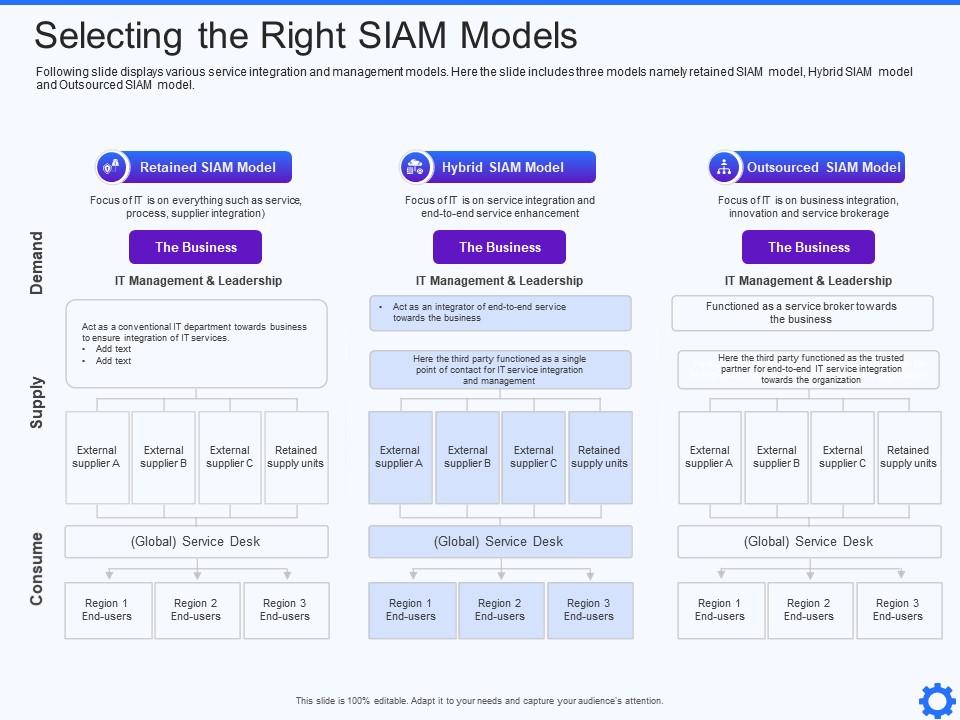
Template 2: Selecting the Right Siam Models IT Service Integration and Management
Choosing the wrong SIAM model early can cost an organization years of rework. This PPT preset lays out all three core options — retained, hybrid, and outsourced — side by side. IT leaders and sourcing heads use it to anchor the model selection conversation with real structure. For context, it maps each model against demand, supply, and business management dimensions. Check out more service integration and management PPT templates with examples and samples for additional framing. The template is 100% editable and customizable.
Download this PowerPoint Template
Template 3: Service Delivery Model Services and Management
Service delivery model design sits at the center of most IT outsourcing decisions. This slide gives practitioners a clean visual framework for presenting how services flow across providers and consumers. It works well in governance reviews where the audience needs to see the model, not just read about it. The template is 100% editable and customizable.

Download this PowerPoint Template
Template 4: Merger and Acquisition Integration Service Model
M&A integration is one of the highest-stakes moments for any IT service model. This PPT template maps the service integration sequence across merger phases — document management, background verification, virtual data services, and benchmarking. Deal teams and IT program managers use it to keep integration workstreams visible and sequenced. It translates a messy process into a five-stage visual that leadership can actually follow. The template is 100% editable and customizable.

Download this PowerPoint Template
Template 5: Service Integration and Management Framework
Connecting IT service management to business outcomes is where most presentations fall short. This PPT slide bridges that gap — covering service strategy, revenue growth, and project management in one coherent view. IT leads and business analysts use it when presenting to stakeholders who care about results, not just process. The template is 100% editable and customizable.

Download this PowerPoint Template
Template 6: Service Integration Management Models Internal External and Hybrid PPT Outline
Internal, external, and hybrid integrator models each carry different risk and control trade-offs. This PPT deck presents all three clearly, giving decision-makers the comparison they need without burying them in text. Sourcing managers and IT governance leads reach for it when the model debate needs a visual anchor. The template is 100% editable and customizable.
[product_image id=1577519]
Template 7: Service Integration and Management Key Concepts PPT Guide
Key concepts in service integration are easy to state and hard to communicate clearly. This PPT preset organizes the foundational ideas — governance, accountability, supplier management — into a visual format that holds a room's attention. It suits onboarding sessions, leadership briefings, and client pitches equally well. The template is 100% editable and customizable.
[product_image id=1820383]
Template 8: Service Integration Management Case Studies PPT Demonstration
Case studies are the fastest way to make a SIAM argument land with skeptical stakeholders. This deck structures real-world service integration scenarios into slides that show outcomes, not just process steps. Program managers and transformation leads use it to move conversations from theory to evidence. The template is 100% editable and customizable.
[product_image id=1771399]
Template 9: Service Integration and Management IT Governance PPT Graphics
Visual clarity drives audience comprehension during complex IT governance presentations. This deck merges structured service integration content with striking design that commands immediate attention. Color-coded visual frameworks deliver instant clarity across multi-vendor management topics. An extensive slide library gives you the visual vocabulary to express every integration scenario. Build compelling IT Service Management presentations that resonate with both technical and executive audiences. Transform your service integration presentations today. Download this dynamic template now and elevate every governance conversation.
[product_image id=1580034]
Template 10: Service Integration Management Best Practices PPT
Best practices without structure are just opinions. This deck captures proven SIAM approaches in slides that make each principle actionable and memorable. The bold visual hierarchy ensures every best practice registers before you've said a word. Intuitive layout gives you professional credibility across service delivery reviews and vendor management sessions. Use it to build governance frameworks that audiences trust. Transform your IT operations best-practice presentations today. Download this dynamic template now and set the standard your teams will follow.
[product_image id=1771398]
Template 11: Service Integration Management Models Explained PPT
Understanding how SIAM models differ is the first step to choosing the right one. This deck breaks down retained, hybrid, and outsourced configurations with precision and visual clarity. Each model comparison drives instant recognition of trade-offs across control, cost, and governance. Purpose-built layouts anchor complex model explanations for IT leadership and procurement audiences. Deliver compelling SIAM Framework model reviews with confidence and authority. Transform your service model presentations today. Download this dynamic template now and make your model selection case unmistakably clear.
[product_image id=1771404]
Template 12: Key Principles of Modern Portfolio Theory and Application PPT Outline
Portfolio theory and IT governance share a common problem — most audiences disengage before the key point lands. This PPT preset structures modern portfolio principles into a clean, presentation-ready format that keeps attention. Finance leads and IT investment managers use it to connect theory to real allocation decisions. It suits boardroom sessions where precision and brevity both matter. The template is 100% editable and customizable.
[product_image id=1574015]
Template 13: Service Integration Management Key Benefits PPT
Selling the value of service integration internally is harder than building the model itself. This PPT deck makes the benefits case visually — showing leadership exactly what a well-run SIAM function delivers. It covers cost, control, service performance, and supplier accountability in one coherent narrative. Transformation leads and IT directors use it when they need budget sign-off or executive buy-in. The template is 100% editable and customizable.
[product_image id=1771403]
Template 14: Ensuring Continuous Process Improvement with PDCA Model in IT PPT
Continuous improvement doesn't happen after a merger without a clear operating model. This slide presents the Plan-Do-Check-Act cycle specifically for post-merger IT service integration. It maps business transformation, service management, and IT service coordination into four defined stages. Program managers use it to keep continuous improvement visible and accountable throughout integration. The template is 100% editable and customizable.

Download this PowerPoint Template
Template 15: Service Integration Management Implementation PPT
Implementation planning is where SIAM initiatives succeed or stall. This deck structures the full implementation journey into clear, presentation-ready slides that keep delivery teams aligned. Visual phase sequencing delivers instant clarity on dependencies and milestones. Intuitive layouts help IT program managers communicate complex rollout plans to mixed audiences. Build confident implementation reviews that move projects forward decisively. Transform your SIAM implementation presentations today. Download this dynamic template now and accelerate your deployment timeline.
[product_image id=1771402]
Template 16: Service Integration Management Framework Overview PPT
Framework overviews set the tone for every governance conversation that follows. This deck presents the SIAM governance framework in a structured, authoritative format. Clean hierarchy drives immediate audience comprehension across all layers of the IT ecosystem. Purpose-built layouts work equally well for internal briefings, vendor kick-offs, and executive reviews. Deliver SIAM framework presentations that establish credibility from the first slide. Transform your governance framework communications today. Download and anchor every conversation.
[product_image id=1771401]
Template 17: Integration Options for Service Management PPT Graphics
Not all integration options fit every IT environment, and stakeholders need to see why. This PPT preset presents the full range of service management integration choices in a structured visual format. IT architects and sourcing leads use it to facilitate decision-making without drowning the room in options. It is grounded enough for technical reviews and clean enough for executive briefings. The template is 100% editable and customizable.
[product_image id=1833775]
Template 18: Service Delivery Management Setting Expectations PPT Structure
Service delivery management conversations often stall because the structure isn't visible. This PPT deck gives practitioners a clear visual scaffold for presenting delivery models, accountability layers, and performance expectations. Operations managers and service desk leaders use it across everything from team briefings to client reviews. The template is 100% editable and customizable.
[product_image id=1577518]
Template 19: Service Integration Management SLA Strategies PPT Sample
SLA design in a SIAM environment is more complex than a bilateral contract. Multiple providers, shared services, and cascading obligations all need to be visible at once. This PPT deck lays out SLA strategies in a format that makes the interdependencies clear. Contract managers and IT governance leads use it to align vendors before disputes arise. The template is 100% editable and customizable.
[product_image id=1771405]
Template 20: Service Integration Management for Teams PPT Complete Deck
Team-level SIAM adoption depends on clarity, not just policy. This deck translates service integration principles into slides that resonate with practitioners doing the day-to-day work. Striking visual design captures team attention and holds it through complex coordination topics. Purpose-built layouts make IT service coordination across teams measurable and accountable. Build presentations that align distributed teams around shared service delivery goals. Transform your team-facing SIAM presentations today. Download this dynamic template now and drive adoption from the ground up.
[product_image id=1771400]
Deliver Integrated IT Services with SlideTeam
SlideTeam's PowerPoint templates are the best in the industry for service integration and management. These content-ready slides give you professional structure for multi-vendor governance, SIAM framework rollouts, and end-to-end service delivery planning — saving hours of design time. Use these ready-made PowerPoint slides to align stakeholders, clarify accountability, and make complex IT ecosystems readable. Deploy these pre-designed templates and turn your next service integration presentation into a decision-driving asset.
FAQs on Service Integration and Management
How does SIAM differ from traditional IT service management frameworks like ITIL?
ITIL is a set of practices for managing IT services within a single organization. SIAM applies on top of ITIL when multiple external providers are involved. The key difference: ITIL focuses on process; SIAM focuses on who coordinates across providers. A service integrator role — absent in ITIL — becomes the accountability layer that stitches vendor outputs into one coherent service. SIAM uses ITIL practices but adds multi-supplier governance.
What are the core responsibilities of a service integrator in a multi-vendor environment?
The service integrator owns end-to-end service performance, even when delivery spans multiple vendors. Core responsibilities include managing provider interfaces, resolving cross-supplier incidents, and enforcing SLA compliance. The integrator also runs governance forums, chairs service reviews, and owns the tooling that connects all suppliers. Think of it as the control tower — it doesn't fly the planes, but nothing lands without it.
How can organizations determine whether to use an internal, external, or hybrid service integrator model?
Three factors drive the decision: internal capability, conflict of interest risk, and control requirements. If an organization has strong IT governance maturity, an internal model is viable. Where capability is low or objectivity is at risk, an external integrator removes bias. Hybrid models work when the organization wants partial control but needs specialist support. Start with an honest assessment of what your IT team can credibly own.
What governance structures are most effective for managing multiple service providers under SIAM?
Effective governance under SIAM requires three layers: strategic (board-level direction), tactical (service review forums), and operational (daily coordination). Each layer needs defined roles, meeting cadences, and escalation paths. A governance framework that only operates at the strategic level fails at execution. Vendor Management Office structures paired with clear RACI models tend to perform best in complex multi-supplier environments.
How does SIAM address the challenge of end-to-end accountability when services span multiple suppliers?
SIAM assigns end-to-end accountability to the service integrator — not to any individual supplier. This means the integrator owns the customer experience regardless of which vendor caused a failure. Contractually, this requires flow-down obligations in supplier agreements. Operationally, it requires integrated tooling so incidents can be tracked across the full supply chain. Accountability without visibility is unenforceable.
What metrics and KPIs should organizations track to measure SIAM effectiveness?
Track four categories: service performance (availability, incident resolution time), supplier compliance (SLA adherence per vendor), integration quality (cross-supplier incident handoff speed), and governance health (forum attendance, action closure rates). KPIs should be measurable at both the individual supplier level and the aggregated end-to-end level. If you can only measure one supplier at a time, you don't have SIAM — you have vendor management.
How does contract design influence the success of a SIAM implementation?
Contracts in SIAM must include cross-supplier obligations, not just bilateral terms. Each supplier agreement needs provisions for collaboration, data sharing, and joint incident resolution. Poorly designed contracts create gaps where no vendor is responsible for cross-boundary failures. The service integrator contract is especially critical — it must define authority clearly, including the right to direct other suppliers during major incidents.
What cultural and organizational changes are required before adopting a SIAM model?
SIAM shifts accountability from individual teams to a shared model — most organizations underestimate the culture change this requires. IT teams must accept that a service integrator now owns cross-supplier decisions. Vendor relationship managers must shift from protecting their supplier to managing outcomes. Leadership must commit to governance forums as real decision-making bodies, not reporting sessions. Without behavioral change at all three levels, the model stays on paper.