





 0 Comment
 Customer Reviews

The deck's done. Three days of work, two rounds of feedback, one very long call about revenue streams.
And now someone in the room asks: "But what's the actual business model?"
Not the pitch. Not the vision. The model. How money comes in, where it goes, what the platform actually charges for—and who's paying. There's a particular silence that follows that question when the answer isn't clean. When the slides show user growth but not monetization logic. When the content plan exists but the revenue architecture doesn't.
Social media business models are genuinely strange. The user pays nothing. The product is attention. The customer is the advertiser, sometimes the enterprise, occasionally the creator. And the whole thing runs on data nobody technically handed over—but everyone technically agreed to. Explaining that to a board, or a client, or an investor, without sounding like you're improvising—that's the hard part.
It's not that people don't understand the model. Most practitioners do, roughly. But "roughly" doesn't hold up in a room. You need structure. You need to show the value proposition, the revenue streams, the cost architecture, the channel logic—all of it connected, not floating. And that's before anyone asks about freemium tiers, influencer marketing ROI, or social commerce revenue.
So the templates exist. Not because the concept is obscure. They exist because building the visual architecture from scratch—every time, for every context—is the thing nobody has time for. The model's understood. The slide isn't built yet.
SlideTeam's social media business model templates handle exactly this gap. Pre-designed frameworks covering everything from platform business model canvases to data licensing models to six-month social media growth roadmaps. Ready to use, built for real presentations.
Here's what's in the collection.
Template 1: Social Media Platform Business Model PowerPoint Template Bundles
Financial clarity is what separates a credible pitch from a polished guess. This PowerPoint slide is built for founders and analysts who need to show a complete financial picture of a social media platform. It covers five-year projections, break-even analysis, valuations, and payback period in one structured deck. Use it when your audience needs numbers, not just narrative. The template is 100% editable and customizable.
[product_image id=1231294]
Template 2: Social Media Marketing Company Business Model PPT Information
A social media marketing company needs more than a service list — it needs a model investors and clients can follow. This PPT preset is built for agency principals and consultants presenting their business logic clearly. It covers the core building blocks of a social media marketing business, including revenue and client relationships. Reach for it when a boardroom or client pitch demands structure over slides. The template is 100% editable and customizable.
[product_image id=1404318]
Template 3: Social Media Platform Business Model and Revenue Discussions PPT Sample
Commanding audience attention starts with a slide that makes the platform's logic immediately visible. This template delivers striking clarity for social media platform business model presentations. Every layout translates complex value chains into visuals your stakeholders can follow without effort. Use it to anchor digital advertising revenue discussions in a structured, compelling framework. Transform your platform strategy presentations today. Download this dynamic template now and unlock your business model communication potential.
[product_image id=1416628]
Template 4: Social Media Data Licensing Company Business Model
Data licensing is one of the least-explained revenue streams in social media—and one of the most scrutinized. This template gives data-driven marketing teams and executives a sharp, professional framework to present data licensing business models with clarity. Every visual element is built to make complex licensing structures and revenue logic readable at a glance. Deliver boardroom-ready presentations on social media revenue streams without starting from a blank slide. Transform your data licensing narrative today. Download this dynamic template now and unlock persuasive, structured storytelling.
[product_image id=1419456]
Template 5: Employment Focused Social Media Platform Business Model PPT
Employment-focused platforms run on a distinct logic — recruiters pay, job-seekers browse, and the model lives in between. This PPT preset is built for strategists and product leads presenting an employment social media platform business model. It maps the key relationships between talent, employers, and the platform's value proposition cleanly. Use it for investor decks or internal B2B social media strategy reviews. The template is 100% editable and customizable.
[product_image id=1402828]
Template 6: Choosing Right Platforms for Your Social Media Strategy
Platform selection is one of the first decisions in any social media marketing strategy — and one of the hardest to justify clearly. This PPT preset helps marketing leads and brand managers build a structured case for why specific platforms fit their audience. It walks through the decision logic visually, making channel trade-offs readable in any room. Reach for it when the question isn't what to post, but where to post it. The template is 100% editable and customizable.
[product_image id=1702748]
Template 7: Social Networking Site Business Model PPT Slides
A social networking site needs a business model that's as clear to stakeholders as its feed is to users. This PPT preset is built for founders, product managers, and strategists presenting social networking platform economics. It frames the model's key components — revenue, relationships, and channels — in a clean, credible structure. Use it when online community engagement metrics need to connect to a real monetization story. The template is 100% editable and customizable.
[product_image id=1406551]
Template 8: Social Networking Platform Business Model Story PPT Sample
Presenting a social networking platform model means showing how the network creates and captures value — not just how it grows. This PPT template is built for product strategists and investor relations teams who need that story told visually. It maps platform growth logic and revenue architecture in a format that holds up to scrutiny. Explore more social media business model templates to find the right fit for your deck. The template is 100% editable and customizable.
[product_image id=1411581]
Template 9: Business Communication Model with Social Media Showing Five Points
Mapping how a business communicates across social channels is harder to visualize than most teams expect. This five-stage communication model template captures the full flow—from message origin to audience response—in one structured visual. Each stage connects cleanly, giving stakeholders an immediate read on the communication architecture. Elevate your brand awareness campaign planning with a framework that makes the process visible. Transform your business communication presentations today. Download this dynamic template now and unlock structured clarity for every stakeholder conversation.

Download this PowerPoint Template
Template 10: Four Pros of Social Media Marketing PPT Outline
Social media marketing has real, defensible advantages — but they're easy to understate in a generic slide. This PPT template is designed for marketing leads who need to make the case for social investment clearly and quickly. It frames the four core benefits in a format that lands in a boardroom without needing explanation. So yeah, reach for it when the question is why social, not just how. The template is 100% editable and customizable.
[product_image id=1840222]
Template 11: Impact of Social Media on Business PPT Presentation
Business leaders want to know what social media actually changes — not in theory, but for operations, revenue, and customer reach. This PPT preset is built for strategists and consultants presenting the measurable impact of social media on a business. It connects social media engagement metrics to real business outcomes in a clean, credible visual format. Use it when the audience needs evidence, not enthusiasm. The template is 100% editable and customizable.
[product_image id=1403405]
Template 12: Social Media Marketing Strategies for Business Growth PPT Structure
Connecting social media marketing activity to measurable business growth demands a framework, not just a content calendar. This template delivers a structured visual for presenting social media growth strategy across channels and time horizons. Every slide element is built to make your approach readable—from content planning to audience targeting to ROI reporting. Use it to turn a fragmented marketing plan into a coherent, persuasive presentation. Transform your social media marketing presentations today. Download this dynamic template now and unlock a growth-ready strategic framework.
[product_image id=1593719]
Template 13: Social Media Platform 9-Block Business Model
The nine-block business model canvas captures everything a platform needs to explain about how it operates and earns. This template maps key partners, value propositions, revenue streams, and cost structure in one clear visual framework. Each block connects logically, helping stakeholders trace the platform's entire value-creation logic without confusion. Use it to present social media monetization architecture with precision and authority. Transform your platform model presentations today. Download this dynamic template now and unlock a complete, investor-ready business model visual.

Download this PowerPoint Template
Template 14: 6-Month Social Media Business Strategy Roadmap
A six-month roadmap forces the hard question: what happens, in what order, and by when. This template gives strategists and marketing managers a clean visual timeline for social media business planning. It structures activities across a half-year horizon so stakeholders can track progress, not just intentions. Use it to turn a vague social media platform strategy into a visible, accountable execution plan. Transform your roadmap presentations today. Download this dynamic template now and unlock a structured path from plan to performance.

Download this PowerPoint Template
Template 15: Types of Social Business Models in Organization
Organizational structure shapes how a social media business makes decisions and scales its operations. This PPT template maps three core social business model types — decentralized, centralized, and hub-and-spoke — in a single, clean visual. For context, the distinction matters most when teams are deciding how to govern content, approvals, and platform ownership. Reach for it when the conversation is about how the organization runs its social presence, not just what it posts. The template is 100% editable and customizable.

Download this PowerPoint Template
Template 16: Business Model Social Media Network Investor Funding Elevator Pitch Deck
Investor pitches live or die on how clearly the business model is communicated in the first few slides. This PPT preset is built for founders pitching a social media network to early-stage or growth investors. It covers the full model — partners, activities, value propositions, channels, and revenue streams — in one structured flow. Use it when the audience needs to understand the business, not just believe in it. The template is 100% editable and customizable.
[product_image id=1109330]
Template 17: Online Social Media Strategy for Business Management
A social media strategy without a clear execution map tends to stay on slide decks and off calendars. This template covers six key stages of online social media planning—goals, audience, timing, and more—in a structured visual. Each stage is distinct and actionable, making it easy for teams to assign ownership and track delivery. Use it when the team needs direction, not another brainstorm. Transform your social media management presentations today. Download this dynamic template now and unlock a clear, stage-by-stage execution framework.

Download this PowerPoint Template
Template 18: Business Case Study Summary on Social Media Marketing
Case studies are most useful when they're honest about what went wrong and what actually worked. This PPT preset is built for consultants and marketing leads presenting a social media marketing case study to clients or leadership. It covers approach, challenges, and recommendations in a format designed for credibility, not just coverage. Reach for it when the goal is a clear-eyed review, not a highlight reel. The template is 100% editable and customizable.

Download this PowerPoint Template
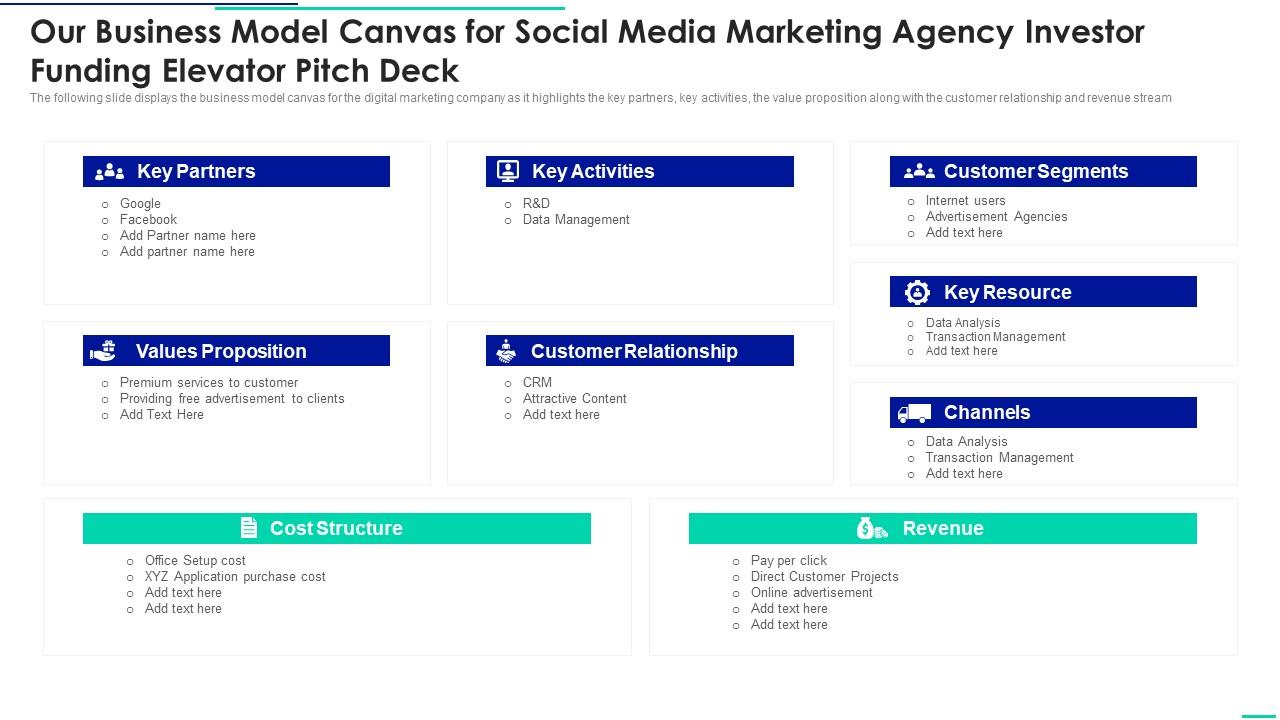
Template 19: Business Model Canvas for Social Media Marketing Agency
A business model canvas for a marketing agency needs to show both the service logic and the commercial structure. This PPT template maps key partners, activities, customer segments, and revenue streams for a social media marketing agency in one visual. It's the slide that belongs at the front of any investor or client engagement deck. Use it when the audience needs to understand how the agency creates and captures value. The template is 100% editable and customizable.
Download this PowerPoint Template
Template 20: Social Enterprise Business Model Canvas
Social enterprises carry a dual mandate—solving a problem and sustaining the organization that solves it. This template maps the social problem, network partners, cost structure, value offerings, and impact channels in one comprehensive canvas. Each element connects to show how the organization creates social and economic value simultaneously. Use it to present a social enterprise model that holds up to stakeholder scrutiny. Transform your social enterprise presentations today. Download this dynamic template now and unlock a clear, impact-driven business model visual.

Download this PowerPoint Template
Win Clients with Social Media Business Model Pitch with SlideTeam
SlideTeam's PowerPoint templates are the best in the industry for social media business model presentations. These content-ready slides cover everything from platform canvases to investor pitch decks, saving hours of build time without sacrificing credibility. Use these PowerPoint slides to present your monetization logic, revenue streams, and platform strategy with professional clarity. Deploy these ready-made templates and turn every stakeholder conversation into a confident, structured win.
FAQs on Social Media Business Model
How do social media platforms monetize user-generated content without direct user charges?
Platforms monetize attention, not content directly. Advertisers pay to reach users; the user's activity becomes targeting data. Sponsored posts, display ads, and promoted content sit between users and free access. User-generated content drives the engagement that makes ad inventory valuable — users build the audience, platforms sell it.
What distinguishes the advertising revenue model of Facebook from that of LinkedIn?
Facebook targets consumer behavior and interest signals, making it ideal for B2C brand campaigns. LinkedIn targets professional attributes — job title, industry, seniority — making it the dominant channel for B2B lead generation. Facebook earns at higher volume and lower CPM; LinkedIn earns at lower volume and significantly higher CPM. The audience data type is the core distinction.
How does the freemium model drive premium subscription conversions on platforms like LinkedIn?
Free access builds the user base; premium features solve specific professional pain points. On LinkedIn, premium tiers offer InMail credits, profile visibility data, and recruiter tools — things power users genuinely need. The conversion trigger is usually a concrete task: a job search, a sales outreach campaign, or a hiring sprint. Free users see the limit; premium users remove it.
What role does data brokering play in sustaining social media business models?
Data brokering sells anonymized or aggregated user data to third parties — advertisers, researchers, and market intelligence firms. It supplements ad revenue and diversifies the revenue base. Regulatory pressure (GDPR, CCPA) has constrained this practice, but it remains active in permissible forms. For platforms, it turns behavioral data into a direct revenue line without touching the user experience.
How do network effects create competitive moats for established social media platforms?
Each new user makes the platform more valuable to existing users — that's the network effect. Advertisers follow users; developers build on large platforms; creators go where the audience is. Competitors face a structural barrier: starting small means low value, which means slow growth. Established platforms compound this advantage every quarter, making user switching costly and entry difficult.
Why do most social media platforms choose advertising over subscription as their primary revenue stream?
Advertising scales without friction — more users means more inventory, with near-zero marginal cost. Subscriptions require users to pay, which limits growth and raises churn risk. Most users tolerate ads far more than they tolerate paywalls. For platforms built on mass reach, advertising revenue grows with the audience; subscriptions cap it.
How does TikTok's algorithm-driven content discovery model differ from traditional social media engagement models?
Traditional platforms surface content from followed accounts — the social graph drives discovery. TikTok's model is interest-graph driven: the algorithm surfaces content based on behavior, not relationships. A new account gets relevant content immediately, removing the cold-start problem. This drives faster engagement and longer session times, which makes ad inventory more valuable.
What are the key metrics that advertisers prioritize when choosing social media platforms for campaigns?
Advertisers prioritize reach, cost per result (CPM or CPC), and audience targeting precision. Social media engagement metrics — click-through rate, video completion rate, and conversion rate — determine campaign efficiency. Brand campaigns weight reach and frequency; performance campaigns weight cost per acquisition. Platform choice follows the match between audience data quality and campaign objective.