




 0 Comment
 Customer Reviews

The deck's been sitting in the shared drive for two weeks. Everyone knows a migration is coming. Nobody's said anything official yet.
That's the gap. Not the technical work—the technical work has a project manager, a timeline, a budget. The gap is everything else. Who tells the floor managers? When? In what order? What happens to the team whose entire workflow changes on a Tuesday?
Change management infrastructure is the answer nobody wants to write down because it sounds like overhead. It sounds like bureaucracy. Like something you add after the real work is done.
But it's not. It's the scaffolding that keeps the real work from collapsing.
Here's what actually goes wrong: the IT team finishes the infrastructure upgrade on schedule, the system goes live, and then six weeks later, half the users are still on workarounds. Not because the technology failed. Because nobody planned for the human part. The change control process existed on paper. The stakeholder communications went out once. There were no follow-ups. No feedback loops. No one owned the adoption problem.
And that's where things stay broken. Quietly. For months.
The organizational resilience question—can we handle the next disruption?—depends entirely on whether you built change management infrastructure the first time. Or improvised it. There's a reason companies that run successful digital transformation programs document what they did. They know they'll need it again.
That's why these templates exist. Not because change is new, but because figuring out how to communicate it, sequence it, and measure it from scratch every single time is how organizations burn out good people.
SlideTeam's pre-designed frameworks tackle this directly—ready-made slides covering everything from stakeholder engagement and change implementation plans to IT service management frameworks and roadmap visuals. They handle the structure so you can focus on the conversation.
Here's what's available.
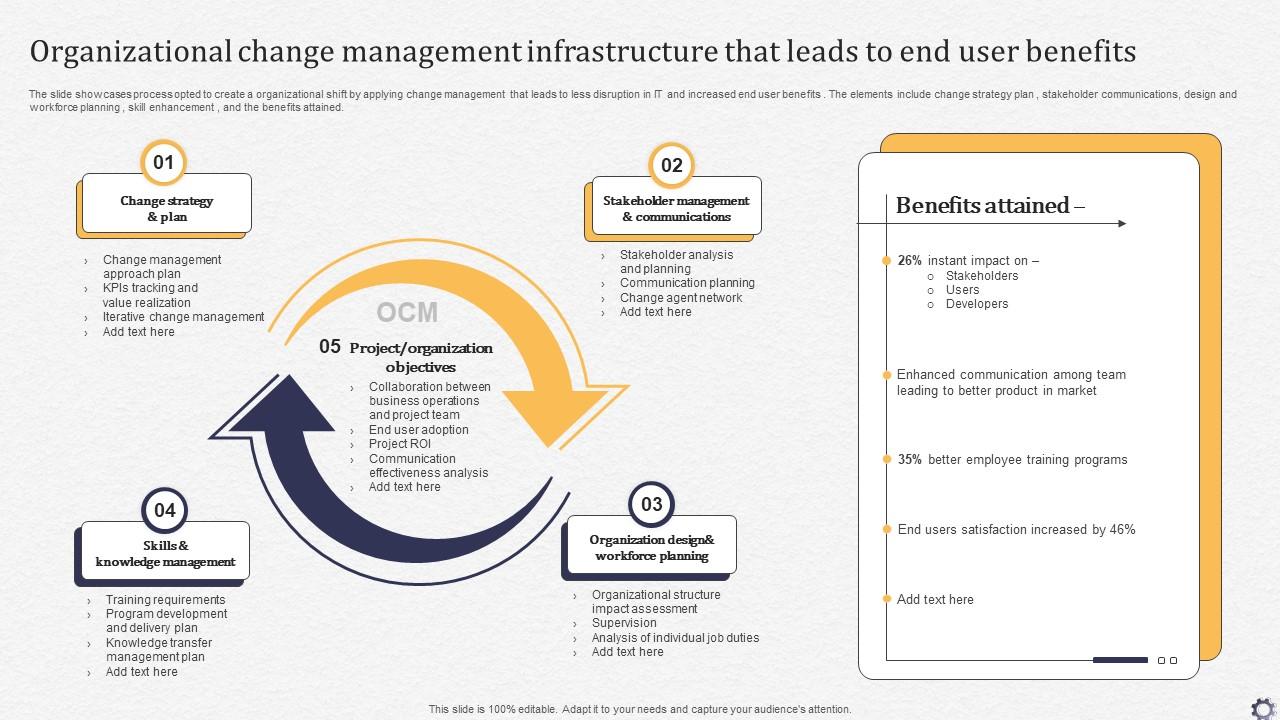
Template 1: Organizational Change Management Infrastructure That Leads to End User Benefits
Structured organizational change starts with a clear visual sequence of every moving part. This template maps the full journey from change strategy planning through stakeholder communications, workforce design, skill enhancement, and end-user benefits. Each stage connects logically, so your audience follows the reasoning—not just the outcome. Knowledge management sits at the center, ensuring nothing critical is lost during transition. Use it to present IT change management programs that reduce disruption while maximizing adoption. For deeper guidance on building these frameworks, explore these leading business change management guidelines. Transform your organizational change presentations today. Download this dynamic template now and unlock a clearer path to measurable end-user benefits.
Download this PowerPoint Template
Template 2: Information Technology Infrastructure Framework with Change Management
Eight interconnected IT management disciplines rarely appear together in one coherent visual—this template delivers exactly that. It maps change management alongside incident management, access management, continuity management, service portfolio management, and financial management in a single structured view. Each element reinforces the others, showing stakeholders how IT infrastructure management functions as an integrated system—not isolated workstreams. Use it to present enterprise change management frameworks that justify investment across departments. Learn how top change management infrastructure templates can sharpen your IT governance story. Transform your IT framework presentations today. Download this dynamic template now and unlock a compelling visual case for integrated service management.

Download this PowerPoint Template
Template 3: Challenges Maintaining Aging Civil Infrastructure Networks PPT Example
Aging civil infrastructure creates real pressure on operations teams and planners alike. This PPT preset lays out the core challenges — deferred maintenance, budget constraints, and network degradation — in a format that makes the problem visible to decision-makers. Infrastructure modernization conversations often stall because the risks aren't communicated clearly; this slide helps fix that. It suits engineers, city planners, and policy teams presenting infrastructure upgrade cases. The template is 100% editable and customizable.
[product_image id=1766230]
Template 4: Technological Change Management Infrastructure Roadmap PPT
A change management roadmap only works if it shows what happens after the planning phase ends. This PowerPoint slide covers assessment, planning, change implementation, and monitoring in a clean sequential structure. Program managers and transformation leads use it to show leadership exactly where the organization is in a change cycle. For teams building a Kotter's change model-aligned plan, this deck maps naturally to those stages. The template is 100% editable and customizable.
[product_image id=1352501]
Template 5: Change Management E-Business Infrastructure
Eight structured phases drive every successful change implementation—this template makes all of them visible at once. It captures how to communicate through phases, establish measurable success criteria, and implement change with organizational clarity. Leaders use it to turn abstract business transformation plans into trackable, presentable commitments. The visual flow ensures audiences grasp sequence and accountability simultaneously. Discover how change management slides support smooth organizational transitions at every stage. Transform your change implementation presentations today. Download this dynamic template now and unlock a sharper framework for driving adoption and measurable results.

Download this PowerPoint Template
Elevate Your Change Management Infrastructure with SlideTeam
SlideTeam's PowerPoint templates are the best in the industry for change management infrastructure planning and execution. These content-ready slides save you hours of design time while delivering professional-quality visuals that communicate complex change control processes with clarity. Use these ready-made frameworks to align stakeholders, sequence implementation, and measure adoption across every phase. Deploy these pre-designed PowerPoint slides to drive organizational resilience and ensure your next transformation lands the way it was planned.
FAQs on Change Management Infrastructure
What are the components that define a robust change management infrastructure in large enterprises?
A solid change management infrastructure in large enterprises rests on four core components. First, a defined change control process that governs how changes are proposed, reviewed, and approved. Second, clear stakeholder communication channels tied to specific change phases. Third, training and skill-building mechanisms for end users. Fourth, a measurement framework tracking adoption, resistance, and outcomes. Without all four working together, even well-funded change programs tend to stall at implementation.
How does change management infrastructure differ between agile and traditional organizational structures?
Traditional structures rely on sequential approval chains—changes are planned, frozen, then executed. Agile change management infrastructure is iterative. Changes are reviewed in shorter cycles, often sprint-by-sprint, with faster feedback loops. The core difference is governance speed: agile organizations make smaller, more frequent change decisions. Traditional organizations make fewer, larger ones. Neither is wrong—the infrastructure simply needs to match the organization's decision-making rhythm and tolerance for mid-course correction.
What role does technology play in modernizing change management infrastructure frameworks?
Technology modernizes change management infrastructure in three direct ways. IT service management platforms like ServiceNow automate change request workflows and approval routing. Analytics tools track adoption rates and flag resistance early. Collaboration software—Teams, Slack—enables real-time change communication without relying on email chains. The key is integration: these tools work when they connect to each other, not when they operate in silos. Technology accelerates the process; people still make the decisions.
How can organizations measure the effectiveness of their change management infrastructure?
Measure three things: adoption rate, resistance rate, and time-to-competency. Adoption rate tells you how many people are using the new process or system. Resistance rate tracks how many are reverting to old behaviors. Time-to-competency measures how long it takes users to perform at pre-change levels. Track these by team, not just organization-wide. Aggregate numbers hide where the real problems are. Review at 30, 60, and 90 days post-implementation.
What are the most common failure points in change management infrastructure and how can they be avoided?
The three most common failure points are: starting communication too late, underestimating training needs, and having no one accountable for adoption after go-live. Late communication creates rumors; early, honest messaging prevents them. Training is often cut when budgets tighten—this is where adoption dies. Assign a change owner beyond the project manager whose job continues after launch. Most failures happen not during implementation, but in the six weeks that follow.
How should change management infrastructure be adapted during mergers and acquisitions?
During mergers and acquisitions, change management infrastructure must account for two different organizational cultures, two sets of processes, and often two legacy IT systems. Start with a change readiness assessment for both entities before any integration begins. Build a joint stakeholder map early—identify who influences adoption on each side. Prioritize communication over speed; rushing integration without clear messaging is the single biggest driver of talent loss during M&A transitions.
What is the relationship between change management infrastructure and organizational resilience?
Change management infrastructure and organizational resilience are directly linked. Organizations that document how they manage change—who decides, who communicates, who trains—recover faster from disruptions. They don't have to rebuild the process every time. Resilience isn't about avoiding change; it's about having a repeatable system for handling it. Companies with mature change management infrastructure adapt to market shifts, technology failures, and restructuring faster than those that improvise each time.
How do communication channels within change management infrastructure impact employee adoption rates?
Communication channel choice directly affects whether employees adopt or resist change. Single-channel communication—one all-staff email—produces the lowest adoption rates. Multi-channel approaches that include manager-led conversations, written updates, and Q&A sessions perform significantly better. The reason is simple: people trust their direct manager more than a corporate announcement. <a href='https://www.slideteam.net/blog/top-20-change-management-communication-templates-with-samples-and-examples'>Structured change management communication templates</a> help teams build that manager-level messaging consistently across the organization.