




 0 Comment
 Customer Reviews

The meeting's over. Someone wrote "PDSA" on the whiteboard and circled it.
Nobody's entirely sure what happens next. There's a change that needs to happen—a process that's broken, a workflow that keeps producing the same bad outcome, a ward that keeps missing the same metric. The problem isn't knowing what's wrong. It's figuring out how to test a fix without burning down everything else in the process.
That's the specific discomfort the Plan Do Study Act model was built for. Not grand transformation. Small tests. Controlled. Reversible. The kind where you can say "that didn't work" and still be standing afterward.
And yet—most teams still get stuck at the whiteboard. Because knowing the four stages isn't the same as knowing how to structure a presentation around them. How to show a stakeholder what the plan actually was. How to display what the study phase found. How to make the "Act" decision look defensible rather than arbitrary.
The gap isn't understanding. It's communication.
That's why these templates exist. Not to explain the PDSA framework—you already know it. But to give you the structure when you're staring at a blank slide wondering how to lay out a quality improvement cycle that people will actually follow. Pre-designed frameworks for exactly that moment.
SlideTeam's PDSA templates handle the part nobody talks about: turning the work you've already done into something a room full of people can read in thirty seconds. Ready-made slides that carry the logic of the Continuous Improvement Model without requiring you to build it from scratch at 10pm before a morning review.
Here's what's available.
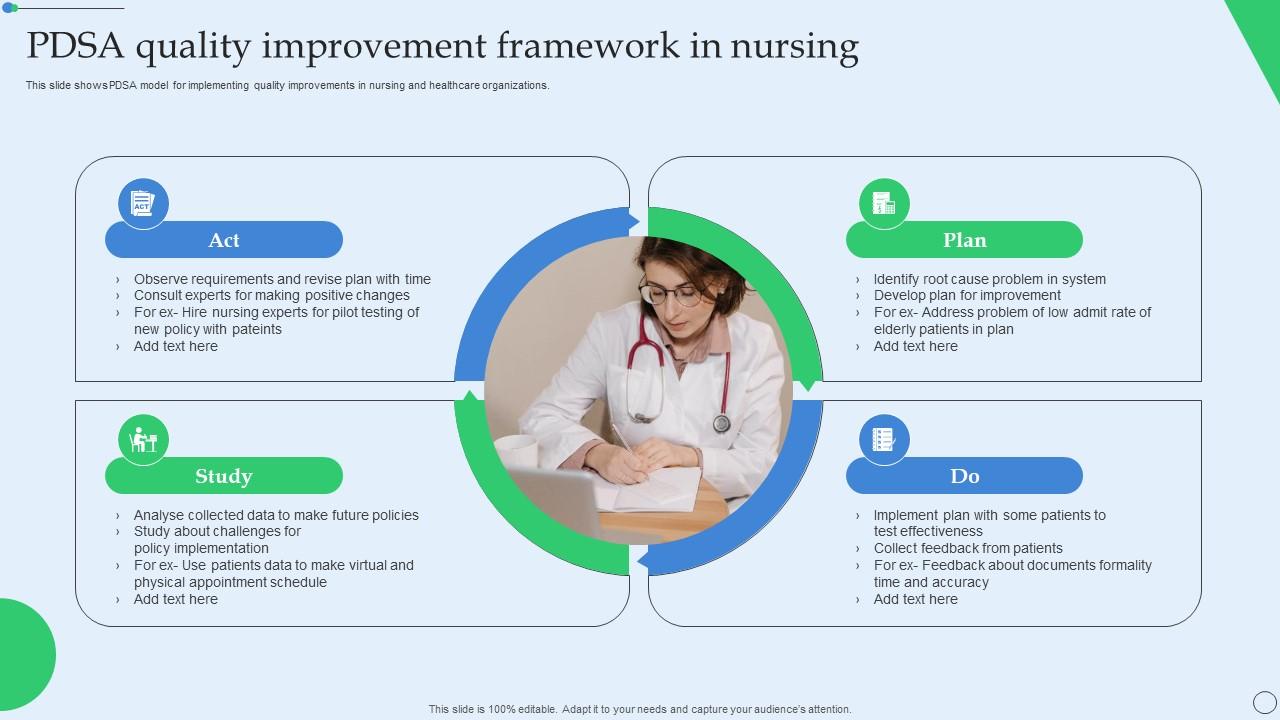
Template 1: PDSA Quality Improvement Framework in Nursing PPT
Nursing teams running quality improvement cycles need a clear, structured visual to anchor each phase. This PPT template is built for nurse leaders and QI coordinators presenting PDSA-driven change initiatives. It covers all four stages — from observing requirements to policy implementation and physical appointment tracking — in one coherent layout. Use it to present a PDSA model for improvement in clinical settings, where clarity directly affects care outcomes. The template is 100% editable and customizable.
Download this PowerPoint Template
Template 2: Quality Control vs Quality Assurance Understanding the Difference PPT Example
Clearly distinguishing Quality Control from Quality Assurance drives sharper team alignment and fewer downstream errors. This deck captures that distinction with crisp, benefit-forward layouts that make complex QA/QC relationships immediately readable. Every slide translates process differences into visual clarity your audience can act on. Flexible design choices let you match your organisation's brand and tailor the narrative to your specific quality management context. Use this presentation to anchor team training, compliance reviews, or stakeholder briefings on your Quality Management System. Transform your QA/QC presentations today. Download this dynamic deck now and deliver the clarity your teams need.
[product_image id=1634567]
Template 3: How to Implement NIST Risk Management Framework Effectively PPT Slides
Cybersecurity risk conversations often stall because the framework never gets properly visualised for the room. This deck brings the NIST Risk Management Framework to life with actionable steps and structured layouts built for compliance and resilience discussions. Each slide converts abstract risk management processes into clear, credible visuals that hold a leadership audience's attention. The polished design builds instant credibility for professionals presenting to boards, auditors, or cross-functional teams. Use this presentation to drive compliance conversations and demonstrate organisational resilience with confidence. Transform your risk management presentations today. Download this dynamic deck now and anchor your PDSA framework communication with world-class structure.
[product_image id=1687075]
Template 4: Quality Improvement Strategies Using PDSA Framework PPT
Quality improvement conversations lose traction when the visual structure doesn't match the method's logic. This PPT preset is built for QI leads and process owners who need to present a PDSA framework clearly to mixed audiences — clinical, operational, or executive. It supports iterative testing process narratives, making each cycle's rationale and findings easy to follow. For teams running rapid cycle improvement reviews, this deck keeps the argument clean and the evidence visible. The template is 100% editable and customizable.
[product_image id=1634568]
Template 5: How to Implement PDCA Cycle PPT Outline
PDCA Cycle implementation is straightforward in theory; presenting it credibly to a sceptical team is harder. This PPT slide is built for operations managers and process leads who need to walk a room through each phase without losing the thread. It pairs the Deming Cycle's logical structure with a clean visual layout that audiences can follow without prior knowledge. For teams introducing a Continuous Improvement Model for the first time, this deck makes the case simply and clearly. The template is 100% editable and customizable.
[product_image id=1829360]
Elevate Every Quality Improvement Presentation with SlideTeam
SlideTeam's PowerPoint templates are the best in the industry for communicating the PDSA framework with clarity and confidence. These content-ready slides save hours of formatting work while delivering professional structure across every phase of your quality improvement cycle. Deploy these ready-made PowerPoint slides to present your Plan Do Study Act findings persuasively — to clinical teams, operations leads, or executive stakeholders — and drive real, measurable change.
FAQs on PDSA Framework
How does the PDSA framework differ from the PDCA cycle in practical application?
In practice, PDSA replaces the PDCA "Check" phase with "Study" — a deliberate shift in intent. "Check" implies verification against a standard. "Study" implies learning from what actually happened, expected or not. PDSA is more hypothesis-driven; teams ask what they predicted versus what occurred. This makes PDSA better suited to iterative testing in complex environments like healthcare, where the goal is learning, not just compliance.
What are the key components of the "Study" phase that distinguish it from simple data review?
The "Study" phase is not just data review — it is structured comparison. Teams measure actual results against what they predicted in the "Plan" phase. Key actions include identifying gaps between prediction and outcome, spotting unintended effects, and asking why deviations occurred. Without that prediction-versus-reality comparison, Study collapses into simple reporting. The distinction matters: learning requires a hypothesis; review only requires data.
How can organizations document lessons learned during the "Act" phase to inform future cycles?
Document lessons in a standard format immediately after each cycle — not weeks later. Capture what was tested, what was predicted, what actually happened, and the decision made in "Act." Store these in a shared, searchable location accessible to future teams. A one-page PDSA worksheet per cycle works well. Organisations that skip this step repeat the same tests and the same mistakes across successive improvement projects.
How does the PDSA framework support a culture of continuous improvement in healthcare settings?
PDSA normalises small, frequent tests rather than large, risky overhauls. In healthcare, this matters — failed changes can affect patient safety. By running rapid cycle improvement tests, teams build confidence to act on evidence rather than opinion. Over time, the habit of testing, studying, and adjusting becomes how the organisation operates. That shift in default behaviour is what a continuous improvement culture actually looks like in practice.
What metrics should teams prioritize when evaluating outcomes during the "Study" phase?
Prioritise three types of metrics: process measures (did the change happen as planned?), outcome measures (did the patient or business result improve?), and balancing measures (did the change cause problems elsewhere?). Tracking all three prevents teams from celebrating a process win that quietly created a new failure downstream. Keep the metric set small — two or three indicators per cycle is enough for a focused Study phase.
How can visual presentation tools enhance the communication of PDSA cycle results to stakeholders?
Visual tools — run charts, annotated timelines, and structured PDSA slide layouts — let stakeholders see trends across multiple cycles at once. A run chart showing improvement over successive tests communicates momentum far faster than a table of numbers. Pre-designed PowerPoint templates give teams a consistent format, so leadership can compare results across different projects without relearning a new layout each time.
What are the most common pitfalls organizations encounter when implementing the PDSA framework for the first time?
The most common pitfall: skipping the prediction step in "Plan." Teams jump to action without stating what they expect to happen — which makes "Study" impossible to execute properly. A close second is running tests that are too large to be reversible. PDSA works best with small, bounded changes. Third: failing to document each cycle, so the organisation learns nothing transferable. Fix all three before the first cycle runs.
How does the "Plan" phase of PDSA align with hypothesis-driven problem solving?
The "Plan" phase is essentially hypothesis formation. Teams state the problem, propose a change, and — critically — predict what will happen if the change is made. That prediction is the hypothesis. Without it, there is no basis for Study. This structure mirrors scientific method: observation leads to a testable prediction, which a controlled test then evaluates. Teams that skip the prediction reduce PDSA to trial and error.