




 0 Comment
 Customer Reviews

Reputation takes years to build but minutes to lose, but all thanks to Third-Party Risk Management (TPRM) that guards it fiercely. Yes, TPRM is an organized process that supports organizations to assess, monitor, and mitigate the risks caused by vendors, suppliers, and partners. TPRM strives to achieve compliance, security, and operational resilience by identifying potential threats, mitigating vulnerabilities, and ensuring availability of controls to support business continuity and protect sensitive data.
How does a TPRM framework protect organizations from hidden vendor risks? Learn by reading our blog on Top 10 Risk Management Framework Templates
A Third-Party Risk Management (TPRM) framework can benefit organizations in many ways, helping them to have safer, stronger, and more reliable partnerships. One of the key benefits of a TPRM framework is the safety from financial, operational, or reputational risk when a third-party fails. The framework provides a way to assess and monitor vendors to prevent data breaches, regulatory violations, and supply chain issues in the event of a failure. The slides below will help to adhere to and comply with standards and regulations outlining the obligations and expectations to maintain risk, liability, and penalties.
Explore here the Top 5 Risk Assessment Framework Templates by SlideTeam
The TPRM process is meant to create a more accountable and transparent process for organizations to manage vendors, strengthening the trust and confidence in their partnerships. TPRM frameworks allow for continuous monitoring of the vendor, reducing risk and detection of issues early, so that there is time for organizations to be proactive.
SlideTeam has curated 100% editable, customizable, and content-ready presentations on Third-Party Risk Management.
Let’s have a look at some of them!
Template 1: Third Party Risk Management Program Framework PPT
This PPT presents a straightforward method for managing risks with third parties. It provides a six-step process, beginning with the Initial Setup, where companies can identify third-party risks and determine risk control policies. It also adds Ongoing GRC monitoring to learn how to continue the due diligence and manage contracts. This process will assist organizations in assessing, mitigating, and monitoring a potential risk to their organization from third-party relationships.

Template 2: Third Party Risk Management Framework PPT Template
This template offers an easy-to-use structure to monitor third-party risk. It instructs on how, initially, to stage your risk tiering and identify business needs. Then it urges to focus on due diligence on conducting a full extent of third-party risk assessments and evaluations. It also focuses on contract phases and ongoing monitoring, including monitoring for compliance and relationship management. The robust, cyclical approach gives organizations the tools to mitigate threats and maintain control throughout the life of a third-party relationship. Grab the template now.

Template 3: SaaS Third Party Risk Management Framework PPT
The structure of this template clearly outlines a lifecycle to manage third-party risk. Organizations can view this template as a guide to help them first identify all of their third-party suppliers and their inherent risk, and then also continually assess and monitor them through due diligence or security ratings. Lastly, the framework provides teams the ability to remediate issues through incident management and action tracking. This PPT has a systematic process to help organizations proactively mitigate possible threats from their partners.

Template 4: Third Party Vendor Risk Management Framework PPT
This template offers easy ways of handling vendor risks and enhancing supply chain value. It will take you through a phase called Initial Setup to find and assess risks. It will then shift to Ongoing GRC Monitoring for providing continuous due diligence and appropriate management of contracts. This structured way of working has resulted in organizations reducing contract breaches and vendor risks while increasing the value and security of their supply chains. It provides a way to ensure vendor performance and adherence to organizational goals and objectives, as well as ethical obligations. Grab the template now.

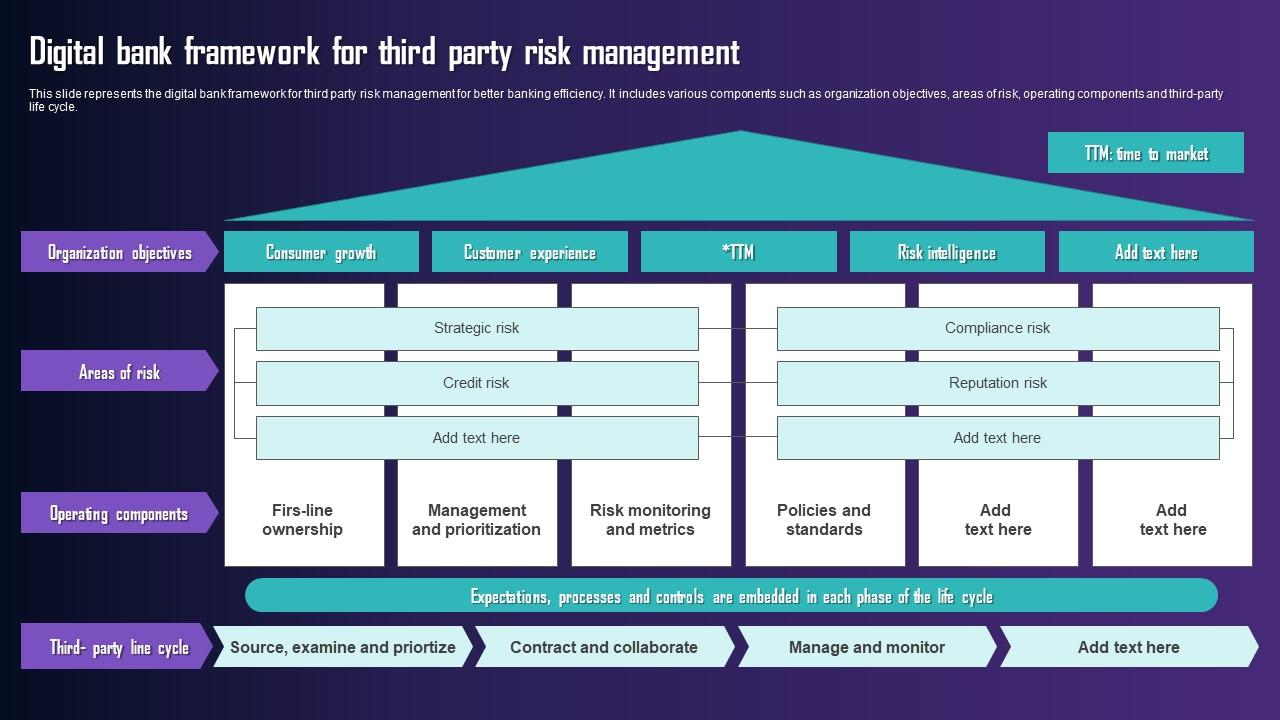
Template 5: Digital Bank Framework for Third Party Risk Management PPT
This tool offers a complete framework for digital banks to manage third-party risk. It allows for defining organizational objectives as well as categorizing areas of risk that span strategic, operational, and compliance risk. This template also walks through a clearly defined third-party life cycle so that companies appropriately source, manage, and monitor relationships with vendors. The structure in this template is intended to mitigate potential threats and maintain security for banks, while providing a systematic way to manage and track risk associated with the business.
Template 6: Framework of Third-Party Risk Management with Assessment PPT Template
This template outlines a concise, two-part approach to assessing third-party risks. In the "Initial Setup" phase, companies will be directed on how to identify third-party risks and bring the data together into a single integrated system. In the "Ongoing GRC Monitoring" phase, the focus will shift to continuous due diligence, reporting, and contract management. This disciplined approach allows organizations to proactively identify, assess, and mitigate third-party risks while maintaining compliance and operational stability.

Template 7: Cyber Security Risk Management Framework for Threat Protection PPT Template
This template gives a clear structure to manage cybersecurity threats. It provides support in building Cyber Security Governance and undertaking detailed IT/IS Risk Assessment to reduce risks. It also offers support to provide an assessment of third-party security, as well as a plan for Security Training & Awareness. This template provides a structured way for organizations to help them identify and address their security gaps, develop a roadmap, and safeguard data from threats.

SHIELDING BUSINESS FROM HIDDEN THREATS
Any organization that relies on a vendor, supplier, or partner to provide products and services will require a Third-Party Risk Management (TPRM) framework. While outsourcing can be effective, it is not without the risk of data breaches, regulatory non-compliance, operational dysfunction, and reputational harm. An effective TPRM framework can enable organizations to identify, analyze, and remediate third-party risks before the risks rise to the level of concern.
The TPRM framework can help organizations sustain organizational resilience to protect sensitive data and avoid penalties. An effective TPRM framework drives accountability and transparency in supply relationships. The organization can ensure that it facilitates knowledge sharing and increased innovation to fulfill security and compliance requirements while encouraging organizational growth, and being aware of the gaps and vulnerabilities present along its extended supply chain.
To understand the topic better, read our blog on Top 10 Operational Risk Management Framework Templates.
FAQs on Third Party Risk Management Framework Templates
What are the core components of an effective third-party risk management framework?
Key components of a successful Third-Party Risk Management (TPRM) framework include risk identification, due diligence, risk assessment, contract management, ongoing monitoring, and governance. These components enable vendors to comply, secure, and maintain ethical adherence. Together with robust reporting and escalation processes to drive decision-making, these components will strengthen an organization's ability to sustain resilience, transparency, and trust across its third-party relationships.
How can organizations identify and classify third-party risks efficiently?
Companies can successfully identify and rank third-party risks through extensive due diligence and assess providers based on the number of criticality, access to data, and regulatory impacts. They then sort risk assessment tools, questionnaires, and audits into high, medium, and low risks. This ongoing work of categorizing allows for identification of the most severe risks, which helps to focus attention on increased monitoring, developing effective risk reduction plans, and more thoughtful vendor management.
What role does continuous monitoring play in third-party risk management?
Continuous oversight is an essential function of Third-Party Risk Management (TPRM) since it involves monitoring the actions, compliance, and performance of vendors over time. Additionally, when done right, it can allow organizations to monitor for emerging risks nearly in real-time. This continuous monitoring function is the most valuable of the TPRM processes as it ensures that the organization can act quickly to address risks, thereby optimizing resilience (reduction of friction or impediment to business operations) and promoting trust, accountability, and sustainability in a company's partnership with third parties.