

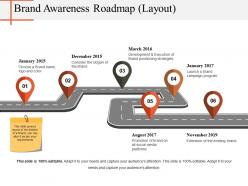
Brand awareness roadmap ppt examples





Try Before you Buy Download Free Sample Product
 Impress Your
 Audience
 100%
100% Editable
 Save Hours
 of Time


Get folks aware of inputs ignored with our Brand Awareness Roadmap Ppt Examples. Highlight errors of judgement.
People who downloaded this PowerPoint presentation also viewed the following :
Brand awareness roadmap ppt examples with all 5 slides:
Add bigger assets with our Brand Awareness Roadmap Ppt Examples. Your bank balance will keep growing.


FAQs for Brand awareness
Key components include target audience analysis, brand positioning strategy, content marketing plans, multi-channel distribution tactics, and performance measurement frameworks. These elements work together by establishing clear messaging consistency, maximizing reach across digital and traditional platforms, and enabling data-driven optimization, with many organizations finding that integrated approaches deliver significantly higher brand recognition and customer engagement rates.
Businesses can measure brand awareness effectiveness through brand recall surveys, social media engagement metrics, website traffic analytics, search volume data, and share of voice analysis. These measurement tools enable organizations to track recognition improvements, monitor competitive positioning, and assess campaign ROI, with many companies finding that consistent tracking ultimately delivers strategic insights for optimizing marketing investments and enhancing market presence.
Social media enhances brand awareness by enabling direct customer engagement, amplifying content reach through viral sharing, and facilitating targeted advertising campaigns. Through strategic social platforms, businesses build authentic relationships, showcase brand personality, and generate user-generated content, with many organizations finding that consistent social presence delivers increased visibility, customer loyalty, and ultimately competitive market positioning.
Storytelling integrates into brand awareness roadmaps through narrative-driven content strategies, consistent brand messaging across touchpoints, emotional connection frameworks, and authentic customer journey mapping. Companies like Nike and Patagonia leverage storytelling by weaving brand values into every campaign, social media interaction, and customer experience, ultimately creating memorable brand identities that resonate deeply and drive sustained engagement.
Brand awareness growth metrics include brand recall surveys, search volume data, social media mentions, website traffic analytics, and share of voice measurements. These tracking methods enable organizations to monitor recognition patterns, measure digital footprint expansion, and assess competitive positioning, with many companies finding that combining quantitative search data with qualitative survey insights delivers comprehensive visibility into brand perception evolution.
Businesses leverage influencer partnerships by selecting authentic voices that align with their target demographics, creating collaborative content that showcases products naturally, and utilizing cross-platform promotion strategies. Through strategic partnerships with micro and macro-influencers, companies enhance credibility, expand reach, and drive engagement, with many retail and lifestyle brands finding that authentic endorsements deliver significantly higher conversion rates than traditional advertising.
Customer feedback plays a crucial role in shaping brand awareness initiatives by identifying perception gaps, revealing messaging effectiveness, and highlighting key differentiators that resonate with target audiences. Through surveys, social listening, and direct testimonials, organizations can refine their positioning strategies, adjust communication channels, and develop authentic campaigns that address real customer needs, ultimately delivering stronger market resonance and competitive advantage.
Visual identity enhances brand awareness strategy by creating memorable logos, consistent color schemes, distinctive typography, cohesive imagery, and recognizable design elements across all touchpoints. These visual components streamline brand recognition, differentiate from competitors, and build emotional connections with audiences, with many organizations finding that strategic visual consistency ultimately delivers stronger market presence and increased customer recall rates.
Content marketing enhances brand awareness by creating valuable, relevant content that educates audiences, builds trust, and establishes thought leadership across multiple channels. Through strategic blog posts, social media content, and educational resources, organizations consistently engage target audiences, improve search visibility, and generate organic reach, ultimately delivering stronger brand recognition and customer loyalty in increasingly competitive markets.
Multi-channel brand awareness approaches deliver enhanced reach, consistent messaging, improved customer engagement, diversified risk management, and comprehensive audience targeting across platforms. Through strategic integration of digital, traditional, and experiential channels, organizations amplify brand visibility, reinforce key messages, and capture diverse consumer touchpoints, ultimately driving stronger market penetration and competitive advantage.
Businesses identify target audiences through demographic analysis, psychographic profiling, market research, competitor analysis, and customer data analytics. These strategies enable precise audience segmentation by analyzing purchasing behaviors, preferences, and engagement patterns, with many retail and financial services companies finding that targeted social media campaigns, personalized content marketing, and strategic partnerships ultimately deliver higher conversion rates and stronger customer relationships.
Common pitfalls include targeting overly broad audiences, neglecting competitor analysis, setting unrealistic timelines, inconsistent messaging across channels, and insufficient budget allocation for sustained campaigns. Many organizations find that rushing market entry without proper research, ignoring customer feedback loops, and failing to establish clear metrics ultimately undermines their strategic positioning and competitive advantage.
Employee advocacy amplifies brand awareness by leveraging authentic employee voices, expanding reach through personal networks, and creating credible third-party endorsements that resonate with target audiences. Through strategic social sharing programs, companies like Microsoft and IBM enable employees to become brand ambassadors, ultimately delivering increased visibility, enhanced trust, and competitive advantage in crowded markets.
Consistency in messaging is crucial for brand awareness as it builds recognition, establishes trust, reinforces brand identity, and creates memorable customer experiences across all touchpoints. This strategic approach enables organizations to strengthen market positioning, reduce confusion, and accelerate brand recall, with many companies finding that consistent messaging delivers significantly higher revenue growth and customer loyalty.
Small businesses can leverage social media partnerships, community event sponsorships, user-generated content campaigns, local influencer collaborations, and guerrilla marketing techniques to maximize brand visibility affordably. These strategic approaches enable businesses to build authentic connections, generate organic buzz, and establish local market presence while minimizing traditional advertising costs, with many finding that creative, community-focused initiatives deliver stronger engagement and lasting brand recognition than expensive mass marketing campaigns.
-
Excellent work done on template design and graphics.
-
Very well designed and informative templates.