Budget allocation for project planning proposal ppt powerpoint presentation introduction

Budget allocation for project planning proposal ppt powerpoint presentation introduction
Slide 1 of 2
Favourites Favourites

Try Before you Buy Download Free Sample Product

Audience Impress Your
Audience
Editable 100%
Editable
Time Save Hours
of Time
The Biggest Sale is ending soon in
0
0
:
0
0
:
0
0
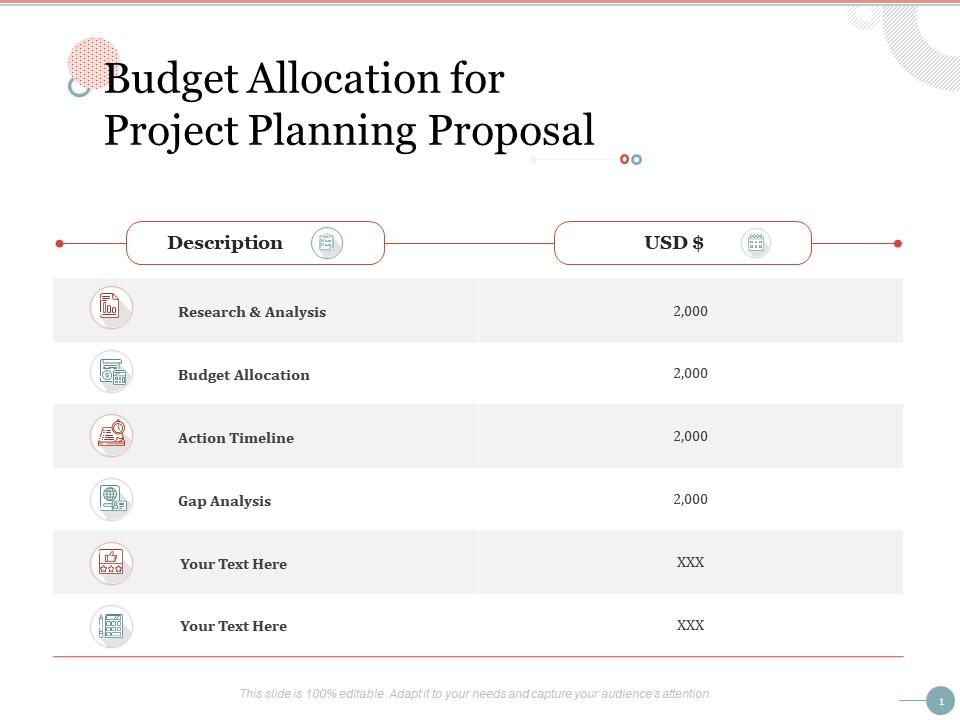
Presenting this set of slides with name Budget Allocation For Project Planning Proposal Ppt Powerpoint Presentation Introduction. The topics discussed in these slides are Budget Allocation, Project Planning. This is a completely editable PowerPoint presentation and is available for immediate download. Download now and impress your audience.

People who downloaded this PowerPoint presentation also viewed the following :

FAQs for Budget allocation for project planning proposal ppt

Key factors include revenue forecasting, strategic priorities, historical spending patterns, risk assessment, and resource availability. These elements work together by ensuring financial alignment with business objectives, enabling organizations to optimize operational efficiency while maintaining flexibility for unexpected opportunities, with many companies finding that systematic allocation ultimately delivers better ROI and competitive advantage.

Organizations prioritize projects effectively by establishing clear strategic alignment criteria, conducting thorough cost-benefit analyses, and implementing scoring matrices that evaluate impact, urgency, and resource requirements. Through systematic assessment frameworks, companies can allocate resources to high-value initiatives while maintaining operational stability, with many finding that regular portfolio reviews enable better decision-making and improved ROI outcomes.

Data analysis plays a crucial role in optimizing budget allocation by identifying spending patterns, predicting ROI across departments, and revealing underperforming investments. Through advanced analytics, organizations can reallocate resources more strategically, with many companies finding that data-driven budgeting reduces waste by 15-30% while enhancing operational efficiency and competitive positioning.

Stakeholder engagement significantly influences budget allocation by providing diverse perspectives on priorities, identifying critical resource needs, and ensuring alignment with strategic objectives. Through collaborative discussions and feedback sessions, organizations can balance competing demands, minimize resistance to budget decisions, and ultimately achieve more effective resource distribution that reflects both operational requirements and stakeholder expectations.

Common budget allocation pitfalls include overestimating revenue projections, underestimating operational costs, failing to allocate contingency funds, neglecting cross-departmental dependencies, and prioritizing short-term gains over strategic investments. These missteps often result from inadequate data analysis and poor communication, with many organizations finding that implementing structured allocation frameworks and regular budget reviews significantly enhances financial planning accuracy.

Technology streamlines budget allocation through automated data collection, real-time analytics, predictive modeling, and collaborative planning platforms that eliminate manual spreadsheet errors. These digital solutions enable organizations to process financial data faster, identify spending patterns more accurately, and adjust allocations dynamically, with many companies finding significantly reduced planning cycles and enhanced resource optimization across departments.

Mid-cycle budget allocation adjustments include performance-based reallocation, contingency fund activation, cross-departmental transfers, zero-based review implementation, and priority matrix restructuring. These strategies enable organizations to respond to market shifts, capitalize on emerging opportunities, and optimize resource distribution, with many companies finding that quarterly reallocation reviews ultimately deliver enhanced operational efficiency and competitive positioning.

Budget allocation varies significantly across industries based on operational priorities, with technology companies investing heavily in R&D and talent acquisition, while manufacturing focuses on equipment and supply chain optimization, and healthcare prioritizes compliance and patient care infrastructure. These strategic allocations enable organizations to maintain competitive advantages within their specific markets, ultimately delivering sector-appropriate growth and operational efficiency.

Budget allocation effectiveness can be evaluated through return on investment (ROI), cost per acquisition, revenue growth rates, operational efficiency ratios, and variance analysis between planned versus actual spending. These metrics enable organizations to track resource utilization, identify high-performing initiatives, and optimize future allocations, with many companies finding that regular measurement ultimately delivers improved financial performance and strategic alignment across departments.

Organizations ensure transparency in budget allocation through detailed documentation, regular stakeholder communication, and clear decision-making criteria that explain funding rationales. By implementing standardized reporting systems, conducting quarterly budget reviews, and sharing allocation metrics across departments, companies enhance accountability, build stakeholder trust, and enable more informed strategic planning, ultimately delivering improved resource optimization and organizational alignment.

Economic factors significantly influence budget allocation strategies through inflation rates, interest rates, market volatility, regulatory changes, and supply chain disruptions. These economic pressures force organizations to prioritize essential operations, diversify investments, and build contingency reserves, with many companies finding that adaptive allocation strategies enhance resilience and competitive positioning.

Non-profits can maximize impact by prioritizing core mission activities, investing in data analytics to measure outcomes, diversifying funding streams, and maintaining adequate operational reserves. Organizations like Habitat for Humanity and United Way increasingly allocate 15-20% to capacity building and technology infrastructure, while dedicating 70-80% to direct services, ultimately delivering measurable community outcomes and enhanced donor transparency.

Employee feedback contributes to better budget allocation by identifying operational inefficiencies, highlighting resource gaps, and revealing priority areas that leadership might overlook from a strategic level. Through regular surveys and structured input processes, organizations can allocate funds more effectively toward training, technology, and infrastructure improvements, ultimately enhancing productivity and employee satisfaction while reducing wasteful spending.

Scenario planning assists budget allocation by modeling multiple future possibilities, identifying potential risks and opportunities, and enabling organizations to allocate resources more strategically across different outcomes. Through predictive analytics and forecasting tools, companies can simulate various market conditions, revenue scenarios, and operational challenges, ultimately creating more flexible budgets that adapt to changing circumstances while maintaining financial stability.

Ethical budget allocation considerations include transparency in decision-making processes, equitable resource distribution across departments, stakeholder impact assessment, environmental responsibility, and fair compensation practices. Organizations increasingly find that incorporating these ethical frameworks enhances employee trust, improves stakeholder relationships, and delivers sustainable competitive advantage while minimizing reputational risks.

Ratings and Reviews

0% of 100
Write a review
Most Relevant Reviews

No Reviews