category-banner

Business Governance Model Corporate Business Playbook

Rating:
100%
Business Governance Model Corporate Business Playbook
Slide 1 of 6
Favourites Favourites

Try Before you Buy Download Free Sample Product

Audience Impress Your
Audience
Editable 100%
Editable
Time Save Hours
of Time
The Biggest Sale is ending soon in
0
0
:
0
0
:
0
0
Rating:
100%
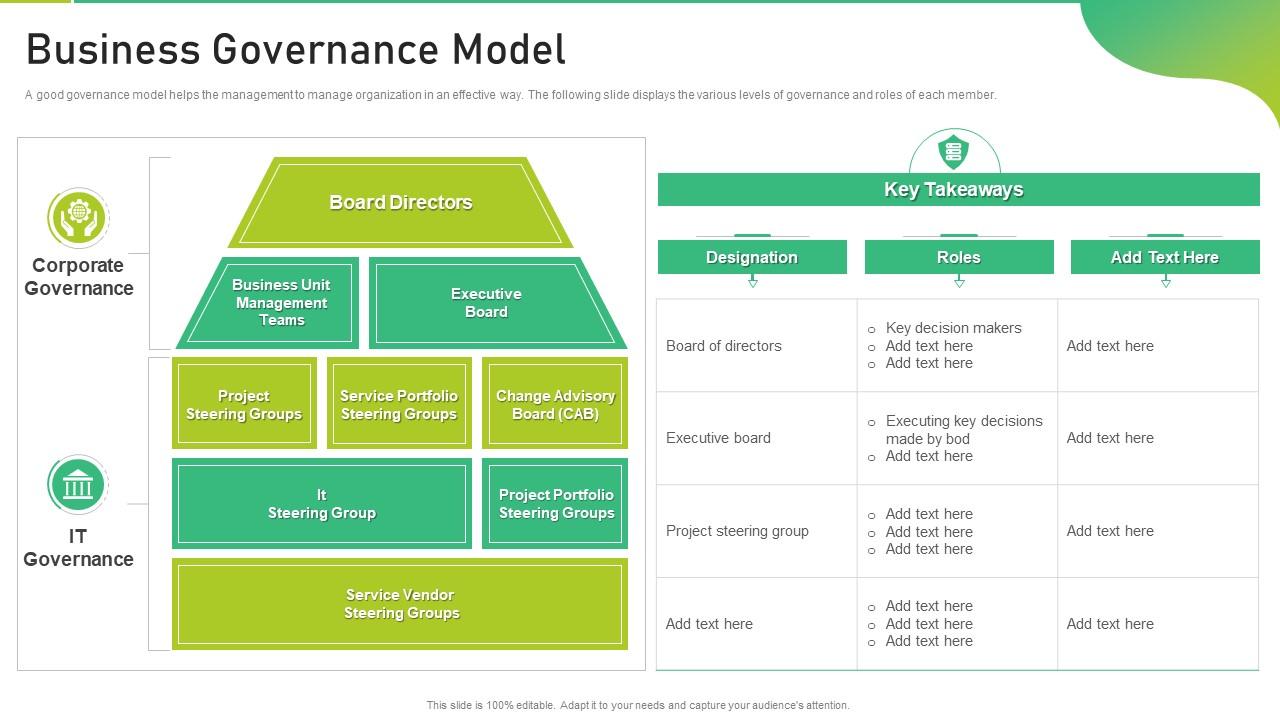
A good governance model helps the management to manage organization in an effective way. The following slide displays the various levels of governance and roles of each member. Present the topic in a bit more detail with this Business Governance Model Corporate Business Playbook. Use it as a tool for discussion and navigation on Business Unit, Management, Executive Board, Steering Groups. This template is free to edit as deemed fit for your organization. Therefore download it now.

People who downloaded this PowerPoint presentation also viewed the following :

FAQs for Business Governance Model

So business governance is basically your company's playbook for handling risks. Your board and executives figure out how much risk they're cool with taking, then set up committees and reporting systems so nothing falls through the cracks. Someone has to actually own each risk though - that's where most companies mess up honestly. Like, if nobody's clearly responsible for monitoring cybersecurity vs. compliance vs. whatever, you're screwed when problems hit. And trust me, they will. Start by mapping out who's accountable for what risks in your org, because unclear ownership kills good risk management every time.

Honestly, good governance is a game-changer for performance. You get clearer accountability and way better risk management. Strong board oversight builds investor confidence - which actually lowers your borrowing costs, believe it or not. It also prevents those crazy scandals you see companies implode from. Don't just copy what massive corporations do though. Find what works for your size and industry. I'd start by figuring out where your current gaps are, then tackle the ones that'll move the needle on your main goals first. Makes way more sense than trying to fix everything at once.

So corporate governance is just for public companies - you know, the whole board of directors thing, SEC filings, shareholder drama. Business governance? That's everything else. Any company really, whether it's some tiny startup or your cousin's nonprofit. People get them confused constantly (I did too honestly). But here's the thing - if you're dealing with a publicly traded company, you've got way more hoops to jump through. All those regulatory requirements are no joke. For private companies though, it's more about having good processes without Uncle Sam breathing down your neck. Figure out which world you're actually in first.

Good governance is basically about setting up clear communication channels so people actually feel heard. Map out your key stakeholders first, then create regular touchpoints with each group - advisory committees work great for this. Don't just collect feedback though, you need defined roles and transparent processes for who does what. The systematic approach beats random check-ins every time. Honestly, most companies mess this up by making it feel like box-checking instead of genuine engagement. Short version: make it regular, make roles clear, and actually respond to what people tell you.

Dude, ethical guidelines are like your company's North Star - they stop you from pulling a Wells Fargo and creating fake accounts (still can't believe they did that). Your team needs clear rules for everything from treating employees fairly to protecting customer data. Without them? You're basically gambling with lawsuits and your reputation. The thing is, they only work if leadership actually follows them - can't just throw policies in a handbook and call it done. Good ethics create trust with customers and make people actually want to work for you. Bottom line: write them clearly, communicate them well, and enforce them consistently.

So basically when new regulations drop, your governance has to get updated to match - stuff like reporting changes, board rules, risk standards. Deadlines are always tight too (regulators love that apparently). You'll end up rewriting policies and tweaking committee structures. Here's what saved me: get someone tracking regulatory updates before they hit. Otherwise you're scrambling to fix everything last minute, which sucks. Maybe set up alerts or something? The monitoring part is honestly tedious but beats panic-updating your entire governance when you're already behind.

Honestly, start with board meeting attendance - if your directors aren't showing up, that's a red flag right there. Financial stuff like ROI and audit results give you the hard numbers. Stakeholder surveys are useful too, though good luck getting people to be brutally honest lol. I'd also look at how fast you're making decisions and whether they're actually good ones. Oh, and employee hotline usage tells you a lot about company culture. Don't try to track everything at once though - pick maybe 3 metrics that match your biggest headaches right now.

Honestly, tech can be a game-changer for transparency if you do it right. Dashboards let you track governance stuff in real-time, blockchain keeps records nobody can mess with, and automated systems catch problems early. I've watched companies completely flip their board meetings just by going digital - no more panicking over missing reports last minute. Don't just grab whatever's trendy though. Pick tools that actually work with how your company operates. Oh, and start small - maybe board communications first? You can always build from there once people get used to it.

Honestly? Change resistance hits the hardest. Nobody wants new processes disrupting their workflow - can't really blame them. Then you've got this weird ownership void where nobody knows who's actually in charge of what. Smaller companies are the worst for this since everyone wears like five hats. Budget's always tight too, and governance feels like bureaucratic fluff instead of something useful. My advice? Pick one simple policy to start with. Give it to someone specific - not a committee or "the team." That whole "shared responsibility" thing is just code for nothing getting done.

Oh man, this is such a headache honestly. German boards want every single data point before they'll decide anything, while Americans just want to move fast. Then you've got Asian subsidiaries doing the whole consensus thing, which totally clashes when auditors show up expecting clear individual accountability. Risk tolerance is all over the place too - what flies in one country freaks out another. Plus transparency expectations? Completely different. You basically need governance that bends with local culture but doesn't break your global standards. I'd start by figuring out what each major market actually expects first.

Business governance and sustainability? They're totally connected now. Boards need people who actually understand ESG stuff, not just finance folks. Risk assessments have to factor in climate change - investors won't shut up about it these days. Your governance framework basically determines whether sustainability becomes real strategy or just nice-sounding website copy. Risk management, stakeholder engagement, board oversight - all of it shapes how companies handle environmental issues. Most reporting now covers both financial and environmental performance anyway. I'd start by checking if your current governance structure actually supports making decisions for the long haul instead of just quarterly earnings.

Honestly, start simple - just nail down who does what, even if it's tiny team. Document your main processes now before things get crazy (learned this the hard way when my co-founder got food poisoning during a big client presentation). Regular check-ins are crucial, but make them count - review actual decisions and performance, not just random updates. Find some advisors you trust, doesn't have to be fancy board stuff. Maybe quarterly coffee chats work better. Pick like 3-4 governance things and actually do them consistently. Don't overcomplicate it early on.

Okay so boards of directors are basically the top dogs who keep an eye on everything. They're the ones hiring and firing CEOs, deciding big-picture strategy, and making sure management isn't screwing around with investor cash. Major stuff like acquisitions, executive pay, huge budget calls - that all goes through them. Legally they have to look out for shareholders' interests, which honestly makes sense. They also deal with risk management and regulatory compliance. Oh and if you're pitching anything to them, just focus on how it benefits shareholders and reduces risk. That's their main concern anyway. Think of it as corporate checks and balances.

Okay so first thing - map out which regulations actually hit your business. SOX, data privacy stuff, industry rules, whatever applies. Internal audits are a pain but way better than panic mode later when regulators show up. Write policies people can actually understand (not lawyer speak nobody reads). Train your team regularly and document everything - I know, boring but necessary. External auditors give you that outside perspective which helps. Oh and make this part of how you normally operate, not something you scramble to fix when you're in trouble. Trust me on that last part.

Honestly, start with the basics - ditch corporate speak and stick to one format for everything. Monthly board updates work way better than randomly dumping info on people whenever. I swear half these governance teams think more communication automatically means better communication, but it just confuses everyone. Different audiences need different stuff though - your board doesn't care about the same details as department heads. Set up some way to actually check if people get what you're saying. Maybe audit what you're doing now? Figure out where people look most lost and fix that first.

Ratings and Reviews

100% of 100
Write a review
Most Relevant Reviews
  1. 100%

    by Donovan Cunningham

    The service is fast, and I could access any presentation after buying the subscription. I don’t think I’ll ever have to worry about a presentation in my life.
  2. 100%

    by Darell Vargas

    Top Quality presentations that are easily editable.

2 Item(s)

per page: