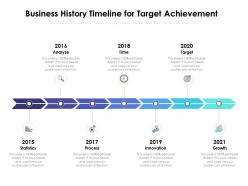
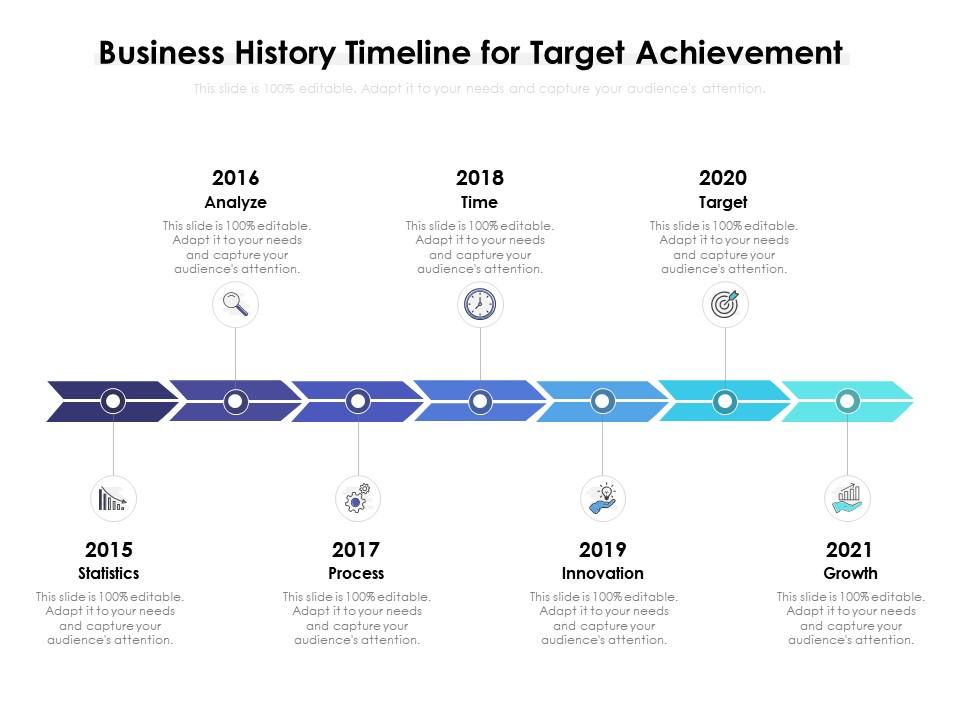
Business history timeline for target achievement
Try Before you Buy Download Free Sample Product
Audience
Editable
of Time
Our Business History Timeline For Target Achievement are topically designed to provide an attractive backdrop to any subject. Use them to look like a presentation pro.
People who downloaded this PowerPoint presentation also viewed the following :
Business history timeline for target achievement with all 2 slides:
Use our Business History Timeline For Target Achievement to effectively help you save your valuable time. They are readymade to fit into any presentation structure.
FAQs for Business history timeline
Key business milestones include company founding, product launches, major partnerships, funding rounds, market expansion, and regulatory approvals. These milestones enhance organizational storytelling by demonstrating growth trajectory, operational achievements, and strategic progress, with many companies finding that well-documented timelines strengthen investor confidence, employee engagement, and stakeholder trust while showcasing competitive positioning.
A business timeline enhances stakeholder understanding by visualizing key milestones, growth phases, financial achievements, strategic pivots, and market expansions in chronological order. This visual storytelling approach enables investors, partners, and team members to quickly grasp company trajectory, identify growth patterns, and assess future potential, ultimately building confidence and facilitating strategic decision-making across all stakeholder groups.
Effective visual elements for business timelines include milestone markers, color-coded phases, progress bars, connecting lines, and data visualization icons. These elements enhance comprehension by creating visual hierarchy, distinguishing time periods, and highlighting key achievements, with many organizations finding that strategic use of colors and consistent iconography significantly improves stakeholder engagement and project clarity.
Business timelines should be updated quarterly for strategic reviews, monthly for operational milestones, and immediately when significant changes occur in market conditions, resource availability, or project scope. Regular updates ensure alignment with evolving business priorities, enable proactive risk management, and maintain stakeholder confidence, with many organizations finding that consistent timeline maintenance ultimately delivers better project outcomes and enhanced operational efficiency.
Tools for creating engaging business timeline presentations include PowerPoint, Canva, Prezi, Visme, and specialized timeline software like Lucidchart. These platforms streamline timeline creation by offering customizable templates, interactive elements, and visual design features, with many organizations finding that well-designed timelines enhance stakeholder communication and strategic planning effectiveness.
A business timeline highlights significant challenges and victories by chronologically mapping key events, milestone achievements, strategic pivots, market obstacles, and breakthrough moments. This visual approach enables stakeholders to identify patterns, understand decision-making contexts, and recognize resilience factors, with many organizations finding that timeline presentations enhance investor confidence and strategic planning effectiveness.
Common pitfalls include unrealistic deadlines, insufficient buffer time, overlooking dependencies between tasks, inadequate stakeholder input, and failing to account for resource constraints. These mistakes often lead to project delays, budget overruns, and team burnout, with many organizations finding that thorough planning and regular timeline reviews ultimately deliver better outcomes and improved operational efficiency.
A timeline helps align team goals with business objectives by establishing clear milestones, defining accountability structures, and creating synchronized workflows that connect daily tasks to strategic outcomes. Through visual project mapping, teams can prioritize activities that directly support organizational targets, track progress against business-critical deadlines, and adjust resources dynamically, ultimately ensuring operational efficiency and strategic goal achievement across departments.
A business timeline serves as the foundational framework for strategic planning sessions, establishing realistic milestones, resource allocation schedules, and accountability measures across departments and initiatives. It enables leadership teams to synchronize cross-functional activities, identify potential bottlenecks, and maintain momentum toward strategic objectives, ultimately delivering clearer decision-making and enhanced organizational alignment.
Historical trends can be effectively integrated into a business timeline by analyzing past market cycles, identifying recurring patterns, and aligning strategic milestones with proven seasonal or economic indicators. These insights enable organizations to anticipate market shifts, optimize resource allocation, and time product launches strategically, with many companies finding that historical data integration ultimately delivers better forecasting accuracy and competitive positioning advantages.
Business timelines should prioritize key milestones, financial achievements, product launches, strategic partnerships, and major operational changes that demonstrate growth trajectory and competitive positioning. These elements enhance stakeholder confidence by showcasing measurable progress, market expansion, and strategic evolution, with many organizations finding that highlighting revenue milestones alongside innovation breakthroughs ultimately delivers compelling narratives for investors and partners.
A business timeline assists in onboarding by providing structured milestone tracking, clear role expectations, departmental integration schedules, and progress checkpoints throughout the transition period. Through strategic timeline implementation, organizations streamline training processes, reduce time-to-productivity, and enhance new hire retention rates, with many companies finding that systematic onboarding timelines ultimately deliver improved employee satisfaction and faster organizational integration.
A business timeline serves as the foundational framework for project management, establishing key milestones, deadlines, and resource allocation phases that guide strategic planning and execution. Through integrated timeline management, organizations streamline project coordination, enhance team accountability, and improve delivery predictability, with many companies finding that structured timeline approaches ultimately deliver better resource optimization and competitive project outcomes.
Customer milestones and feedback integrate into business timeline frameworks by serving as validation checkpoints, progress markers, and pivot triggers throughout development cycles. These touchpoints enable companies to adjust strategies, refine products, and optimize resource allocation based on real user data, with many organizations finding that structured feedback loops accelerate time-to-market while reducing costly late-stage revisions.
**INPUT**: What examples of successful business timelines can inspire new presentations? **OUTPUT**: Successful business timeline examples include product launch roadmaps from tech companies, merger integration schedules from financial institutions, digital transformation journeys from retail organizations, and project milestone tracking from manufacturing firms. These timelines enhance presentations by demonstrating clear progression, accountability phases, and strategic outcomes, with many presenters finding that visual chronologies significantly improve stakeholder engagement and decision-making processes.
-
Attractive design and informative presentation.
-
Good research work and creative work done on every template.
-
Innovative and attractive designs.
-
Enough space for editing and adding your own content.