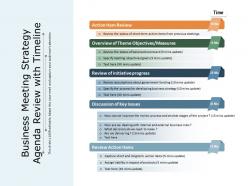
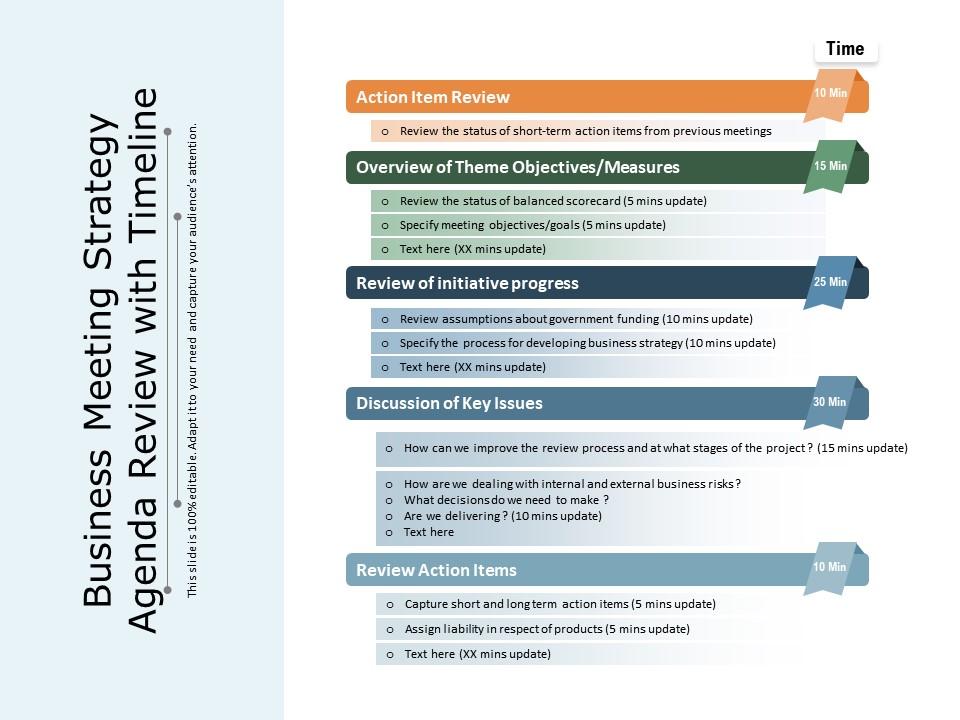
Business meeting strategy agenda review with timeline
Try Before you Buy Download Free Sample Product
Audience
Editable
of Time
Our Business Meeting Strategy Agenda Review With Timeline are topically designed to provide an attractive backdrop to any subject. Use them to look like a presentation pro.
People who downloaded this PowerPoint presentation also viewed the following :
Business meeting strategy agenda review with timeline with all 2 slides:
Use our Business Meeting Strategy Agenda Review With Timeline to effectively help you save your valuable time. They are readymade to fit into any presentation structure.
FAQs for Business meeting strategy agenda
Put your main objective right up top - people need to know why they're there. Then break down each topic with time slots and who's presenting what. Trust me, assigning speakers ahead of time prevents that awkward "so... who's handling this?" moment. List any docs people should read beforehand too. I always block out time for Q&A and action items at the end because otherwise meetings just sort of... fizzle out? Nobody knows what happens next. Send it out at least a day early so people can actually prep instead of walking in blind.
Honestly, visuals are a game-changer for meetings. People retain way more when they can see charts or slides versus just listening to you ramble. Everyone's got the attention span of a goldfish these days anyway, so anything that keeps their eyes focused helps. It gives you something concrete to gesture at too - way better than just standing there talking into the void. Oh, and don't make your text microscopic. Nothing worse than squinting at slides from across the room. Trust me, I've been there. Clean visuals = engaged audience.
Definitely do a quick audio check before you start - I've sat through way too many meetings where someone's been muted the whole time! Ask remote people directly for their input instead of waiting for them to jump in. Someone should watch the chat too since that's usually where remote folks will drop questions. Screen sharing the agenda helps keep everyone on the same page. After each big topic, specifically call out "hey remote team, what do you think?" Google docs or whatever collaborative tool works so people can contribute without interrupting. Trust me, your remote colleagues will actually feel included instead of like they're just eavesdropping on your conversation.
Here's what I've learned the hard way: most meetings are way too long. Figure out what you actually need to cover, then give each big topic maybe 5-10 minutes. More people = more time since everyone wants to chime in (shocking, I know). Past 4-5 people, tack on another 10%. You can always run over if things get interesting, but people literally love you when you wrap up early. I've started doing 25 or 50-minute blocks instead of the full half hour or hour - gives everyone a breather between calls. Honestly? Cut 15 minutes from whatever time you first thought of. You'll be surprised how much you can get done.
Dude, body language is everything in meetings. I made this mistake once where I was slouched over during a presentation - totally killed my credibility. People could tell I wasn't confident about what I was saying. Now I focus on sitting up straight and making good eye contact. Open hand gestures help too instead of crossing your arms or whatever. Even something as simple as nodding shows you're actually listening. Here's a weird trick that works: mirror whoever's running the meeting. Sounds ridiculous but it builds rapport fast. Your posture and gestures can either back up your words or completely sabotage them.
Honestly, just get that summary email out within 24 hours - list who's doing what and when it's due. I throw everything into a shared Google doc or Asana because digging through old email threads later is the worst. Check in a few days before deadlines hit (people need the nudge, trust me). Then kick off your next meeting by going through what actually got finished. The trick is staying consistent with follow-ups so your team knows you're serious about it. Makes a huge difference in getting stuff done.
Only invite people who actually need to be there - decision makers, anyone with crucial info, or whoever's gonna handle the work afterward. I learned this the hard way after sitting through way too many pointless meetings. Don't invite people just because they might find it "interesting" - that's how you end up with 12 people in a room where maybe 4 should be. Keep it between 3-7 max. Everyone should know why they're there and what you need from them. If someone just needs updates? Send them notes later instead of wasting their time.
Honestly, just pick 2-3 tools and stick with them - don't go crazy with every new app. Miro's great for brainstorming sessions, and shared docs let people add thoughts beforehand so you're not starting from zero. Record everything! I can't tell you how many times I've left a meeting thinking we agreed on something completely different. Calendar blocking helps too - forces you to actually set agendas instead of just winging it. Oh, and polling apps are lifesavers when discussions start going in circles. My team uses one for quick votes and it's honestly changed everything.
Start by setting some basic rules - no personal attacks, all ideas are fair game. Instead of asking yes/no stuff, try "what are we missing here?" Give people a few minutes to write down thoughts first (this actually saves you from the loudmouths taking over). Do a round robin where everyone gets one point before anyone goes again. Here's the thing though - you gotta go first with something vulnerable. Admit you're not sure about something or share a real concern. People won't open up unless you do it first. Makes a huge difference honestly.
Ugh, meeting drama is the worst. Don't ignore it though - that just makes everything awkward and derailed. Call it out calmly and ask each person to actually explain their position. Here's the thing: you want to figure out what problem you're all trying to solve instead of who's "right." Focus on facts and business stuff, not feelings or whatever. If people start getting snippy, just call a break - seriously, it works. Oh and definitely recap any decisions before moving on or someone will "forget" what was agreed to later.
Start with a quick agenda - just two minutes explaining why you're all there and what needs to get done. Keeps people focused instead of wandering off into random topics. When you're wrapping up, always hit the key decisions and who's doing what by when. I can't stress this enough - send that follow-up email within 24 hours or people will totally forget what they agreed to do. Trust me on this one. Oh, and honestly? Most meetings really could've just been an email, but good luck convincing your boss of that.
Oh man, cultural stuff can absolutely wreck meetings if you're not paying attention. Like, some people are crazy direct while others dance around topics forever. What feels like good discussion to you might seem aggressive to them - I've definitely stepped in that one before! Do a quick check on where your attendees are from culturally. Mix up how you run things so everyone gets to jump in their own way. Short sentences work. But also give people room to breathe and contribute however they're comfortable. Sometimes I just straight-up ask people how they prefer communicating. Makes everything smoother honestly.
Oh there's a bunch of good stuff for this! Miro and Mural are solid if you want that visual brainstorming vibe - sticky notes everywhere, drawing, the whole deal. Google Docs/Sheets work great too since everyone can edit at once and you'll see their cursors moving around (which is weirdly satisfying tbh). Figma's perfect for design stuff, Notion for docs. Even Zoom has whiteboards now, though I forget they exist half the time. Honestly just go with whatever your team already uses - learning new tools mid-project is a pain.
Oh, pre-meeting surveys are a game changer! Ask 3-5 quick questions beforehand to see what people actually think. Something like "What's your biggest concern here?" or have them rank priorities. You'll spot the real issues and figure out what folks genuinely care about vs. what they're just nodding along to. I swear it's saved me from sitting through meetings where we just go in circles collecting everyone's random thoughts - such a waste of time. Then you can jump straight into the meaty stuff that needs real discussion.
Honestly, the easiest thing is just asking people to rate the meeting 1-10 afterwards - sounds basic but it works. You'll want to check if decisions actually got made or if everyone just talked in circles (happens way too often). Did people complete the action items from last time? That's huge. Also track whether the right people showed up and if you finished on time. I always look at engagement too - are folks asking follow-up questions or just sitting there? Oh and definitely see if you hit whatever goals you set going in. The attendance thing is harder to fix but super telling.
No Reviews