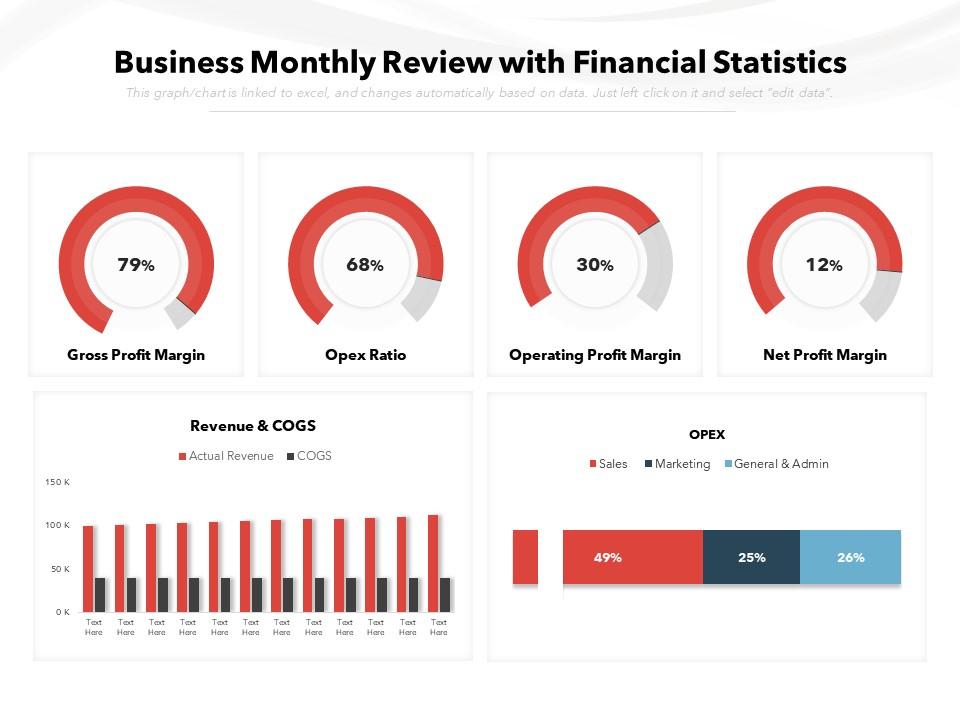
Business monthly review with financial statistics
Try Before you Buy Download Free Sample Product
Audience
Editable
of Time
Our Business Monthly Review With Financial Statistics are explicit and effective. They combine clarity and concise expression.
People who downloaded this PowerPoint presentation also viewed the following :
Business monthly review with financial statistics with all 2 slides:
Give your audience a fulfilling experience. They will find our Business Monthly Review With Financial Statistics elevating.
FAQs for Business monthly review
A comprehensive business financial review encompasses key components like revenue analysis, expense tracking, cash flow projections, and balance sheet evaluation. These components work together to paint a clear picture of the company's financial health, enabling strategic decision-making by identifying areas of strength, highlighting potential risks, and ultimately guiding resource allocation for growth and profitability.
Financial reviews should be conducted on a regular basis, typically quarterly or semi-annually, to ensure accuracy and relevance. This allows businesses to track performance against budgets, identify trends, and make timely adjustments to strategies. For example, a retail company might conduct quarterly reviews to analyze sales data and inventory levels, enabling them to optimize pricing and stock replenishment, ultimately improving profitability.
A comprehensive financial review prioritizes key metrics such as profitability, liquidity, and solvency. Profitability, measured by metrics like net income and profit margin, reveals operational efficiency and revenue generation. Liquidity, assessed through current ratio and quick ratio, gauges a company's ability to meet short-term obligations, while solvency, reflected in debt-to-equity ratio and interest coverage ratio, evaluates long-term financial stability. These metrics, when analyzed in conjunction with industry benchmarks and historical trends, provide a holistic picture of a company's financial health and its capacity for sustainable growth.
A business can effectively identify trends in financial data by utilizing a combination of analytical tools and strategic review processes. Financial dashboards and reporting software can visualize key metrics over time, highlighting fluctuations and potential patterns, while trend analysis techniques, such as moving averages and regression analysis, can uncover deeper correlations and forecast future performance. By analyzing these trends across departments like sales, expenses, and customer acquisition, businesses can gain actionable insights to optimize resource allocation, anticipate market shifts, and make data-driven decisions for sustainable growth.
Cash flow analysis plays a crucial role in a business financial review, as it examines the movement of cash both into and out of the company. It not only reveals a company's liquidity position, indicating its ability to meet short-term obligations, but also highlights potential areas of improvement, such as optimizing inventory management or negotiating better payment terms with suppliers. Many businesses find that a thorough cash flow analysis provides insights into operational efficiency, enabling strategic financial decisions and ultimately contributing to long-term stability and growth.
Financial reviews provide a critical lens to assess past performance and identify areas for budgeting improvement. By analyzing historical spending patterns, revenue trends, and profitability, businesses can refine their budget allocations, anticipate future cash flow needs, and make data-driven decisions. Many organizations find that this leads to more accurate forecasting, reduced cost overruns, and a stronger financial foundation for growth, ultimately enabling them to make strategic resource allocation decisions.
Financial review software can significantly enhance efficiency by automating tasks, providing real-time insights, and streamlining reporting. Solutions like cloud-based accounting platforms, data analytics tools, and dedicated financial review software enable organizations to automate data consolidation, identify trends, and generate comprehensive reports with greater accuracy and speed, ultimately saving time and resources while improving decision-making.
Stakeholder feedback can be incorporated into the financial review process through surveys, focus groups, and one-on-one interviews, providing valuable insights into financial performance perception and areas for improvement. These perspectives, particularly from customers, employees, and investors, can highlight emerging trends, operational inefficiencies, or unmet needs, ultimately enabling businesses to make more informed financial decisions and enhance stakeholder value.
Benchmarking is crucial during a financial review as it provides a comparative framework for assessing performance and identifying areas for improvement. It entails analyzing key financial metrics against industry averages, competitors, or best-in-class organizations, highlighting both strengths and weaknesses. By comparing operational efficiency, profitability ratios, and growth trends, businesses can pinpoint opportunities for cost reduction, revenue enhancement, and strategic realignment, ultimately driving competitive advantage and sustainable growth.
A successful business financial review requires meticulous preparation to avoid common pitfalls like overlooking key performance indicators, neglecting to reconcile accounts, or failing to analyze trends. While accurate financial data is crucial, businesses should also proactively address potential discrepancies, ensure consistent reporting methodologies across departments, and utilize financial analysis tools to identify areas for improvement, ultimately enabling data-driven decision making and strategic financial planning.
A financial review analyzes past performance and current financial health, pinpointing potential risks and highlighting areas for improvement. This analysis enables organizations to identify vulnerabilities, such as cash flow issues or excessive debt, and develop mitigation strategies. By revealing trends and patterns, a financial review streamlines strategic planning, allowing businesses to allocate resources effectively, capitalize on emerging opportunities, and make informed decisions for long-term growth, ultimately enhancing competitiveness in an increasingly dynamic market.
A business financial review involves comparing current performance metrics against historical data to identify trends, evaluate progress, and make informed decisions. This comparison illuminates whether key performance indicators like revenue, profitability, and cash flow are improving, declining, or remaining stable over time, allowing businesses to understand if they are meeting their financial goals and adjust strategies accordingly. By analyzing historical data, businesses can pinpoint areas of strength and weakness, identify potential risks and opportunities, and make data-driven decisions for future financial planning.
Integrating qualitative factors into a quantitative financial review enriches the analysis by providing context and nuance. This can be achieved by incorporating customer feedback surveys, employee engagement data, and market trend analyses alongside financial metrics. For example, while profitability numbers may look strong, analyzing customer satisfaction scores can reveal potential churn risks, prompting strategic adjustments to retain customers and ultimately safeguard long-term revenue streams.
Effectively communicating financial review findings to investors involves a clear, concise, and transparent approach that highlights both successes and areas for improvement. Businesses should present key performance indicators (KPIs) like revenue growth, profitability, and cash flow alongside insightful analysis of trends and drivers, using visuals like charts and graphs to make data more accessible. By demonstrating a strategic understanding of their financial position and outlining a clear path forward, businesses can build investor confidence and attract future investment, particularly in sectors like technology and financial services where transparency is paramount.
Aligning financial reviews with business objectives involves integrating key performance indicators (KPIs) that directly reflect strategic goals into the review process. For example, a retail company might track online sales growth, customer acquisition costs, and inventory turnover alongside traditional metrics like profit margins and cash flow, enabling a holistic view of financial performance in relation to their overall business strategy of expanding online presence and customer base. This ensures the financial review becomes a strategic tool, not just a historical snapshot, driving informed decision-making and progress towards business objectives.
No Reviews