Business plan executive summary market competitor analysis

Rating:
90%
Business plan executive summary market competitor analysis
Slide 1 of 5

or

Favourites Favourites

Try Before you Buy Download Free Sample Product

Audience Impress Your
Audience
Editable 100%
Editable
Time Save Hours
of Time
The Biggest Sale is ending soon in
0
0
:
0
0
:
0
0
Rating:
90%
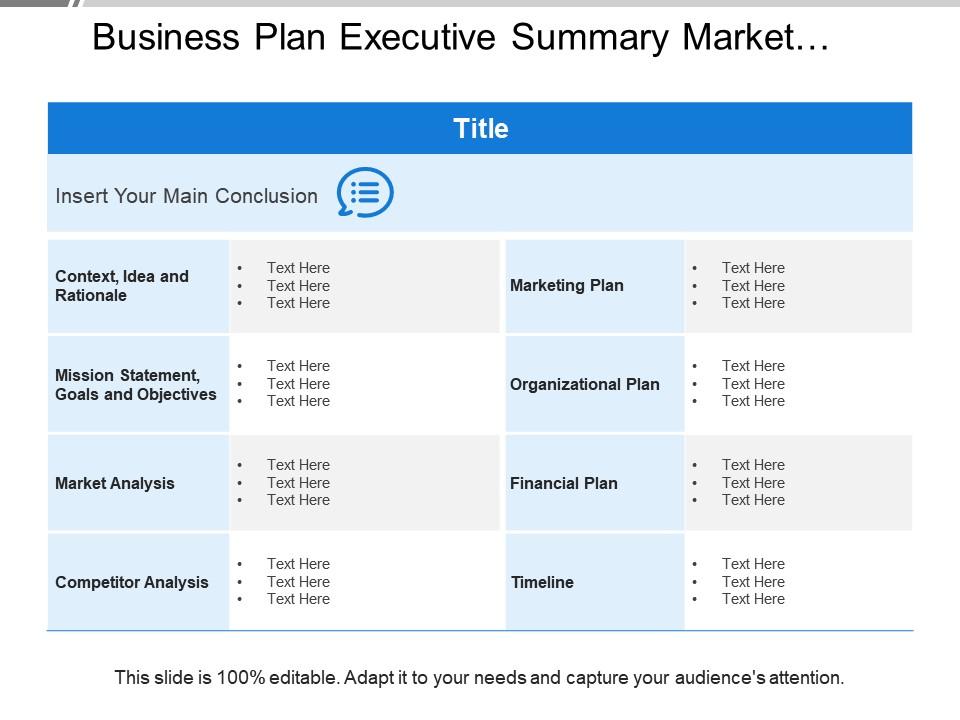
Presenting this set of slides with name - Business Plan Executive Summary Market Competitor Analysis. This is a four stage process. The stages in this process are Business Plan Executive Summary, Business Strategies Executive Summary, Business Plan Executive Overview.

FAQs for Business plan executive summary

Key metrics include market share, pricing strategies, product offerings, customer satisfaction scores, and financial performance indicators like revenue growth and profitability. These metrics enable businesses to identify competitive gaps, benchmark performance across sectors like retail and technology, and develop strategic positioning that enhances market advantage, ultimately delivering improved customer targeting and operational efficiency.

Identify primary competitors through market research, customer surveys, keyword analysis, industry reports, and social media monitoring to map businesses targeting similar audiences. These approaches enable discovery of direct competitors offering identical products, indirect competitors solving similar problems, and substitute competitors providing alternative solutions, ultimately delivering comprehensive competitive intelligence for strategic positioning and market advantage.

Effective competitor intelligence tools include SEMrush, Ahrefs, SimilarWeb, Brandwatch, and Crayon, alongside specialized platforms like Klenty and SpyFu for digital insights. These technologies streamline competitive analysis by automating data collection, tracking competitor pricing and campaigns, and monitoring social media presence, with many organizations finding that integrated intelligence platforms deliver comprehensive market visibility and faster strategic decision-making.

Analyzing a competitor's pricing strategy involves examining their price points, discount patterns, promotional offers, value propositions, and pricing models across different market segments. Through market research, customer surveys, and competitive intelligence tools, businesses can identify pricing gaps, understand competitor positioning, and adjust their own strategies, ultimately enabling more competitive pricing decisions and enhanced market positioning.

Consumer feedback reveals competitor strengths through positive reviews highlighting superior features, customer service excellence, and product reliability, while exposing weaknesses via complaints about pricing, functionality gaps, and support issues. This intelligence enables businesses to identify market opportunities, benchmark performance against rivals, and strategically position offerings to capitalize on competitor vulnerabilities, ultimately delivering enhanced customer experiences and sustainable competitive advantage.

Social media presence reveals competitors' marketing strategies, customer engagement tactics, brand positioning, content approaches, and audience demographics through direct observation of their posts, interactions, and follower responses. This intelligence enables businesses to identify market gaps, benchmark engagement rates, analyze customer sentiment, and adapt their own social strategies, ultimately delivering competitive insights that traditional analysis methods often miss.

Effective benchmarking techniques include competitive pricing analysis, feature comparison matrices, market share evaluation, customer satisfaction surveys, and financial performance reviews. These methods enable organizations to identify strategic gaps, optimize pricing strategies, and enhance product offerings, with many companies finding that systematic benchmarking ultimately delivers improved market positioning and sustainable competitive advantages.

SWOT analysis enables deeper competitive understanding by systematically evaluating competitors' strengths, weaknesses, opportunities, and threats alongside your own positioning. This strategic comparison reveals market gaps, competitive advantages, and potential vulnerabilities, with many organizations finding that regular SWOT assessments of key competitors ultimately streamline strategic planning and enhance market positioning decisions.

Key factors include revenue comparison, customer base size, geographic presence, product portfolio breadth, and distribution channels. Through analyzing pricing strategies, marketing spend, and customer retention rates, businesses can gauge competitive positioning while identifying market gaps, with many organizations finding that combining quantitative metrics with qualitative brand perception data delivers comprehensive competitive intelligence for strategic planning.

Marketing strategy variations significantly reshape competitor positioning by influencing brand perception, market share distribution, and customer loyalty patterns across different segments. Companies employing digital-first approaches often capture younger demographics while traditional advertisers maintain established customer bases, with many organizations finding that strategic combinations of both channels deliver enhanced market differentiation and competitive advantage.

Competitor product analysis reveals pricing strategies, feature gaps, target market positioning, customer pain points, and differentiation opportunities. These insights enable organizations to identify unmet market needs, optimize their value propositions, and develop strategic advantages, with many companies finding that comprehensive competitor analysis drives product innovation, improves market positioning, and ultimately delivers enhanced competitive differentiation.

Track competitors' strategic changes through financial report analysis, product launch monitoring, partnership announcements, leadership shifts, and market positioning evolution. By systematically analyzing quarterly earnings calls, patent filings, and strategic communications, businesses can identify emerging competitive threats and opportunities, ultimately enabling proactive strategy adjustments and maintaining competitive advantage in dynamic markets.

Ethical competitor analysis considerations include respecting intellectual property rights, avoiding industrial espionage, maintaining transparency in research methods, protecting confidential information, and adhering to legal boundaries. While competitive intelligence gathering is legitimate business practice, organizations must balance strategic advantage with ethical standards, ensuring their research methods comply with industry regulations and privacy laws, ultimately building sustainable competitive positioning through legitimate means.

Competitor analysis reveals market gaps, positioning opportunities, and unmet customer needs that help define your brand's distinctive strengths and differentiators. By examining competitors' messaging, pricing strategies, and service limitations, you can identify white space areas where your brand delivers superior value, ultimately crafting a compelling proposition that resonates with target audiences.

When analyzing competitors in rapidly changing industries, focus on their adaptation strategies, innovation pipelines, customer retention methods, technology investments, and strategic partnerships. These elements reveal competitive positioning, with companies in sectors like fintech, healthcare technology, and renewable energy finding that monitoring competitor responses to market shifts, digital transformation initiatives, and emerging customer needs ultimately delivers strategic advantages and faster market positioning.

Ratings and Reviews

90% of 100
Review Form
Write a review
Most Relevant Reviews
  1. 80%

    by Danial Fernandez

    Awesomely designed templates, Easy to understand.
  2. 100%

    by Domingo Hawkins

    Understandable and informative presentation.

2 Item(s)

per page: