

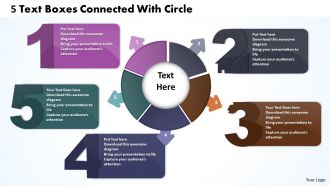
Business powerpoint templates five text boxes connected with circular process sales ppt slides






Try Before you Buy Download Free Sample Product
 Impress Your
Audience
 100%
Editable
 Save Hours
of Time


Maintain one of the most essential business process “Sales” for your growth through our business PowerPoint templates five text boxes connected with circular process sales PPT slides. This sales process PPT template is designed to signify the nature and importance of sales for the business. You can describe 5 stages of sales structure with this text boxes presentation template such as lead generation, qualify leads, demonstrate value, and more Whereas you can utilize this PPT design for describing other business processes such as customer retention, procurement process, production, sales strategies, business planning and many more. You can also use this sales process template as an effective business management tool to control or assess all your business strategies. Thus, simply download the PPT template to start working over this exceptional PowerPoint layout slides to represent your idea to your prospective viewers. Click on the download button. Bring on a change for the better with our Business PowerPoint Templates five text boxes connected with circular process Sales PPT Slides. Prove that you can improve on present results.
People who downloaded this PowerPoint presentation also viewed the following :
Business powerpoint templates five text boxes connected with circular process sales ppt slides with all 10 slides:
A well designed and put together presentation is the first step towards telling your audience that you know what you are talking about. That's why you need our Business PowerPoint Templates five text boxes connected with circular process Sales PPT Slides created by the best PowerPoint gurus in the industry.


FAQs for Business powerpoint templates five text boxes connected with circular process
Look, it's basically prospecting, qualifying, presenting your solution, handling objections, closing, then follow-up. Most teams tweak these - maybe throw in discovery calls or demos depending on your industry. Qualifying is honestly where everything gets decided, so don't speed through that part. Each stage needs clear "go/no-go" criteria so your team knows when to advance someone or just drop them. Oh, and here's what actually works: map out what your best salespeople are already doing at each step, then build your process around that. Way better than starting from scratch.
Honestly, flowcharts are a game changer for sales processes. Your team won't have to wade through endless bullet points anymore. Map out decision points, use timelines for deal progression, throw in some icons or colors for different stages. Most people absorb visual stuff way better anyway - it's just how our brains work. Plus charts help you catch bottlenecks that text might hide. I'd start with a simple one-page visual showing your whole process. Trust me, everyone will actually understand what's happening for once.
Look, you need the basics first - stage definitions with clear entry/exit points, plus who owns what at each step. Timeline expectations and metrics matter too. But here's the thing: most templates are just pretty flowcharts that nobody actually uses. The real value comes from adding objection handling scripts and knowing when to escalate deals. Oh, and resource requirements - can't forget those. Honestly, don't build some fantasy process that sounds perfect on paper. Map out how your team actually sells right now, then clean it up from there. Otherwise you'll just create something that sits in a drawer.
Honestly, just start with whatever basic template you have and then mess around with it until it actually matches how your team sells. Maybe you need an extra discovery stage, or your demo process is totally different - whatever. The email templates are usually the worst part though, they sound so robotic. Make them sound like actual humans wrote them. Oh, and don't make everything mandatory at each stage. Some activities should be optional depending on the deal. Definitely test it with just a couple reps first before you roll it out to everyone - trust me on that one. Their feedback will save you headaches later.
Dude, this is where the magic happens - data tells you if your sales templates actually work or if they're just pretty documents collecting dust. Track your conversion rates at each stage and see where people bail out. I swear, sometimes the stuff we think is brilliant totally bombs while random touchpoints end up closing deals. Look at win/loss ratios, how long cycles take, and which reps crush it following specific steps. Those insights help you ditch what's not working and focus on the money-makers.
Dude, you gotta stop using the same pitch for everyone - it's killing your close rates. When you build your personas into your sales templates, you can actually speak to what each buyer type cares about. Like, your CFO prospects want different info than your marketing directors, right? Short sentences work. But then you can flow into explaining how this makes conversations feel way more natural instead of robotic. Honestly, I've seen reps boost their numbers just by having 3 different template versions. Your prospects will actually think you get them rather than feeling like target
-
The content is very helpful from business point of view.
-
Out of the box and creative design.