

Business transformation framework presentation visual aids





Try Before you Buy Download Free Sample Product
 Impress Your
Audience
 100%
Editable
 Save Hours
of Time


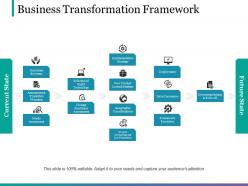
The business transformation framework Template can show a five-stage process which includes features like Future State, Current State, Management, Business, and Analysis. The Template basically shows 2 stages which are present and future state of a business company. The Business Transformation Framework ensures effective tuning of business organization and information system management. Customer needs, products, services, channels, business processes, management and organization on one side and IT requirements, data, information systems and infrastructure on the other. With BTF these different organizational elements are completely aligned, resulting in maximizing business results. The business transformation ideology Template can be used by various companies and organizations to present their ideas and strategies to change their inside framework of the business schemes and management. Business Transformation is the process of fundamentally changing the systems, processes, people, and technology across a whole business or business unit, to achieve measurable improvements in efficiency, effectiveness and stakeholder satisfaction. Save the business transformation Template to completely and clearly show the business transformation ides or steps necessarily required and that too in a short span of time. Our Business Transformation Framework Presentation Visual Aids are the basis for good growth. An excellent foundation for development.
People who downloaded this PowerPoint presentation also viewed the following :
Business transformation framework presentation visual aids with all 5 slides:
Expose the falsehoods being generated with our Business Transformation Framework Presentation Visual Aids. Don't allow instigators to foment chaos.


FAQs for Business transformation framework
Key components of a successful business transformation framework include strategic vision alignment, comprehensive change management processes, technology integration strategies, stakeholder engagement protocols, and performance measurement systems. These elements work together by establishing clear objectives, managing organizational resistance, and enabling seamless implementation, with many organizations finding that this structured approach delivers measurable outcomes, enhanced operational efficiency, and sustainable competitive advantage in an increasingly dynamic business environment.
Organizations assess their current state through comprehensive audits examining operational processes, technology infrastructure, financial performance, workforce capabilities, and market positioning. This baseline evaluation enables strategic gap identification and resource prioritization, with many companies finding that thorough current-state analysis accelerates transformation timelines while minimizing implementation risks and costs.
Technology serves as the primary enabler of business transformation by automating processes, enhancing data analytics capabilities, improving customer experiences, and streamlining operations across departments. Through cloud computing, AI, and digital platforms, organizations revolutionize their workflows, accelerate decision-making, and deliver faster services, ultimately gaining competitive advantage in increasingly dynamic markets.
Companies ensure transformation framework adaptability by implementing continuous monitoring systems, establishing flexible governance structures, incorporating feedback loops, and maintaining modular design approaches. Through agile methodologies and real-time data analytics, organizations in retail, financial services, and manufacturing can quickly pivot strategies, reallocate resources, and adjust priorities, ultimately delivering sustained competitive advantage in increasingly dynamic markets.
Business transformation success metrics include financial performance indicators, operational efficiency measures, customer satisfaction scores, employee engagement levels, and digital adoption rates. These comprehensive metrics enable organizations to track progress across revenue growth, cost reduction, and process streamlining, with many companies finding that balanced scorecards ultimately deliver clearer visibility into transformation outcomes and competitive advantage.
Cultural factors significantly influence transformation framework effectiveness by shaping employee acceptance, resistance levels, communication patterns, and change adaptability across organizational hierarchies. Organizations with collaborative cultures, open communication channels, and growth mindsets typically experience smoother implementations, while rigid or siloed cultures may require additional change management strategies, ultimately determining whether transformation initiatives deliver sustained competitive advantage.
Leaders can gain employee buy-in through transparent communication, involving staff in planning decisions, providing comprehensive training programs, and celebrating early wins to demonstrate progress. These strategies work by building trust, addressing concerns proactively, and showing tangible benefits, with many organizations finding that employees become transformation champions when they understand the vision and see personal growth opportunities.
A business transformation framework aligns with strategic goals by mapping transformation initiatives to key business objectives, establishing clear metrics that track progress toward strategic outcomes, and ensuring resource allocation supports priority areas. Through systematic alignment processes, organizations streamline operations, enhance competitive positioning, and accelerate goal achievement, with many companies finding that structured frameworks deliver measurable improvements in performance and strategic execution.
Common pitfalls include inadequate stakeholder engagement, insufficient change management processes, unrealistic timelines, lack of executive commitment, and poor communication strategies. These challenges often emerge when organizations underestimate cultural resistance, fail to allocate adequate resources, or attempt transformation without proper training, with many companies finding that gradual implementation and continuous feedback mechanisms deliver more sustainable results.
Industries adapt transformation frameworks by customizing methodologies, timelines, and priorities to address sector-specific regulations, customer expectations, and operational complexities. Healthcare organizations focus on patient safety and compliance, while manufacturing emphasizes automation and supply chain optimization, and financial services prioritize security and regulatory adherence, ultimately delivering enhanced efficiency and competitive positioning.
Business transformation efforts benefit from methodologies like Lean Six Sigma, Agile frameworks, change management models, digital maturity assessments, and stakeholder mapping tools. These approaches streamline processes by identifying inefficiencies, accelerating implementation timelines, and ensuring organizational alignment, with many enterprises finding that combining multiple methodologies delivers faster adaptation and sustainable competitive advantage.
Organizations can prioritize transformation initiatives by assessing business impact, resource requirements, strategic alignment, and implementation complexity through structured evaluation matrices. This approach enables companies to sequence high-impact, low-complexity projects first, while building capabilities for larger initiatives, with many enterprises finding that phased prioritization delivers measurable results and sustained momentum.
Stakeholder engagement ensures business transformation success by securing buy-in, identifying potential resistance, gathering critical insights, and facilitating smoother implementation across all organizational levels. Through strategic communication and involvement, companies minimize disruption, accelerate adoption rates, and enhance project outcomes, with many organizations finding that engaged stakeholders become transformation champions, ultimately delivering sustainable change and competitive advantage.
A successful business transformation framework supports innovation by establishing clear governance structures, fostering cross-functional collaboration, and creating dedicated resources for experimental initiatives. Through systematic change management and cultural alignment, organizations like Tesla and Amazon have accelerated product development cycles, reduced time-to-market, and enhanced customer experiences, ultimately delivering sustainable competitive advantage in rapidly evolving markets.
Continuous improvement serves as the foundation for sustainable business transformation by enabling organizations to adapt processes, refine strategies, and optimize operations through iterative cycles of assessment and enhancement. This approach ensures transformation initiatives remain relevant and effective over time, with companies like Toyota and Amazon leveraging continuous improvement to maintain competitive advantage while delivering enhanced customer experiences and operational efficiency.
-
Informative design.
-
Understandable and informative presentation.