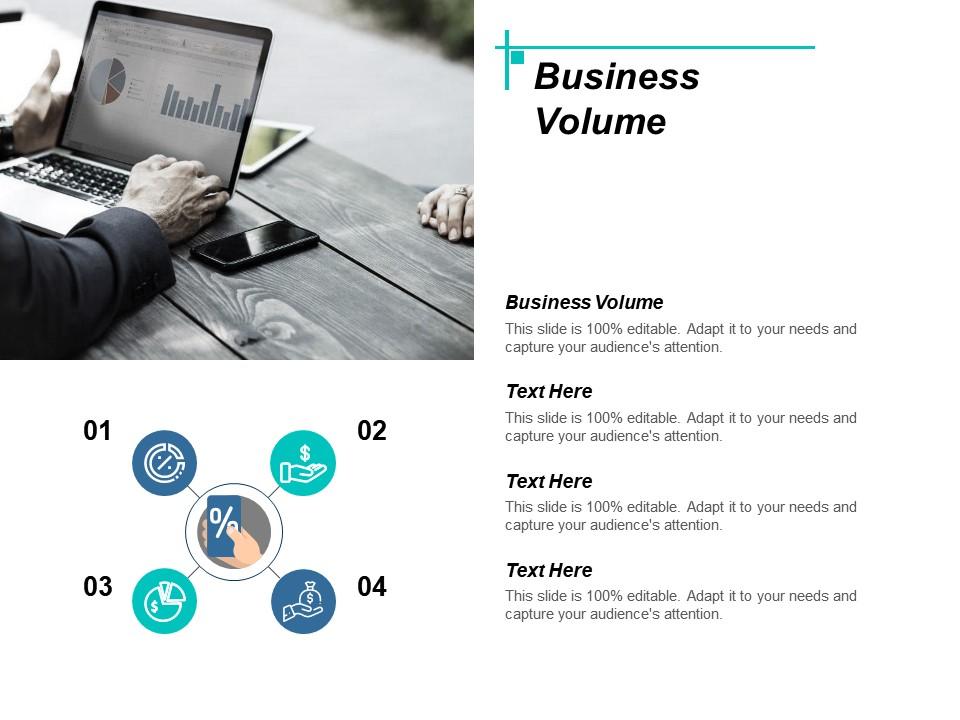
Business volume ppt powerpoint presentation gallery designs cpb
Try Before you Buy Download Free Sample Product
Audience
Editable
of Time
Ensure everyone is fully aware of his duties with our Business Volume Ppt Powerpoint Presentation Gallery Designs Cpb. Be able to issue comprehensive instructions.
People who downloaded this PowerPoint presentation also viewed the following :
Business volume ppt powerpoint presentation gallery designs cpb with all 6 slides:
Acquire credits galore with our Business Volume Ppt Powerpoint Presentation Gallery Designs Cpb. Get a huge amount of appreciation.
FAQs for Business volume ppt powerpoint presentation
Business volume fluctuations stem from seasonal demand patterns, economic cycles, consumer behavior shifts, regulatory changes, and competitive market dynamics. These factors impact industries differently, with retail experiencing holiday surges, healthcare showing steady demand, and construction facing weather-related variations, ultimately requiring companies to develop strategic forecasting and resource allocation capabilities for sustained operational efficiency.
Small businesses can increase business volume through strategic digital marketing, customer retention programs, operational automation, and strategic partnerships with complementary services. By leveraging social media advertising, implementing referral systems, and automating routine processes, companies streamline operations while expanding reach, ultimately delivering higher revenue with minimal cost increases and sustainable competitive advantage.
Market research enables businesses to forecast volume trends by analyzing consumer behavior, competitor activities, economic indicators, seasonal patterns, and emerging market opportunities. Through surveys, focus groups, and data analytics, organizations can identify demand shifts, predict purchasing cycles, and anticipate market fluctuations, ultimately delivering more accurate volume projections and strategic planning advantages.
Seasonal variations create predictable peaks and valleys in business volume through consumer behavior shifts, weather patterns, and holiday cycles, significantly impacting cash flow and resource allocation. Strategic mitigation includes diversifying product lines, implementing flexible staffing models, developing counter-seasonal revenue streams, and leveraging predictive analytics for inventory management, with many retailers and hospitality businesses finding that proactive planning ultimately delivers consistent profitability.
Technology and automation enhance business volume for service-oriented businesses by streamlining operations, reducing manual tasks, and enabling faster service delivery. Through AI-powered scheduling, automated customer communications, and digital workflow management, companies like healthcare providers, financial services, and consulting firms can serve more clients simultaneously while maintaining quality, ultimately delivering improved capacity utilization and competitive advantage.
Businesses should track revenue growth rates, unit sales volumes, customer acquisition numbers, market share percentages, and transaction frequency to evaluate volume changes effectively. These metrics enable organizations to identify trends, optimize resource allocation, and enhance operational efficiency, with many companies finding that combining leading indicators like pipeline growth with lagging indicators delivers comprehensive insights for strategic decision-making.
Customer feedback drives business volume increases by identifying service gaps, revealing new product opportunities, enhancing customer experiences, and building stronger retention strategies. Through systematic feedback analysis, organizations streamline operations, develop targeted offerings, and improve customer satisfaction rates, with many companies finding that responsive feedback implementation delivers higher repeat purchase rates, expanded market reach, and ultimately sustainable revenue growth in competitive markets.
Low business volume typically necessitates organizational restructuring through downsizing, role consolidation, and streamlined hierarchies to maintain operational efficiency and cost control. These adjustments enable organizations to optimize resource allocation by prioritizing core functions, reducing overhead expenses, and maintaining strategic flexibility, with many companies finding that leaner structures ultimately deliver improved decision-making speed and competitive responsiveness.
Marketing strategies influence business volume by enhancing brand visibility, targeting specific customer segments, and optimizing conversion rates across multiple touchpoints. Digital channels like social media marketing, search engine optimization, and email campaigns tend to deliver the highest ROI, with many organizations finding that integrated omnichannel approaches combining traditional advertising with digital platforms ultimately drive sustained volume growth and competitive advantage.
Customer loyalty and retention serve as fundamental pillars for sustaining business volume by reducing acquisition costs, increasing lifetime value, and generating predictable revenue streams through repeat purchases and referrals. Loyal customers in sectors like retail and financial services typically spend 67% more than new customers, while delivering consistent cash flow and enabling businesses to forecast growth more accurately, ultimately creating sustainable competitive advantages in increasingly crowded markets.
Businesses can diversify their offerings through product line extensions, market expansion, strategic partnerships, customer segmentation refinements, and complementary service additions. These approaches enable organizations to capture new revenue streams, reduce dependency on single markets, and enhance customer lifetime value, with many companies finding that strategic diversification delivers sustained growth and competitive resilience.
B2B companies typically manage fewer, higher-value transactions with longer sales cycles, complex decision-making processes, and relationship-focused approaches, while B2C businesses handle higher transaction volumes with shorter cycles and standardized processes. Through different operational frameworks, B2B organizations prioritize account management and customized solutions, whereas B2C companies streamline automation and customer experience optimization, ultimately requiring distinct scaling strategies for sustained growth.
Strategic partnerships increase business volume by expanding market reach, sharing customer bases, combining complementary expertise, leveraging joint marketing efforts, and accessing new distribution channels. Through strategic collaborations, companies in sectors like retail, technology, and financial services can reduce customer acquisition costs, accelerate market penetration, and deliver enhanced value propositions, ultimately achieving faster growth than competing independently.
Companies that successfully scaled rapidly emphasize robust infrastructure development, strategic partnerships, data-driven decision making, and agile operational frameworks that adapt to increased demand. These organizations, particularly in tech and retail sectors, demonstrate that sustainable scaling requires balancing growth speed with quality control, ultimately delivering competitive advantage through operational efficiency and enhanced customer experiences.
Economic indicators strongly correlate with business volume through employment rates, consumer spending, interest rates, and GDP growth affecting sector performance differently. While retail and hospitality sectors closely track consumer confidence indicators, manufacturing and construction respond more to interest rates and industrial production metrics, with financial services finding that credit demand fluctuations ultimately deliver predictive insights for volume planning.
No Reviews