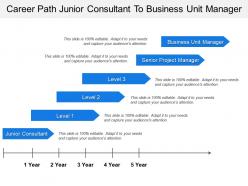
Career path junior consultant to business unit manager

Rating:
100%
Career path junior consultant to business unit manager
Slide 1 of 5
Favourites Favourites

Try Before you Buy Download Free Sample Product

Audience Impress Your
Audience
Editable 100%
Editable
Time Save Hours
of Time
The Biggest Sale is ending soon in
0
0
:
0
0
:
0
0
Rating:
100%
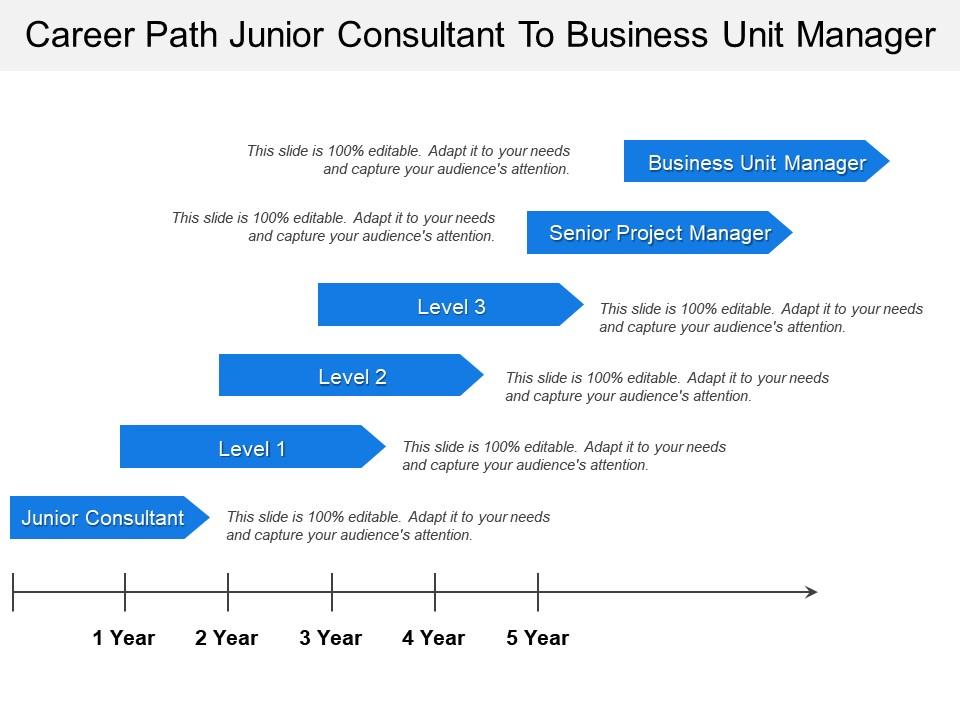
Presenting this set of slides with name - Career Path Junior Consultant To Business Unit Manager. This is a six stage process. The stages in this process are Career Mapping, Career Growth, Career Path.

FAQs for Career path junior consultant to

Essential steps for creating a successful career progression plan include conducting honest skills assessments, defining specific long-term goals, identifying required competencies, mapping potential pathways, and establishing measurable milestones. These strategic components work together by aligning personal strengths with market opportunities, enabling targeted skill development, and creating accountability frameworks, with many professionals finding that structured planning accelerates advancement while maximizing earning potential.

Leveraging mentorship accelerates career advancement by providing personalized guidance, expanding professional networks, and offering insider industry insights that aren't typically accessible through formal channels. Through strategic mentor relationships, professionals gain accelerated skill development, enhanced visibility within organizations, and access to leadership opportunities, with many finding that mentorship ultimately delivers faster promotions and increased strategic positioning.

Networking facilitates career growth by providing access to hidden job opportunities, industry insights, mentorship guidance, and professional referrals that accelerate advancement. Through strategic relationship building, professionals unlock doors to leadership positions, collaborative projects, and skill development opportunities, with many finding that strong networks deliver faster promotions and expanded influence.

Transferable skills significantly accelerate career progression by enabling professionals to pivot between industries, leverage diverse experiences, and adapt to evolving market demands. Skills like leadership, analytical thinking, and communication translate seamlessly across sectors, with many professionals finding that their cross-industry expertise provides competitive advantages in strategic roles, ultimately delivering faster promotions and broader opportunities.

Professionals can navigate career stagnation through strategic skill development, lateral moves, expanded networking, seeking mentorship, and pursuing additional certifications or education. These approaches enable career momentum by diversifying expertise, building cross-functional relationships, and demonstrating initiative, with many organizations increasingly recognizing proactive professionals who invest in continuous learning and strategic positioning for advancement opportunities.

Continuous education is essential for maintaining career relevance, as it enables professionals to adapt to evolving technologies, industry standards, and market demands while developing new competencies. Through strategic upskilling and professional development, employees enhance their value proposition, accelerate advancement opportunities, and maintain competitive positioning, with many organizations increasingly prioritizing learning-focused talent for leadership roles.

Key indicators of career progression include increased responsibility and decision-making authority, salary advancement, leadership opportunities, expanded professional networks, and recognition through promotions or industry awards. These markers typically manifest through project ownership, team management roles, cross-functional collaboration, and strategic contributions, with many professionals finding that consistent skill development and measurable business impact ultimately accelerate their advancement trajectory.

Personal branding significantly influences advancement opportunities by establishing your professional reputation, demonstrating thought leadership, and increasing visibility within your industry and organization. A strong personal brand opens doors through enhanced networking, positions you as a subject matter expert, and attracts recruiters, with many professionals finding that consistent brand building accelerates promotions and career transitions.

Common career progression pitfalls include neglecting skill development, avoiding feedback, focusing solely on promotions over learning, and failing to build professional networks. While these mistakes can stall advancement, organizations increasingly recognize that employees who embrace continuous learning, seek mentorship, and align goals with business objectives ultimately deliver stronger performance and accelerate their career trajectory.

Workplace culture significantly influences career trajectories by shaping promotion opportunities, mentorship availability, skill development programs, and performance evaluation criteria. Organizations with collaborative, growth-oriented cultures enable employees to advance through cross-functional projects, leadership training, and transparent feedback systems, while many professionals find that inclusive environments accelerate advancement and enhance long-term career satisfaction.

Career development tracking tools include performance management software, learning management systems, mentorship platforms, skill assessment applications, and goal-setting frameworks. These technologies enhance professional growth by providing structured feedback mechanisms, competency mapping, and progress visualization, with many organizations finding that integrated platforms deliver better employee engagement, clearer advancement pathways, and improved talent retention.

Performance reviews facilitate career planning by identifying skill gaps, documenting achievements, setting development goals, and establishing clear advancement pathways with supervisors. Through structured feedback sessions, professionals can align their aspirations with organizational needs, secure targeted training opportunities, and create measurable milestones, ultimately enabling strategic career progression and enhanced professional growth.

Remote work presents both challenges and opportunities for career advancement, with reduced face-time potentially limiting visibility while digital collaboration tools enable broader networking and skill development. Many professionals find that remote work enhances career progression through increased flexibility, access to global opportunities, and improved work-life balance, ultimately delivering greater job satisfaction and strategic career positioning in an increasingly digital workplace.

Individuals can effectively communicate career aspirations through scheduled one-on-one meetings, documented development plans, and specific goal-setting conversations with direct supervisors. By articulating clear timelines, desired skill developments, and alignment with organizational objectives, professionals create transparent pathways for advancement while enabling management to provide targeted mentorship, training opportunities, and strategic project assignments that accelerate career progression.

Underrepresented groups face challenges including limited mentorship access, unconscious bias in promotions, fewer networking opportunities, and stereotype-based assumptions about capabilities. These professionals can overcome barriers by seeking diverse mentors, building strategic alliances across departments, leveraging employee resource groups, and consistently documenting achievements, ultimately creating visibility that accelerates advancement in increasingly inclusive organizations.

Ratings and Reviews

100% of 100
Review Form
Write a review
Most Relevant Reviews
  1. 100%

    by Thomas Hill

    Attractive design and informative presentation.
  2. 100%

    by O'Connor Collins

    Great designs, Easily Editable.

2 Item(s)

per page: