Chain of events for scientific method

Chain of events for scientific method
Slide 1 of 5
Favourites Favourites

Try Before you Buy Download Free Sample Product

Audience Impress Your
Audience
Editable 100%
Editable
Time Save Hours
of Time
The Biggest Sale is ending soon in
0
0
:
0
0
:
0
0
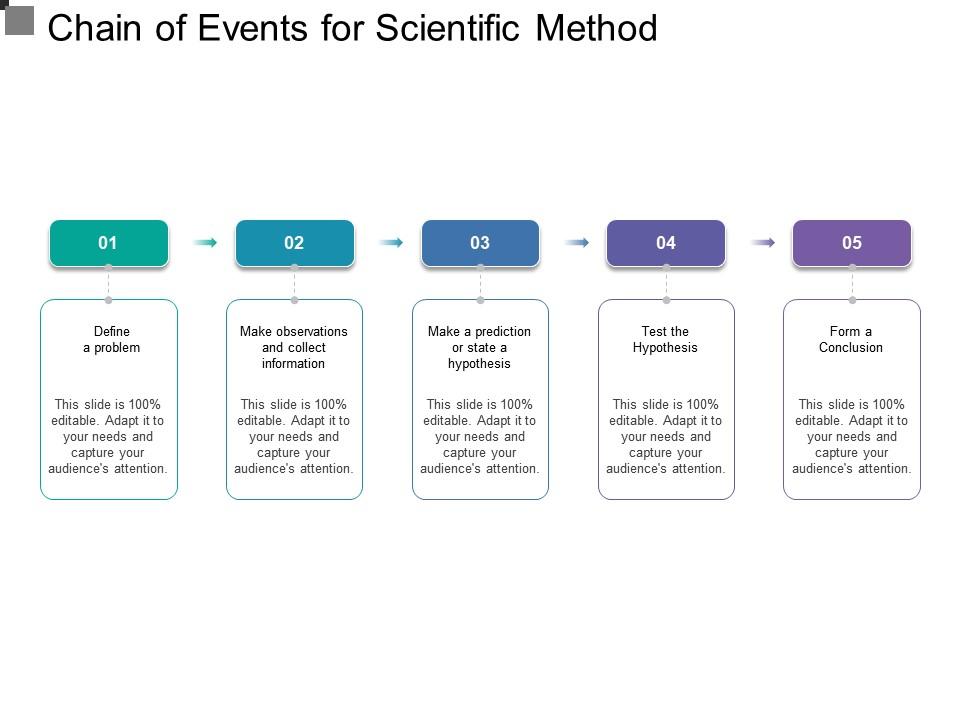
Presenting this set of slides with name - Chain Of Events For Scientific Method. This is a five stage process. The stages in this process are Chain Of Events, Corporate, Business.

FAQs for Chain of events

The scientific method includes observation, hypothesis formation, experimentation, data analysis, and conclusion drawing, with each step building systematically on the previous one. These interconnected stages enable researchers across industries like pharmaceuticals, technology development, and quality control to validate theories, minimize uncertainty, and deliver evidence-based solutions, ultimately enhancing decision-making processes and competitive advantage.

Hypotheses are testable predictions or educated guesses that researchers propose before conducting experiments, while theories are well-established explanations supported by extensive evidence from multiple studies and observations. In pharmaceutical research, scientists might hypothesize that a specific compound reduces inflammation, but germ theory represents decades of validated research, with many research institutions finding that this distinction streamlines experimental design and enhances scientific credibility.

Experimentation serves as the critical testing mechanism that determines whether a hypothesis accurately predicts real-world outcomes through controlled variables, measurable data collection, and reproducible results. Through systematic testing, researchers can either confirm their theoretical predictions or identify flaws in their reasoning, with many scientific institutions finding that well-designed experiments ultimately deliver reliable evidence and competitive research advantages.

The scientific method enhances decision-making across business, education, healthcare, and public policy by systematically forming hypotheses, collecting data, and testing results. Organizations increasingly use this approach for market research, operational improvements, and strategic planning, with companies like Amazon and Netflix applying controlled experiments to optimize customer experiences, ultimately delivering data-driven insights and competitive advantages.

Biases can influence scientific research through selective data collection, confirmation bias in hypothesis testing, publication preferences favoring positive results, and unconscious researcher expectations affecting observations. These influences compromise objectivity by skewing sample selection, interpretation methods, and statistical analysis, with many research institutions increasingly implementing blind studies, peer review processes, and diverse research teams to minimize bias impact and enhance scientific credibility.

Peer review processes enhance scientific reliability by subjecting research to independent expert evaluation, identifying methodological flaws, verifying data accuracy, and ensuring proper statistical analysis. Through this rigorous vetting system, institutions across sectors like pharmaceuticals, environmental consulting, and medical research find that peer-reviewed studies deliver greater credibility, reduce costly errors, and ultimately provide more dependable foundations for evidence-based decision-making.

Reproducibility ensures scientific findings are reliable and valid by allowing independent researchers to replicate experiments and verify results, building credibility through consistent outcomes. This fundamental principle strengthens research integrity across disciplines like pharmaceuticals, climate science, and medical research, with many institutions finding that reproducible studies accelerate innovation, reduce costly errors, and ultimately deliver trustworthy knowledge for evidence-based decision-making.

Qualitative and quantitative research methods complement each other within the scientific method by providing comprehensive understanding through different lenses, with qualitative methods exploring underlying motivations and behaviors while quantitative methods measure statistical relationships and outcomes. Many research organizations find that combining both approaches delivers deeper insights, enhanced validity, and more robust conclusions, ultimately enabling better decision-making across sectors.

Ethical considerations include informed consent, participant safety, data privacy, research integrity, and minimizing harm to subjects or environments. These principles ensure responsible innovation across sectors like pharmaceuticals, technology, and healthcare, with many organizations finding that robust ethical frameworks enhance credibility, reduce regulatory risks, and ultimately deliver sustainable competitive advantages in research-driven markets.

The scientific method evolves through refined measurement techniques, enhanced data collection technologies, computational modeling advances, and collaborative research platforms that enable more precise hypotheses and faster validation cycles. Modern discoveries in fields like genomics, quantum physics, and artificial intelligence continuously expand methodological frameworks, with researchers increasingly leveraging machine learning and big data analytics to uncover patterns previously beyond human detection capabilities.

Scientific literacy enhances public understanding by teaching critical thinking skills, evidence evaluation methods, hypothesis testing principles, and data interpretation techniques. Through improved scientific literacy, communities better recognize peer review processes, distinguish correlation from causation, and make informed decisions about health policies, while ultimately fostering evidence-based civic engagement and reducing susceptibility to misinformation.

Educators can effectively teach the scientific method through hands-on experiments, age-appropriate inquiry projects, interactive demonstrations, visual learning aids, and real-world problem-solving activities. By adapting complexity levels, incorporating technology tools, and connecting scientific processes to students' everyday experiences, teachers enhance engagement and comprehension, ultimately delivering stronger analytical skills and scientific literacy across diverse learning environments.

Scientists face challenges including funding constraints that influence research directions, time pressures that may limit thorough hypothesis testing, ethical considerations in human studies, and institutional biases toward publishable results. These obstacles often require researchers to balance methodological rigor with practical limitations, while many institutions increasingly recognize that supporting comprehensive scientific processes ultimately delivers more reliable findings and stronger competitive advantage in research outcomes.

Interdisciplinary collaboration enriches the scientific method by combining diverse methodologies, theoretical frameworks, and analytical perspectives from multiple fields, enabling more comprehensive hypothesis testing and data interpretation. When researchers from biology, physics, computer science, and social sciences collaborate on complex problems like climate change or medical research, they deliver more robust findings, accelerate innovation, and ultimately achieve breakthroughs impossible through single-discipline approaches.

Common misconceptions include believing the scientific method produces absolute truths, that theories are just guesses, and that single studies definitively prove concepts. Many also assume scientific consensus emerges quickly and that scientists work in isolation rather than collaboratively, with educational institutions increasingly finding that structured teaching approaches help clarify these processes and enhance critical thinking skills.

Ratings and Reviews

0% of 100
Review Form
Write a review
Most Relevant Reviews

No Reviews