Checklist needed for autonomous maintenance total productivity maintenance

Rating:
80%
Checklist needed for autonomous maintenance total productivity maintenance
Slide 1 of 6

or

Favourites Favourites

Try Before you Buy Download Free Sample Product

Audience Impress Your
Audience
Editable 100%
Editable
Time Save Hours
of Time
The Biggest Sale is ending soon in
0
0
:
0
0
:
0
0
Rating:
80%
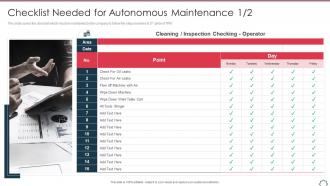
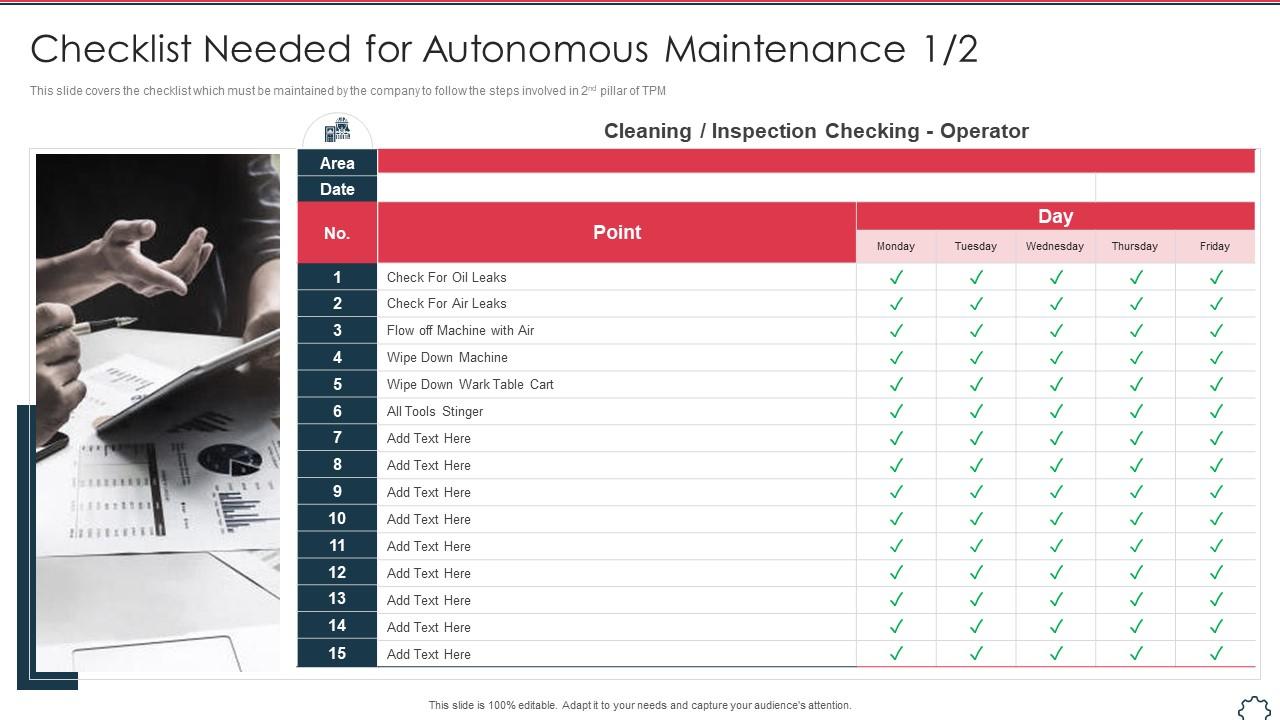
This slide covers the checklist which must be maintained by the company to follow the steps involved in 2nd pillar of TPM. Introducing Checklist Needed For Autonomous Maintenance Total Productivity Maintenance to increase your presentation threshold. Encompassed with one stages, this template is a great option to educate and entice your audience. Dispence information on Operator, Checklist Needed, Autonomous Maintenance, using this template. Grab it now to reap its full benefits.
FAQs for Checklist needed for autonomous maintenance

Honestly, the biggest thing you'll notice is way less downtime - your operators start catching problems before everything goes to hell. Maintenance costs drop like crazy since you're not doing those brutal 2am emergency repairs anymore. Your team actually gets invested too, which is huge - they finally understand what they're running instead of just babysitting machines. Oh, and product quality gets way more consistent when your equipment isn't falling apart. I'd say pick your most critical machines first and just build from there. Don't try to do everything at once or you'll burn out your crew.

So basically, autonomous maintenance is just giving your operators simple daily tasks they can handle - cleaning, visual checks, basic lubrication. Nothing too crazy. Meanwhile your actual maintenance team handles the heavy stuff like overhauls and complex repairs. Honestly, it makes total sense because operators are already there watching the machines anyway, so why not have them catch small problems before they blow up? I'd start by figuring out what routine tasks your operators can safely do without needing a ton of training. Then just build your checklist around that stuff. Way more efficient than waiting for scheduled maintenance.

For your checklist, hit the basics first: cleaning, inspection, lubrication, minor adjustments. Visual checks are huge - look for leaks, weird wear patterns, loose bolts, fluid levels. Don't forget safety stuff like guards and emergency stops. Temperature readings or vibration checks work great if your equipment can handle it. Honestly, the biggest mistake I see is making these things too complicated. Keep it simple enough that operators won't skip steps or get overwhelmed. Nobody's got time for a PhD-level checklist when there's production to run. Build from these core items, then tweak based on what actually breaks on your specific machines.

Honestly, the biggest thing is getting your people to actually care about the equipment instead of just going through the motions. Have them help build the checklists - they know what breaks and what warning signs to watch for way better than some manager in an office. Train them properly so they get why they're doing each step. I've watched so many of these programs crash and burn because leadership just drops some generic checklist and expects magic to happen. Celebrate when someone spots a problem early, and actually listen to their suggestions. Oh, and start with your best team first - you'll need those success stories to convince everyone else it's worth doing.

Dude, the resistance is real - operators think it's not their problem and supervisors get all territorial about control. I've watched some pretty heated pushback happen! Train people on easy stuff first like cleaning and basic checks, then work up from there. Your checklists better be crystal clear with visuals because nobody's got time for confusing instructions. Quick wins are everything for getting buy-in. Oh, and definitely pilot this with whoever's most willing first. Use those success stories to win over the doubters - works way better than trying to convince everyone at once.

Quarterly reviews are the bare minimum, but honestly that's pretty weak if you're having real issues. When operators start cutting corners or equipment keeps acting up, switch to monthly. New gear or process changes? Update that checklist right away - don't sit on it. The whole thing falls apart if it's not actually helping your crew day-to-day. Set those calendar reminders though, and make sure someone owns this task. Otherwise it'll keep getting bumped for "more urgent" stuff and you'll never get around to it.

Training makes or breaks the whole thing, honestly. Your operators can't just magically know how to spot problems - they need the actual skills first. I've watched so many places crash and burn because they skipped this step and went straight to handing out checklists. Bad move. People need to get why they're doing each check, not just what to look for. Normal vs. weird equipment behavior, when to call for help, basic troubleshooting stuff. Start simple with equipment basics, then work up from there. Without solid training upfront, you're basically setting everyone up to fail.

Honestly, going digital with your maintenance checklists is a game changer. Real-time data flows in automatically, and you'll get pinged when tasks are actually due. Mobile devices give your team instant access to equipment history and manuals - no more hunting around for paperwork. The analytics side is pretty sweet too; you can spot equipment patterns and track completion rates easily. Photo documentation becomes simple. Lost forms? That's ancient history now. I'd start small though - pick your most critical equipment and test a basic mobile app first. You'll see the difference right away, trust me.

Honestly, I'd start simple with just uptime tracking and how often stuff breaks down unexpectedly. Mean time between failures is solid too. The thing that really matters though? See how many small problems your operators are catching themselves vs calling maintenance every time. Training completion rates are obvious but operator confidence surveys - that's where you get the real tea on how things are going. Cost per maintenance hour gives you the money side of things, and OEE shows the big picture. But seriously, don't try to track everything at once or you'll drown in spreadsheets. Pick like 3-4 metrics max to start.

Honestly, start with a dead simple checklist - daily inspections, basic cleaning, lube points, stuff they can handle without calling maintenance every five minutes. Photos and diagrams are clutch because nobody wants to guess what "check the thingamajig" means. I'd run quick training sessions first, then let them tweak the checklist based on what they're actually seeing. Makes them feel like partners instead of robots following orders. Oh, and don't try to do everything at once - pick one machine, get their input, then roll it out. Way less overwhelming that way.

Keep it simple but cover your bases - write down what you found, when, and what you did about it immediately. Everyone should use the same forms or apps so the info stays consistent. Take tons of photos, especially for weird wear patterns that are impossible to describe properly. Write like you're leaving notes for the next person - specific enough they won't need to track you down later asking "what did you mean by this?" Oh, and definitely flag any patterns or repeat issues you notice. That stuff's pure gold when you're planning maintenance schedules.

Dude, autonomous maintenance is like a cheat code for OEE. Your operators do the basic stuff - cleaning, lubing, quick visual checks - and boom, you catch problems before they wreck your day. No more surprise breakdowns tanking your availability numbers. Quality stays consistent too since everything's running at peak condition. Train your crew on simple checks during their regular shifts. Way better than playing catch-up after something already broke. I swear, it sounds almost too easy but it actually works. Performance rates just naturally stay higher when equipment isn't constantly fighting you.

Oh totally! Hospitals do this all the time - nurses check their own monitors and IV pumps instead of calling maintenance for every little thing. Hotels are big on it too. Their housekeeping crews handle basic HVAC checks and spot leaks before they become disasters. Really it's just teaching your front-line people to catch problems early and do simple fixes themselves. Way less downtime that way. I'd probably start with equipment that won't kill anyone if it breaks - build up confidence first, you know? Then move to the critical stuff once everyone's comfortable with the routine.

Look at your incident reports from last year first - that's where you'll find patterns. Food processing? Heavy focus on sanitation, temp monitoring, contamination stuff. Manufacturing leans more toward vibration analysis and lube schedules. Healthcare equipment needs biocompatibility and sterilization checks since patient safety is everything. Oil and gas gets tricky with explosion-proof gear and leak detection. Honestly, just figure out what failures would totally screw you over, then build those checks into your routine. Each industry has its own nightmare scenarios, so your checklist should reflect that reality.

Look, cross-functional teams are total game-changers for autonomous maintenance. Get your maintenance crew, operators, engineering, and quality people in the same room - they'll figure out what operators can actually handle vs what needs the specialists. Different perspectives make all the difference here. Have them design checklists together and train operators on the basic stuff. Oh and set up clear escalation paths for when things get messy (they will). The real breakthrough happens when everyone stops hoarding knowledge in their little silos. I'd start with weekly meetings to tackle your biggest maintenance headaches, then slowly hand off the simple tasks to operators.

Ratings and Reviews

80% of 100
Review Form
Write a review
Most Relevant Reviews
  1. 80%

    by Jack Johnson

    Perfect template with attractive color combination.
  2. 80%

    by O'Kelly Phillips

    Great quality slides in rapid time.

2 Item(s)

per page: