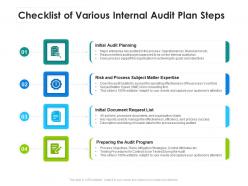
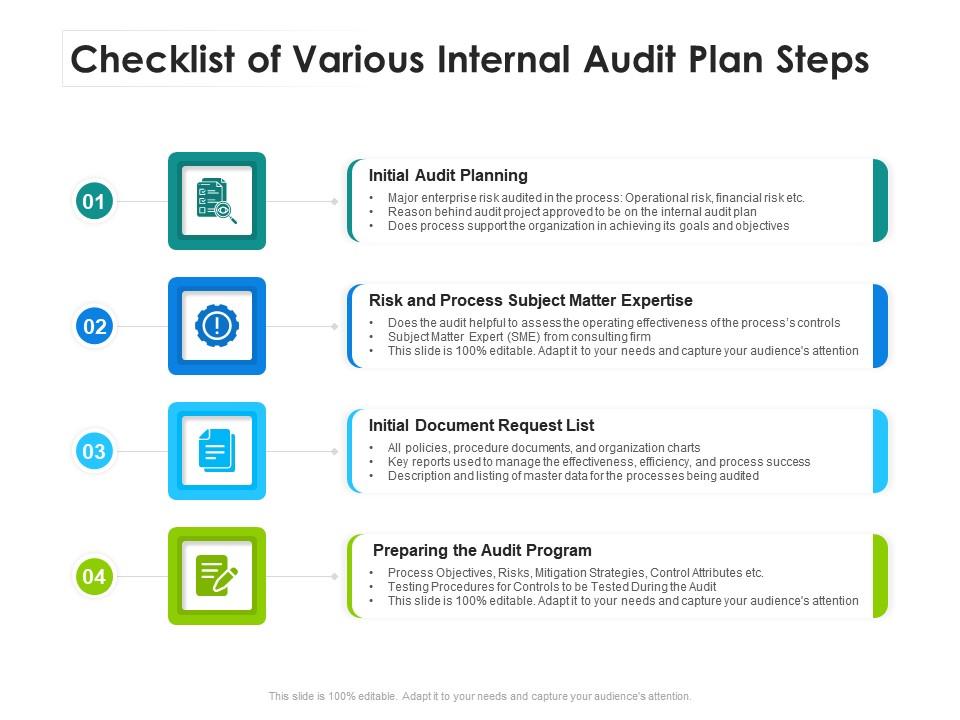
Checklist of various internal audit plan steps
Try Before you Buy Download Free Sample Product
Audience
Editable
of Time
Our Checklist Of Various Internal Audit Plan Steps are topically designed to provide an attractive backdrop to any subject. Use them to look like a presentation pro.
People who downloaded this PowerPoint presentation also viewed the following :
Checklist of various internal audit plan steps with all 2 slides:
Use our Checklist Of Various Internal Audit Plan Steps to effectively help you save your valuable time. They are readymade to fit into any presentation structure.
FAQs for Checklist of various internal
An effective internal audit plan checklist should include risk assessment frameworks, audit scope definitions, resource allocation timelines, compliance requirements, and stakeholder communication protocols. These components work together by establishing clear audit objectives, ensuring regulatory alignment, and streamlining execution processes, with many organizations finding that comprehensive checklists ultimately deliver improved audit efficiency and enhanced risk management capabilities.
An internal audit plan checklist helps identify organizational risks by systematically evaluating financial controls, operational processes, compliance requirements, data security measures, and strategic alignment across departments. Through structured risk assessment frameworks, organizations can pinpoint vulnerabilities in areas like fraud prevention, regulatory compliance, and process efficiency, ultimately enabling proactive risk mitigation and enhanced operational resilience.
Materiality guides internal audit plan development by helping auditors prioritize high-risk areas, allocate resources to significant processes, and focus on transactions that could substantially impact financial statements. This risk-based approach enables organizations to concentrate audit efforts on material business operations, regulatory compliance areas, and strategic initiatives, ultimately delivering more effective risk management and stakeholder confidence.
**INPUT**: Which stakeholders should be consulted when creating an internal audit plan checklist? **OUTPUT**: Key stakeholders include the audit committee, senior management, department heads, compliance officers, and risk management teams. These consultations streamline audit planning by incorporating diverse perspectives, identifying critical risk areas, and ensuring comprehensive coverage, with many organizations finding that this collaborative approach ultimately delivers more effective audits and stronger governance outcomes. **Word count: 52 words**
Internal audit plan checklists should be reviewed quarterly and updated annually, with immediate revisions following significant organizational changes, regulatory updates, or risk landscape shifts. Many organizations find that regular reviews enable enhanced compliance monitoring, streamlined audit processes, and proactive risk management, ultimately delivering improved operational efficiency and stronger governance frameworks in an increasingly complex regulatory environment.
Methods to assess internal audit plan checklist effectiveness include regular performance reviews, stakeholder feedback collection, compliance rate tracking, audit quality measurements, and comparative benchmarking against industry standards. Through these assessment approaches, organizations can identify process gaps, enhance operational efficiency, and strengthen risk management capabilities, with many finding that systematic evaluation ultimately delivers improved audit outcomes and greater organizational transparency.
Common pitfalls include insufficient risk assessment, lack of stakeholder input, overly rigid timelines, inadequate resource allocation, and failure to align with organizational objectives. These oversights can compromise audit effectiveness by missing critical risk areas, creating unrealistic expectations, and reducing stakeholder buy-in, with many organizations finding that flexible, risk-based approaches ultimately deliver more comprehensive coverage and actionable insights.
Technology enhances internal audit plan checklist effectiveness by automating risk assessments, enabling real-time data analysis, and streamlining documentation processes through cloud-based platforms and AI-powered analytics. These digital solutions deliver continuous monitoring capabilities, predictive risk identification, and seamless collaboration across audit teams, with many organizations finding that automated workflows reduce audit cycle times while improving accuracy and compliance tracking.
Regulatory requirements for internal audit plan checklists include SOX compliance, industry-specific regulations like GDPR or HIPAA, financial reporting standards, risk management protocols, and data protection mandates. These requirements enable organizations to maintain compliance across banking, healthcare, and manufacturing sectors, while streamlining audit processes, minimizing regulatory violations, and ultimately delivering enhanced operational transparency and competitive advantage.
An internal audit plan checklist ensures consistency by standardizing audit procedures, documentation requirements, risk assessment criteria, and reporting formats across all departments. This systematic approach enables organizations to maintain uniform audit quality, streamline compliance processes, and deliver consistent findings, with many companies finding that standardized checklists reduce audit variability and enhance overall governance effectiveness.
Implementing an internal audit plan checklist typically requires skilled audit personnel, robust audit management software, comprehensive documentation templates, stakeholder collaboration tools, and adequate budget allocation. These resources work together by streamlining audit processes, enhancing documentation accuracy, and facilitating seamless communication across departments, with many organizations finding that strategic resource investment ultimately delivers improved compliance outcomes and operational efficiency.
An internal audit plan checklist facilitates communication by establishing clear expectations, timelines, and deliverables that both audit teams and management understand from the outset. This structured approach streamlines coordination, enables proactive resource allocation, and ensures transparent reporting protocols, while many organizations finding that well-defined checklists minimize misunderstandings and enhance collaborative decision-making throughout the audit process.
Key metrics include audit completion rates, finding resolution timeframes, stakeholder satisfaction scores, risk mitigation effectiveness, and compliance improvement percentages. These indicators enable organizations to measure audit efficiency, track remediation progress, and assess overall governance enhancement, with many companies finding that regular metric evaluation ultimately delivers stronger internal controls and improved operational performance.
An internal audit plan checklist contributes to continuous improvement by systematically identifying operational gaps, monitoring compliance effectiveness, and tracking performance metrics across departments. Through structured evaluation processes, organizations streamline risk management, enhance process efficiency, and strengthen internal controls, with many companies finding that regular checklist-driven audits ultimately deliver measurable cost reductions and improved operational transparency.
Employee training ensures internal audit plan checklists are executed consistently and effectively, as trained auditors understand risk assessment methodologies, compliance requirements, documentation standards, and analytical techniques. With comprehensive training programs, organizations enhance audit quality, reduce procedural errors, and maintain regulatory compliance, while teams develop specialized skills in fraud detection and process evaluation, ultimately delivering more thorough audits and strategic insights.
-
Really like the color and design of the presentation.
-
Enough space for editing and adding your own content.