

Church org chart pastor deacons and ministers






Try Before you Buy Download Free Sample Product
 Impress Your
Audience
 100%
Editable
 Save Hours
of Time


Looking for an editable template which can showcase the hierarchy of your church? If yes, then download our church org chart pastor deacons and ministers PowerPoint template design created by the professional presentation and PowerPoint designers. You can depict your future planning and organizing data for the accomplishment of your business objectives with our church org chart pastor deacons and ministers PPT template. This church organization chart pastor deacons and minister’s presentation slide layout contains the idea of business management and development. This church PPT template outline helps in showcasing the different jobs and positions which are there in a congregation. This church organization structure represents five levels. It highlights the position of a pastor, ministers, youth department, brotherhood, women’s mission, music department, authoritative, Sunday school, administrative staff, nursery, and secretary. A professional top to bottom org structure with visuals and text boxes has been used to craft this church org chart pastor deacons and ministers PowerPoint template design. Get dealt a good hand by our Church Org Chart Pastor Deacons And Ministers. Get all the aces that you desire.
People who downloaded this PowerPoint presentation also viewed the following :
Content of this Powerpoint Presentation
A church hierarchy is a general structure of church governance that assigns leaders to different degrees of authority. This human institution has a hierarchical structure to establish clear lines of power and speed decisions.
If you are a part of the Advertising and Marketing Department, do check out our Advertising and Marketing Department Organization Chart.
SlideTeam has prepared an organizational chart to highlight a church's hierarchical position. Use it to list various roles or positions.
This visually appealing template allows you to plan and outline the responsibilities of church members and relevant entities at different levels. So, let's begin by exploring the template, which explains the functions of different roles in a well-documented slide given below.
Check out our Marketing Agency Departmental Organization Chart to use the org chart containing the stakeholders of a typical marketing agency.
Church Org Chart Pastor Deacons and Ministers PPT Templates
The PPT template design has been crafted with visuals and text boxes to help you describe the organizational structure of the church highlighting their distinct roles.
Now, let us understand what this org chart is all about and discuss its features in detail.
Template 1: Church Org Chart Pastor Deacons and Ministers
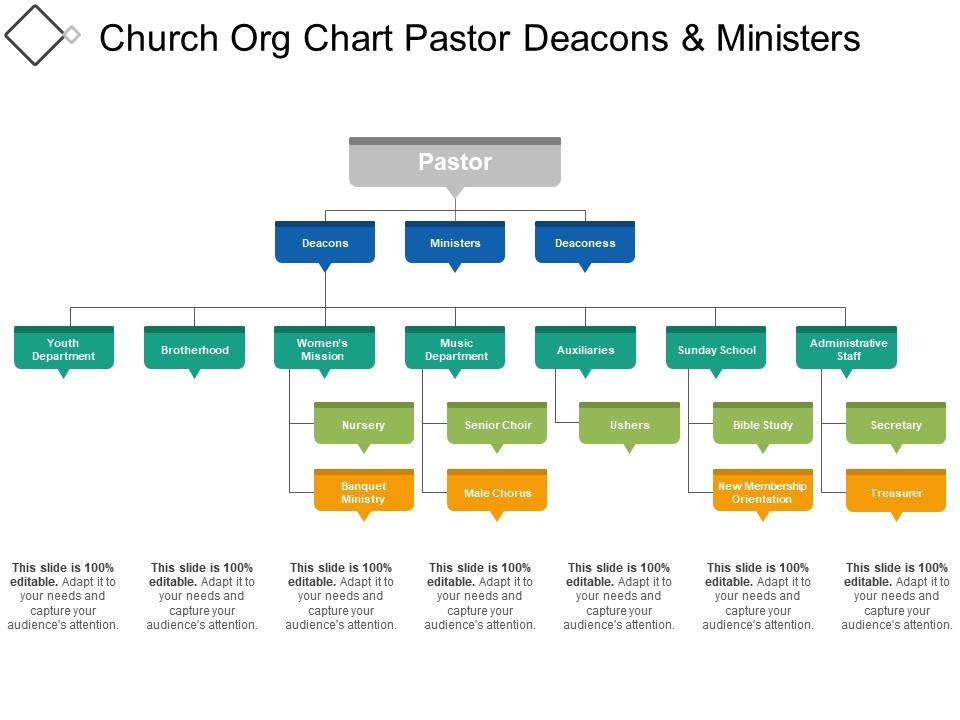
In this organizational chart, different sections have been made using the flowchart which appealingly represents the hierarchy of the church.
As you can see the Pastor holds the topmost position as he is responsible for all the spiritual activities of the church.
Below him, Deacons, Ministers, and Deaconesses are appointed and accordingly, you can also add the specific roles they serve to this PPT template. They work closely with the pastor and are mostly involved in the daily operation of the church.
Next, you can divide the services of Deacons into categories such as Youth Department, Brotherhood, Women’s Mission, Music Department, School, and Staff. As per your requirements and the structure of your church, you can further group these units and make relevant changes.
This template is designed in a way to make your work easier and present the hierarchy structure in a visually attractive and customized document,
Conclusion.
Use this PowerPoint Template to capture your viewers' attention and give them a clear visual of the dynamic church roles.
Explore our pre-designed Logistics Company Organization Chart.
Church org chart pastor deacons and ministers with all 5 slides:
Your assets will grow with our Church Org Chart Pastor Deacons And Ministers. Get access to the best available.


FAQs for Church org chart pastor
So basically every church has a pastor who's the main spiritual leader, then there's a board or elders who make the big decisions. Deacons handle all the practical stuff - honestly they're the ones who actually keep things running. You've also got ministry leaders for specific things like youth group or music. Most places have some admin staff too. The pastor usually answers to the board, ministry folks report to the pastor. If you need to reach someone about something, just call the main office first - they'll tell you exactly who to bug.
Your governance structure is basically who makes decisions and how fast they happen. Too much red tape? You'll miss every opportunity while committees debate for months. I watched one church spend half a year just to approve a food drive - ridiculous. But swing too far the other way with one person calling all the shots, and you're flying blind to what your community actually needs. Good governance means clear authority exists, but there's still room for input from people who know the neighborhood best. Otherwise you're just guessing what'll work.
Hierarchical is nice because decisions happen faster - there's always someone clearly in charge. Works well for bigger churches where you've got tons of moving pieces. But flat structures? Way more collaborative, honestly feels less like you're running a business. Everyone gets a voice. Though sometimes that means discussing paint colors for three weeks straight lol. Really comes down to your church's vibe and size. What does your team naturally gravitate toward? I'd start there and see what clicks with how you guys already work together.
Honestly, you've gotta separate the ministry stuff from all the business headaches. Get your pastors doing what they're actually good at - the spiritual side. Then find admin people or volunteers to handle budgets, building issues, HR drama, whatever. Maybe rotate those duties around your staff or train some church members to own specific areas. Seriously though, I've watched way too many pastors burn out trying to juggle everything. It's brutal. If you can swing it budget-wise, hire an actual church administrator. Otherwise, set up committees that can make real decisions without bothering your pastor about every little thing.
So think of your church council like the board of directors, but for Jesus stuff. Get 7-12 people max - any bigger and you'll never agree on anything, trust me. Mix it up with pastors, regular members, maybe some department leads, and definitely different age groups. Rotate people out every few years or some folks will camp there forever. The whole point is balancing the spiritual side with actual decision-making. You want them handling big choices and keeping leadership honest with the congregation. Oh, and write down everyone's role clearly from the start - saves drama later when someone thinks they're in charge of everything.
Oh man, church structures are kinda all over the place! Catholics have that super rigid hierarchy thing going - Pope, cardinals, bishops, priests, very top-down. But Protestant churches? Total chaos honestly. Some Baptist churches run themselves completely independently, while Methodists have bishops but way more flexibility regionally. Orthodox falls somewhere in between with their patriarchs and metropolitans. It gets confusing quick! I'd figure out what denominational family you're dealing with first - that'll help you understand how they actually make decisions. Way easier starting point.
Oh man, volunteer management is honestly what holds most churches together. Someone's gotta wrangle all the Sunday school teachers, worship teams, ushers - the whole crew basically. Most churches would be screwed without their volunteers since they can't afford to pay everyone. Usually these coordinators report to ministry leaders or pastors, depends how big your church is. If you're thinking about changing things up, just make sure someone's clearly handling the recruiting and training stuff. Trust me, volunteers will bail if they feel forgotten about. Oh and retention gets way better when people actually know what they're supposed to be doing.
Honestly, start with weekly all-staff meetings - that's your lifeline right there. Get everyone using Slack or Teams for quick updates between meetings too. Churches that only rely on Sunday announcements are kidding themselves (half the staff misses those anyway). Set up clear channels where department heads can share stuff and catch scheduling conflicts before they blow up. Oh, and this is huge - pick someone to be your communication point person. Without that, things will slip through the cracks guaranteed. Bi-weekly meetings work too if weekly feels like overkill for your team.
Honestly, start with a solid 90-day plan covering theology, culture, and all the practical stuff. Pair them with good mentors and set up regular check-ins with leadership right away. Those coffee meetings? Pure gold - that's where they'll actually figure out how things really work around there. Make sure you're covering doctrinal alignment, key volunteer intros, and training on whatever software nightmare you're currently using lol. Oh, and clear role expectations from day one saves everyone headaches later. Document what's not working now so you can build something that actually sticks.
Oh man, church management software is where you should start - it'll handle your member info, events, volunteers, all that stuff in one spot. Online giving platforms make donations way easier too. We kept our streaming setup after COVID because honestly, why not reach more people? Automated emails save so much time on newsletters and announcements. Digital finance tracking is huge - frees up your staff to actually do ministry instead of paperwork hell. Don't try everything at once though. Pick one system, master it, then slowly add more as everyone gets used to it.
Look, you can't just hope diverse leaders will magically appear. Partner with community orgs outside your usual network and actively recruit from underrepresented groups. Build real mentorship programs too. Sometimes the best potential leaders don't see themselves that way yet - they need someone to tap them on the shoulder. Check if your current leadership structure accidentally blocks certain people out. Oh, and don't wait for your succession planning meeting to think about this stuff. Start building diversity into those pipelines now, because playing catch-up later sucks.
Look, you need solid planning and structure if you want growth that actually sticks. Without it, everything falls on like 3 people who burn out fast. Think McDonald's vs your local diner - one can scale, the other maxes out pretty quick. Clear roles matter. So does knowing how decisions actually get made around there. I'd start by figuring out where things get stuck when you try launching something new. Usually it's some weird approval process nobody really understands. Fix the bottlenecks first, then build from there.
Look, churches get super attached to their leaders and never plan ahead - they're scrambling once someone announces they're leaving. Power struggles between different groups make it even worse. Honestly, people can be really territorial about change. Start working on formal succession policies now while everything's calm, not when you're in crisis mode. Build up future leaders through mentoring and cross-train people in key roles. Your board needs to write down how things actually work around there. Oh, and begin these conversations like 2-3 years early - trust me on this one.
Honestly, you need dedicated people running specific stuff - like someone actually in charge of the food pantry, another person handling youth programs, that kind of thing. Otherwise everyone assumes someone else is doing it and nothing happens (learned this the hard way lol). Give these ministry leaders real budgets and let them make decisions without having to ask permission for every little thing. Make sure they can actually talk to each other and your main leadership team too. When people have clear ownership and resources, your community impact just takes off. Structure sounds boring but it's what makes the difference.
Honestly, start by mapping out who actually makes decisions in your church - I bet you'll find some weird bottlenecks. Does everyone know who handles what? Like, if the sound system breaks, who fixes it without three meetings first? Look at how info flows too. Leaders should feel free to act in their roles instead of asking permission for everything (that drives people crazy). The real test though? Are you actually growing as a community and getting stuff done. Check where decisions get stuck - that's usually where your structure's breaking down.
No Reviews