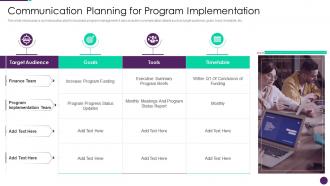
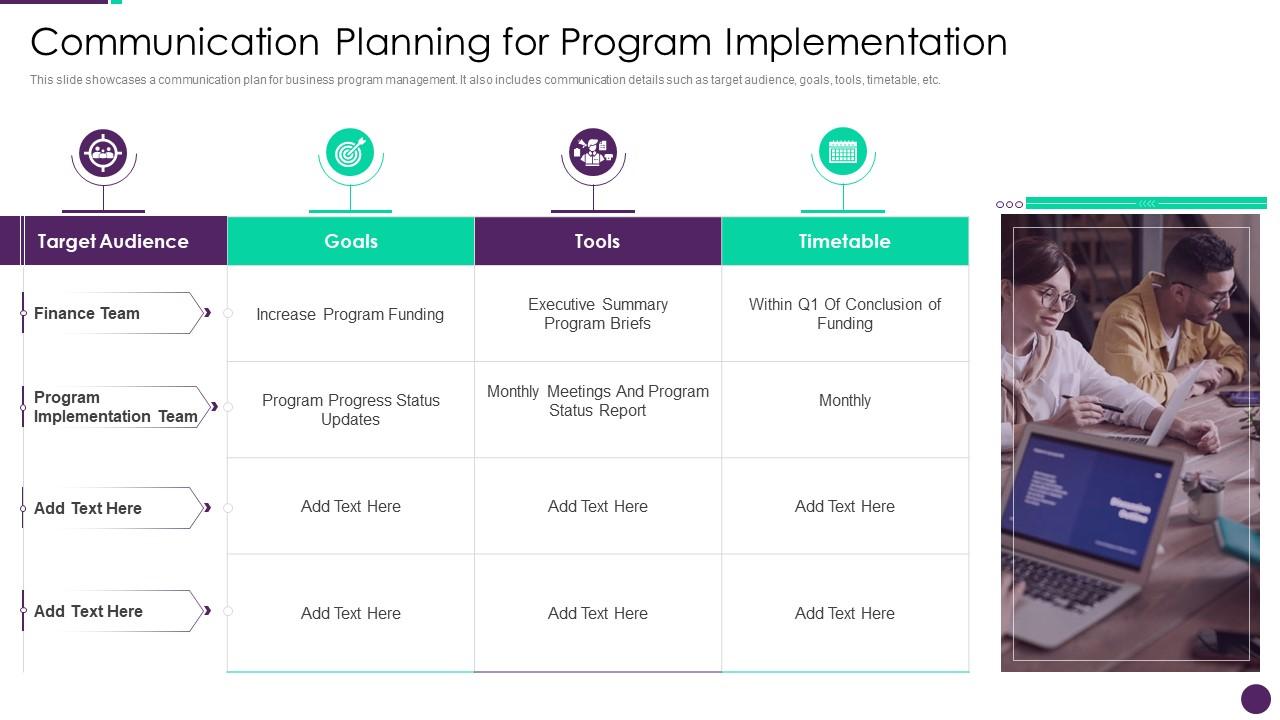
Communication Planning For Program Implementation
Try Before you Buy Download Free Sample Product
Audience
Editable
of Time
This slide showcases a communication plan for business program management. It also includes communication details such as target audience, goals, tools, timetable, etc.
People who downloaded this PowerPoint presentation also viewed the following :
Communication Planning For Program Implementation with all 6 slides:
Use our Communication Planning For Program Implementation to effectively help you save your valuable time. They are readymade to fit into any presentation structure.
FAQs for Communication Planning
Key components of an effective communication plan include clear objectives, target audience identification, key messaging frameworks, communication channels selection, and timeline establishment. These elements work together by ensuring consistent messaging across platforms, optimizing resource allocation, and enabling measurable outcomes, with many organizations finding that strategic communication planning significantly enhances stakeholder engagement and operational efficiency.
Audience analysis enhances communication strategy effectiveness by identifying demographics, preferences, communication channels, pain points, and behavioral patterns, enabling precise message targeting and optimal channel selection. Through detailed audience insights, organizations can craft personalized messaging, choose appropriate platforms, and deliver content that resonates deeply, ultimately improving engagement rates, response quality, and strategic communication outcomes.
Messaging serves as the strategic backbone for stakeholder alignment by establishing consistent communication frameworks, clarifying roles and expectations, and ensuring unified project understanding across all parties involved. Through targeted messaging strategies, project managers streamline decision-making processes, minimize miscommunication risks, and maintain transparency, with many organizations finding that structured messaging approaches ultimately deliver faster project completion and stronger stakeholder buy-in throughout implementation phases.
Communication planning mitigates project risks by establishing clear reporting protocols, defining escalation procedures, and creating structured feedback loops that identify issues early. Through regular stakeholder updates, risk assessment meetings, and transparent progress tracking, project managers can address potential problems before they escalate, while ensuring all team members remain aligned and informed throughout execution.
Success measurement methods include analytics tracking, feedback surveys, engagement metrics, conversion rates, and performance benchmarking against established KPIs. These approaches enable organizations to assess message effectiveness, audience reach, and behavioral changes, with many companies finding that combining quantitative data with qualitative insights delivers comprehensive understanding of communication impact and strategic value.
Digital tools streamline communication planning by automating scheduling, centralizing content management, enabling real-time collaboration, and providing analytics-driven insights across multiple channels. Through platforms integrating project management with communication workflows, organizations enhance team coordination, reduce planning cycles, and deliver more targeted messaging strategies, ultimately improving campaign effectiveness and operational efficiency.
Cultural differences in global communication strategies present both challenges and opportunities, requiring adaptation of messaging, channels, timing, and visual elements to local preferences and values. These considerations enable organizations to enhance engagement, build trust, and avoid misunderstandings across diverse markets, with many multinational companies finding that culturally-sensitive approaches ultimately deliver stronger brand loyalty and competitive advantage internationally.
Feedback systems can be integrated through regular surveys, focus groups, digital analytics, social media monitoring, and structured review meetings to assess message effectiveness and audience engagement. These mechanisms enable organizations to continuously refine their communication strategies, identify gaps in understanding, and adapt messaging in real-time, ultimately delivering more targeted outreach and stronger stakeholder relationships.
Timing in communication planning ensures messages reach audiences when they're most receptive and relevant, maximizing engagement and impact through strategic scheduling, audience behavior analysis, and market conditions assessment. Proper timing enhances campaign effectiveness by coordinating launches with peak attention periods, seasonal trends, and competitive landscapes, ultimately delivering higher response rates and stronger business outcomes.
Visual aids like presentations enhance effective communication by simplifying complex information, improving audience retention, and creating engaging multi-sensory experiences that accommodate different learning styles. Through well-designed slides and graphics, organizations streamline knowledge transfer, reduce misunderstandings, and accelerate decision-making processes, with many companies finding that visual presentations increase meeting productivity and stakeholder alignment significantly.
Strategies include establishing unified brand guidelines, implementing centralized messaging frameworks, conducting regular cross-channel audits, training all communication teams, and utilizing integrated content management systems. These approaches streamline messaging by standardizing tone, visual identity, and key messages across platforms, with many organizations finding that consistent multi-channel strategies enhance brand recognition and customer trust significantly.
Businesses align communication strategies with organizational goals by establishing clear messaging frameworks, defining target audience segments, setting measurable communication objectives, and creating consistent brand narratives across all channels. Through strategic planning processes, companies in sectors like retail and healthcare streamline internal alignment, enhance stakeholder engagement, and accelerate goal achievement, ultimately delivering improved operational efficiency and stronger competitive positioning.
Common pitfalls include unclear messaging, inadequate audience analysis, poor channel selection, insufficient feedback mechanisms, and unrealistic timelines. These challenges often stem from lack of stakeholder input, limited budget allocation, and inconsistent brand voice, with many organizations finding that thorough planning and regular strategy reviews ultimately deliver more effective campaigns and stronger audience engagement.
Internal communication improves employee engagement and productivity by fostering transparency, aligning teams with organizational goals, and creating channels for feedback and recognition. Through strategic communication platforms, companies streamline information flow, reduce misunderstandings, and enhance collaboration, with many organizations finding that clear, consistent messaging ultimately delivers higher retention rates and measurable productivity gains.
Storytelling transforms abstract concepts into relatable narratives, making messages more memorable and emotionally engaging while building trust through shared experiences and values. Through compelling case studies, customer success stories, and scenario-based presentations, organizations enhance audience connection, improve message retention, and ultimately drive stronger decision-making outcomes across stakeholder communications.
-
Great work on designing the presentation. I just loved it!
-
A library of engaging, customizable and content-ready templates.Â