

Company departmental task and time tracking report





Try Before you Buy Download Free Sample Product
 Impress Your
Audience
 100%
Editable
 Save Hours
of Time


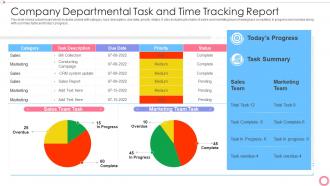
This slide shows a dashboard which includes a table with category, task description, due date, priority, status. It also includes pie charts of sales and marketing team showing task completed, in progress and overdue along with summary table and todays progress.
People who downloaded this PowerPoint presentation also viewed the following :
Company departmental task and time tracking report with all 7 slides:
Use our Company Departmental Task And Time Tracking Report to effectively help you save your valuable time. They are readymade to fit into any presentation structure.






FAQs for Company departmental task and
Task tracking tools deliver enhanced project visibility, improved accountability, streamlined resource allocation, better deadline management, and real-time progress monitoring. These solutions enable project managers to identify bottlenecks early, optimize team productivity, and maintain stakeholder transparency, with many organizations finding that systematic task tracking reduces project delays by up to 30% while enhancing overall delivery quality.
Task tracking improves team collaboration and accountability by providing real-time visibility into project progress, enabling transparent communication, and establishing clear ownership of deliverables. Through centralized platforms, teams streamline workflow coordination, minimize duplicated efforts, and enhance resource allocation, with many organizations finding that systematic tracking ultimately delivers faster project completion and stronger individual performance metrics.
Effective task tracking software should include project visualization tools, automated progress monitoring, collaborative workspaces, customizable reporting dashboards, and integration capabilities with existing business systems. These features streamline workflow management by enhancing team coordination, reducing manual oversight, and providing real-time visibility into project status, with many organizations finding that comprehensive tracking solutions ultimately deliver improved productivity and faster project completion rates.
Task tracking significantly influences project timelines by enabling real-time progress monitoring, identifying bottlenecks early, and facilitating proactive adjustments to schedules and resource distribution. Through automated tracking systems, project managers streamline resource allocation by analyzing workload patterns, optimizing team capacity, and reallocating personnel strategically, ultimately delivering faster project completion and enhanced operational efficiency across organizations.
Prioritization serves as the foundation of effective task tracking by enabling clear resource allocation, deadline management, and strategic focus alignment across projects. Through priority-based systems, organizations streamline workflow efficiency, minimize bottlenecks, and enhance team productivity, with many finding that systematic prioritization ultimately delivers faster project completion and improved operational outcomes.
Visual aids like Gantt charts enhance task tracking by providing clear timeline visualization, dependency mapping, resource allocation tracking, and progress monitoring at a glance. These tools streamline project oversight by enabling teams to identify bottlenecks, adjust schedules proactively, and maintain stakeholder alignment, with many organizations finding that visual project management ultimately delivers improved coordination and faster project completion rates.
Common pitfalls include overcomplicating workflows, neglecting user training, choosing inflexible platforms, failing to establish clear ownership protocols, and creating excessive reporting requirements. While these systems enhance productivity through streamlined processes, organizations often find that starting simple, ensuring team buy-in, and gradually scaling features delivers better adoption rates and ultimately stronger operational efficiency.
Task tracking integrates seamlessly with project management methodologies like Agile, Scrum, Kanban, and Waterfall by providing real-time visibility into work progress, resource allocation, and milestone completion. Through digital platforms, teams can synchronize task updates with sprint planning, workflow boards, and project timelines, ultimately delivering enhanced coordination and accountability across methodologies.
Automation enhances task tracking through real-time status updates, automatic deadline reminders, progress monitoring, workflow triggers, and intelligent resource allocation. These capabilities streamline project management by reducing manual oversight, minimizing human error, and enabling instant visibility across teams, with many organizations finding that automated tracking delivers faster project completion and improved accountability.
Task tracking helps identify workflow bottlenecks by monitoring task completion times, resource allocation patterns, and process dependencies across teams and projects. Through detailed analytics and real-time visibility, organizations can pinpoint delayed approvals, resource constraints, and inefficient handoffs, ultimately streamlining operations and enhancing productivity while delivering faster project outcomes.
Key metrics include task completion rates, time-to-completion, resource utilization, milestone adherence, and quality scores. These measurements streamline project management by identifying bottlenecks, optimizing resource allocation, and enhancing team productivity, with many organizations finding that consistent tracking ultimately delivers improved operational efficiency and competitive advantage.
Task tracking for remote teams requires cloud-based platforms, real-time collaboration features, automated status updates, clear deadline management, and enhanced communication tools. These systems streamline coordination by providing centralized visibility, enabling asynchronous updates, and facilitating seamless handoffs between time zones, with many distributed organizations finding that structured tracking ultimately delivers improved accountability and project transparency.
Best practices for creating a task tracking template include defining clear task categories, establishing priority levels, incorporating deadline fields, adding status indicators, and including assignee designations. These elements streamline project management by enabling real-time visibility, facilitating resource allocation, and enhancing team accountability, with many organizations finding that comprehensive templates ultimately deliver improved operational efficiency and faster project completion rates.
Ensuring buy-in requires involving team members in system selection, providing comprehensive training, and clearly communicating benefits like improved visibility and reduced workload confusion. Many organizations find success by starting with pilot groups, addressing concerns transparently, and demonstrating how streamlined task tracking enhances productivity, reduces missed deadlines, and ultimately delivers better project outcomes while minimizing administrative burden.
Task tracking supports continuous improvement by providing detailed performance data, identifying bottlenecks, and enabling teams to analyze completion patterns and resource allocation. Through comprehensive tracking systems, project managers can streamline workflows, enhance team productivity, and optimize delivery timelines, with many organizations finding that data-driven insights ultimately deliver faster project cycles and improved client satisfaction.
-
Unique research projects to present in meeting.
-
Commendable slides with attractive designs. Extremely pleased with the fact that they are easy to modify. Great work!