Competency based employee job description with skill levels
Try Before you Buy Download Free Sample Product
Audience
Editable
of Time
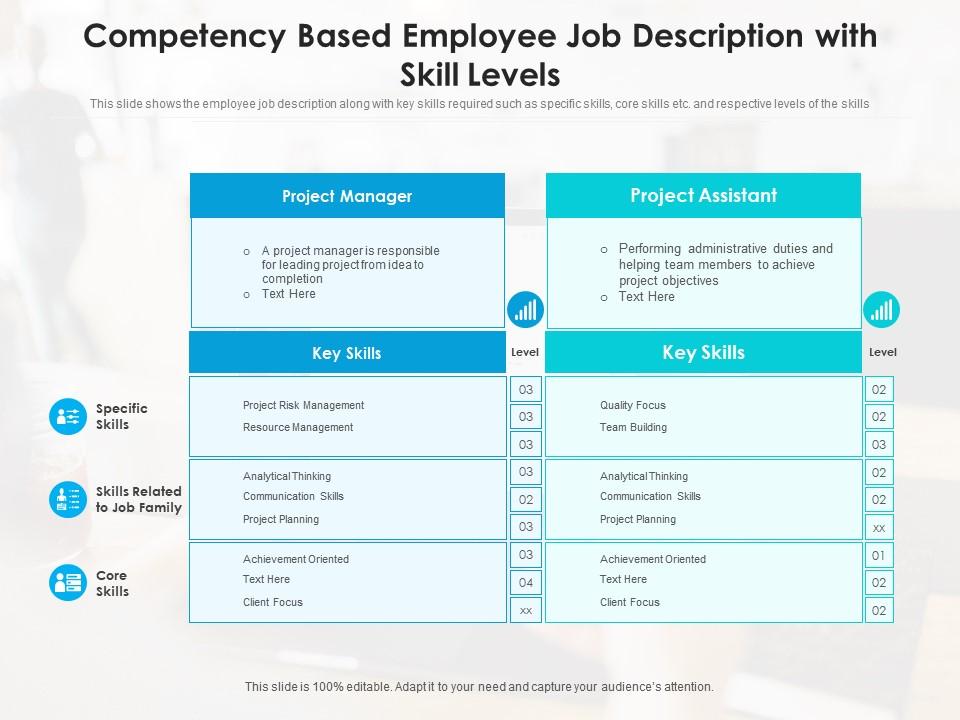
This slide shows the employee job description along with key skills required such as specific skills, core skills etc. and respective levels of the skills
People who downloaded this PowerPoint presentation also viewed the following :
Competency based employee job description with skill levels with all 2 slides:
Use our Competency Based Employee Job Description With Skill Levels to effectively help you save your valuable time. They are readymade to fit into any presentation structure.
FAQs for Competency based employee job description
So basically you need three main things: your must-have skills (core competencies), examples of what those actually look like day-to-day, and different skill levels for each. Obviously include the standard job title and who they report to stuff, but honestly the competencies are what matter most. Pick maybe 6-8 critical skills for the role first. Then - and this is where people mess up - define what "crushing it" looks like for each one in your specific company. It's kinda like giving someone a recipe but actually explaining the techniques, not just throwing ingredients at them. Way more useful that way.
Okay so basically traditional job descriptions just list what you'll do - like "manages 5 people" or whatever. Competency-based ones are way smarter though. They focus on HOW you need to do things well. So instead of just saying you manage people, they'd say you need "emotional intelligence for conflict resolution" or "coaching skills to develop others." Way better for actually hiring the right person, you know? You can test if someone has those abilities during interviews. The old way is pretty useless tbh - tells you the tasks but not if they'll be good at them. Next time try identifying 4-6 key competencies first before writing duties.
Look, defining competencies upfront makes hiring so much more accurate - you're actually screening for skills that matter, not just fancy degrees. Performance reviews become way less awkward too since there's real criteria instead of that vague "meets expectations" nonsense. Your recruitment gets smoother because you know exactly what you want. Honestly, I've watched teams blow months on terrible hires when they skip this step. But here's the thing - employee development is where it really pays off. People finally get clear growth paths and know which skills to build. Start with maybe 4-6 core competencies for your main roles.
Start by talking to your best people in that role - they know way better than any job description what actually works. Interview their managers too about what separates the stars from everyone else. Break down the job into specific behaviors you can actually observe, not fluffy stuff like "team player." Look for patterns in your top performers' backgrounds and how they work. Oh, and think ahead a bit since jobs change fast these days. Skip the vague personality traits. Focus on what people DO that makes them successful.
So instead of writing job descriptions with boring stuff like "manage projects," you'd get specific about what good performance actually looks like. Like "shows strategic thinking by analyzing market trends and adjusting projects accordingly." Way more helpful, right? Your people can figure out what they need to work on instead of guessing. You can use the same competencies for reviews and promotions too, which is pretty smart. I'd start with maybe 4-5 key competencies per role - don't go crazy with it. It's honestly just giving people a clearer picture of how to succeed.
First thing - grab your top performers and some subject matter experts for workshops to figure out what skills actually matter. Way better than trying to guess on your own. Map out the technical stuff, behavioral traits, all of it. Then ditch those useless "team player" descriptions in job postings and replace them with specific, measurable competencies. Honestly, most job descriptions are pretty terrible at this. Each competency needs to connect to real results though - otherwise you're just making fancy lists. Test it with one department first before going crazy and rolling it out everywhere. You'll definitely want to tweak things.
You definitely need to talk to people who actually do the job - current employees, their bosses, customers, whoever works with them regularly. I've learned this the hard way, but there's always a huge difference between what looks good on paper and what actually matters in real life. The people doing the work every day? They know exactly which skills separate the rockstars from everyone else. I'd start with maybe 3-5 interviews from each group and ask them about specific situations - like when someone really succeeded or totally bombed. Don't try building these descriptions alone in your office.
Set up review cycles every 6 months if possible - annually works too but feels too slow honestly. Talk to people actually doing the jobs and their bosses about which skills they're really using vs what's written down. Industries move crazy fast now, so scan for new tech or skills that are becoming must-haves. Your performance data will tell you if certain competencies need better definitions or updates. Oh and definitely set those calendar reminders right now because this stuff always gets buried under daily fires.
Honestly, the biggest pain will be managers clinging to their old job descriptions - they hate change. Takes forever to figure out what competencies actually matter too. Everyone freaks out about measuring fuzzy stuff like "strategic thinking" fairly across teams. Your HR folks will probably struggle fitting this into whatever ancient recruiting system you're using (ours was a nightmare). Most people don't get behavioral indicators either, so there's definitely a learning curve. I'd start with just one or two roles as a test run. Get some influential people on board first or you'll be fighting an uphill battle later.
Honestly, competency-based job descriptions are a total game-changer. You're not just throwing random tasks at people anymore - you're actually defining what skills and behaviors someone needs to crush it in that role. Better job posts, way fewer terrible candidates applying. Your interviews get so much more focused too since you can ask specific questions about each competency. I learned this the hard way after hiring someone who looked great on paper but couldn't handle the actual work. Pick like 5-7 key competencies for whatever role you're filling and build everything around testing for those. Trust me, you'll save yourself so many headaches down the road.
So you'll want to watch your time-to-fill rates and how new hires actually perform in their first 90 days - that's the real proof. Quality of hire scores matter too. I'd definitely track if people are dropping out during applications because honestly, nobody wants to deal with crazy complicated requirements. Employee retention tells you a lot - better job clarity usually means people stick around longer. Also check promotion rates within your company. The biggest win though? When your hiring managers start saying they're getting way better candidates who don't bail after three months.
Honestly, just use those competency job descriptions as your training roadmap. Map out what skills each role actually needs - like if your analysts need "analytical thinking," build training around exactly that instead of random generic stuff. Way better than throwing training at everything and hoping it sticks. Create learning paths from beginner to advanced using those competency levels. Your training budget actually goes toward stuff that matters for job performance then. I'd start by looking at what training you already have and seeing where the gaps are. Makes so much more sense than the old way, right?
Honestly, tech makes this whole thing way less painful. Start by checking what competency data you've already got buried in your systems - there's usually more than you think. AI tools can pull key competencies straight from job postings, which saves tons of time. Platforms like TalentGuard or Cornerstone are pretty solid for building standardized libraries. Your HR software probably already tracks gaps across teams too. The real game-changer? Templates make mapping so much faster. You can even hook these descriptions into your ATS for better candidate matching, though that's getting ahead of yourself a bit.
Honestly, competency-based job descriptions are a game changer for cutting bias. Instead of "Ivy League MBA preferred," write "must be detail-oriented" - way more people can actually qualify. Diverse candidates can picture themselves in the role because you're being super clear about what matters. Your hiring managers get real criteria to judge against instead of that "gut feeling" nonsense (which is usually just bias anyway). I'd start by going through your current job posts and cutting the unnecessarily picky stuff. It's wild how much language excludes people for no good reason.
Okay so here's the thing - you've gotta get way more specific about what "good" actually means for each skill. Like instead of "strong communication," say something like "writes emails that solve client problems in one go" or "runs meetings where everyone actually talks." I learned this the hard way lol. Think about explaining it to someone who's never done the job before. What would they need to see? Use real examples from your actual workplace. The whole point is making it clear enough that people can honestly figure out if they can do it, rather than just saying what they think sounds right.
-
Presentation Design is very nice, good work with the content as well.
-
Thanks for all your great templates they have saved me lots of time and accelerate my presentations. Great product, keep them up!
-
Content of slide is easy to understand and edit.
-
Best Representation of topics, really appreciable.
-
Excellent design and quick turnaround.