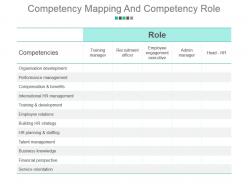
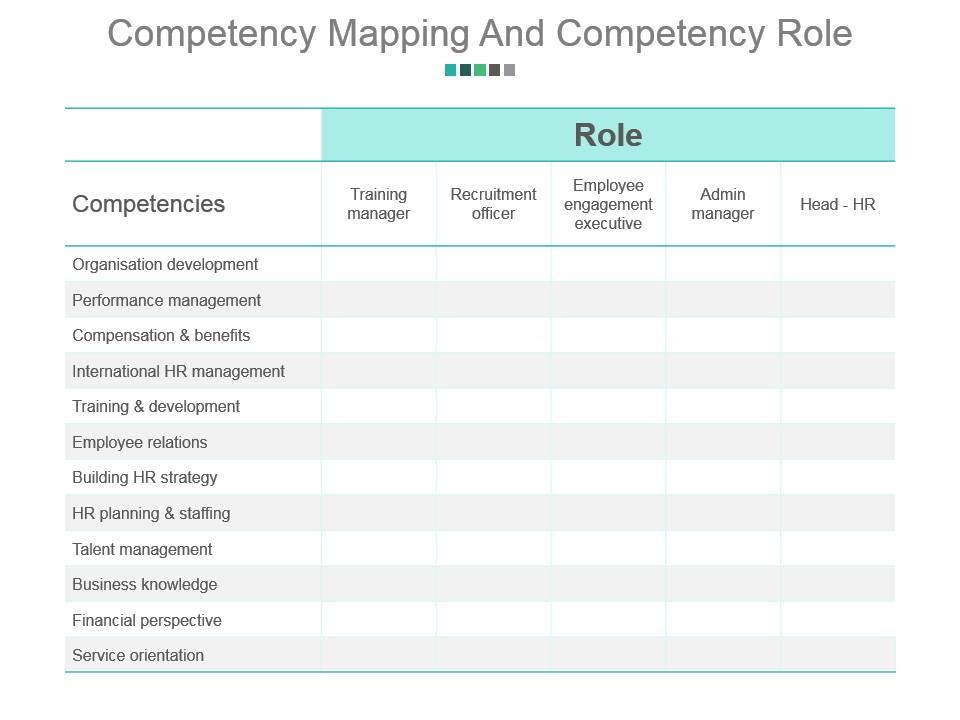
Competency mapping and competency role powerpoint slide designs
Try Before you Buy Download Free Sample Product
Audience
Editable
of Time
Our Competency Mapping And Competency Role Powerpoint Slide Designs go all out to gain from changes. They believe it is essential.
People who downloaded this PowerPoint presentation also viewed the following :
Competency mapping and competency role powerpoint slide designs with all 5 slides:
Each idea could be the great one. Present them all through timeless design with our library of Competency Mapping And Competency Role Powerpoint Slide Designs.
FAQs for Competency mapping and competency role
Key components of an effective competency mapping process include job analysis, behavioral identification, skill assessment frameworks, performance benchmarking, and gap analysis methodologies. These elements work together by defining role requirements, measuring current capabilities, and identifying development priorities, with many organizations finding that systematic competency mapping streamlines recruitment, enhances training effectiveness, and ultimately delivers improved performance management and strategic workforce planning.
Competency mapping enhances talent management by identifying skill gaps, aligning employee capabilities with strategic goals, and creating targeted development pathways for career progression. Through systematic assessment frameworks, organizations streamline recruitment processes, optimize training investments, and build succession pipelines, with many companies finding that strategic competency alignment ultimately delivers improved performance outcomes and competitive advantage.
Competency mapping methods include behavioral interviews, 360-degree feedback, skills assessments, performance evaluations, and competency-based surveys. These tools work together by identifying skill gaps, evaluating current capabilities, and aligning talent with organizational goals, with many companies finding that strategic competency mapping enhances workforce planning, streamlines recruitment processes, and ultimately delivers improved performance outcomes.
Competency mapping aligns with strategic goals by identifying skill gaps, defining role-specific requirements, and establishing development pathways that support business objectives. This strategic alignment enables organizations to enhance talent acquisition, streamline succession planning, and optimize resource allocation, ultimately delivering improved performance outcomes and competitive advantage in an increasingly dynamic business environment.
Employee feedback serves as a critical data source in competency mapping, providing self-assessments, peer evaluations, and insights into skill gaps that managers might overlook. This input enables organizations to create more accurate competency profiles, identify development opportunities, and align training programs with actual performance needs, ultimately delivering enhanced employee engagement and more targeted professional development initiatives.
Organizations ensure competency model relevance through regular reviews, stakeholder feedback, industry benchmarking, performance data analysis, and alignment with strategic goals. By conducting annual assessments, engaging employees and managers, monitoring market trends, and incorporating emerging skills requirements, companies maintain models that reflect evolving business needs, ultimately delivering enhanced talent development and competitive advantage.
Core competencies encompass universal skills like communication, teamwork, leadership, and problem-solving required across all organizational roles, while role-specific competencies include technical skills, specialized knowledge, and particular behaviors essential for individual positions. These strategic combinations enable organizations to streamline talent development, enhance performance management, and deliver consistent standards, with many companies finding that this dual approach ultimately accelerates professional growth and competitive advantage.
Competency mapping enhances employee performance by identifying skill gaps, aligning roles with strengths, and creating targeted development pathways that boost productivity and job satisfaction. Through clear performance expectations and personalized growth plans, organizations streamline talent management, reduce turnover, and increase engagement, with many companies finding that employees become more motivated when they understand their career progression opportunities.
Organizations face challenges including inconsistent competency definitions, resistance to assessment processes, resource-intensive data collection, difficulty measuring soft skills, and maintaining updated competency frameworks. While these obstacles require careful planning, many companies find that structured implementation approaches, clear communication about benefits, and phased rollouts ultimately deliver enhanced talent management and strategic workforce alignment.
Competency mapping integrates into performance appraisal systems by establishing clear skill benchmarks, creating structured evaluation criteria, and linking individual capabilities to organizational goals. Through systematic assessment frameworks, managers can evaluate employee competencies against defined standards, identify development gaps, and align performance ratings with strategic objectives, ultimately delivering more objective appraisals and targeted career development pathways.
Competency mapping supports succession planning by identifying skill gaps, defining leadership requirements, creating development pathways, and establishing clear performance benchmarks for potential successors. Through systematic assessment and targeted training programs, organizations can nurture internal talent, accelerate leadership readiness, and ensure seamless transitions, with many companies finding that structured competency frameworks reduce succession risks while building stronger leadership pipelines.
Competency mapping significantly enhances training and development programs by identifying specific skill gaps, aligning learning objectives with organizational needs, and creating personalized development pathways for employees. Through targeted assessments, companies streamline resource allocation, accelerate skill acquisition, and improve training ROI, with many organizations finding that competency-based programs deliver faster promotions and higher employee engagement.
Diversity and inclusion can be reflected in competency mapping frameworks by incorporating cultural competencies, inclusive leadership behaviors, bias awareness skills, and collaboration across diverse teams as core competencies. Organizations in sectors like healthcare, financial services, and technology increasingly integrate these elements into their talent assessment processes, ultimately enhancing team performance, innovation, and employee engagement while delivering competitive advantage.
Organizations can evaluate competency mapping effectiveness through performance improvement rates, skill gap reduction percentages, employee engagement scores, training ROI measurements, and succession planning success rates. These metrics enable companies to track enhanced productivity, reduced recruitment costs, and improved talent retention, with many financial services and healthcare organizations finding that systematic competency assessment ultimately delivers measurable competitive advantages and operational efficiency.
Technology streamlines competency mapping through AI-powered skill assessments, automated performance analytics, real-time feedback systems, and integrated learning management platforms. These digital solutions enable HR teams to identify skill gaps faster, track employee development more accurately, and create personalized training pathways, ultimately delivering enhanced workforce planning and strategic talent management across organizations.
-
I discovered this website through a google search, the services matched my needs perfectly and the pricing was very reasonable. I was thrilled with the product and the customer service. I will definitely use their slides again for my presentations and recommend them to other colleagues.
-
Best Representation of topics, really appreciable.