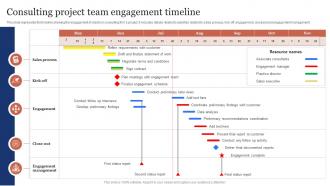
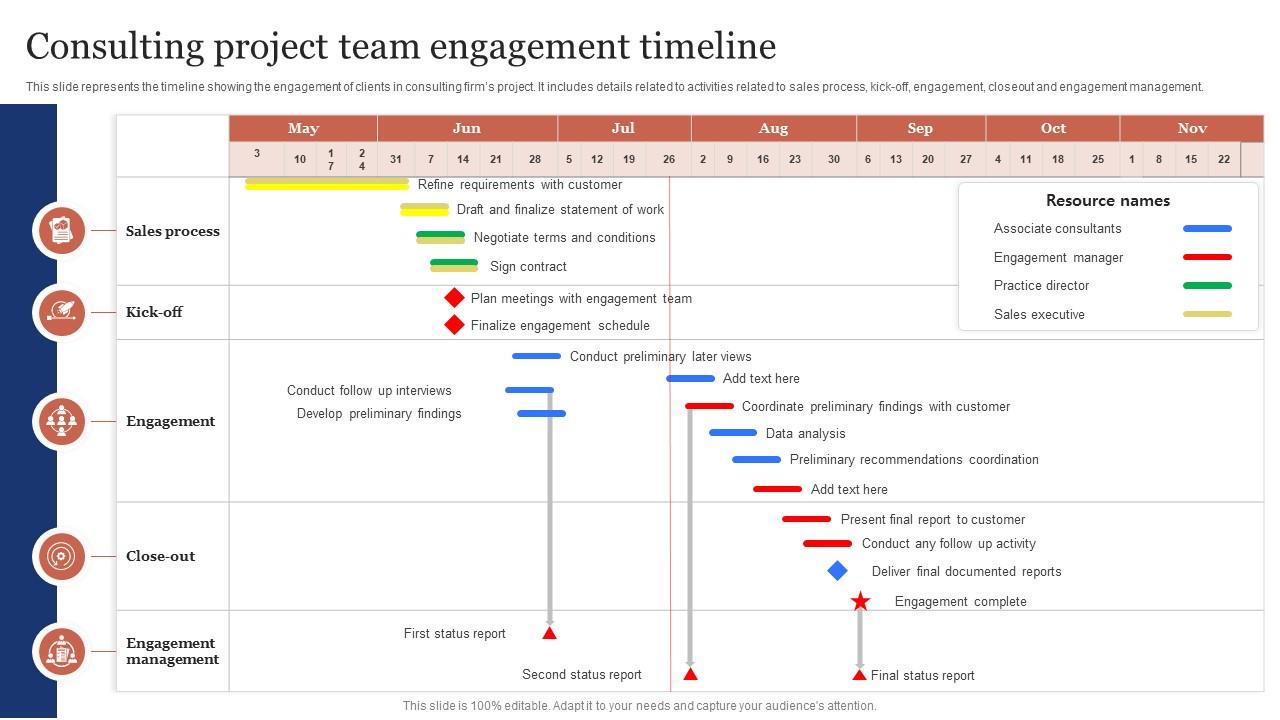
Consulting Project Team Engagement Timeline

Rating:
80%
Consulting Project Team Engagement Timeline
Slide 1 of 6
Favourites Favourites

Try Before you Buy Download Free Sample Product

Audience Impress Your
Audience
Editable 100%
Editable
Time Save Hours
of Time
The Biggest Sale is ending soon in
0
0
:
0
0
:
0
0
AI-Ready
Upload this template to AI and ask it to make any changes to content or color
100% editable Powerpoint Template for AI-assisted presentations. Finish your work in less time. Download Prompt Kit ​
Works with
Microsoft PowerPoint
Microsoft 365
Claude for PowerPoint
ChatGPT
Google Slides
Microsoft Copilot
Rating:
80%
This slide represents the timeline showing the engagement of clients in consulting firms project. It includes details related to activities related to sales process, kick off, engagement, closeout and engagement management. Introducing our Consulting Project Team Engagement Timeline set of slides. The topics discussed in these slides are Sales Process, Engagement, Engagement Management. This is an immediately available PowerPoint presentation that can be conveniently customized. Download it and convince your audience.
People who downloaded this PowerPoint presentation also viewed the following :

FAQs for Consulting Project

Key milestones in an effective engagement timeline include project kickoff, stakeholder alignment sessions, initial deliverable reviews, feedback incorporation phases, and final approval checkpoints. These structured touchpoints enhance project transparency, minimize miscommunication risks, and ensure consistent progress tracking, with many organizations finding that well-defined milestones ultimately deliver faster project completion and stronger client relationships.

Visual elements enhance engagement timeline clarity by using color coding, milestone markers, progress bars, icons, and hierarchical layouts to distinguish phases, deadlines, and responsibilities. Through strategic design choices, organizations streamline project communication, reduce misunderstandings, and accelerate decision-making processes, with many teams finding that visual timelines improve stakeholder alignment and ultimately deliver more efficient project outcomes.

Common mistakes when creating an engagement timeline include unrealistic deadlines, insufficient buffer time, poor stakeholder communication, lack of milestone clarity, and inadequate resource allocation planning. These oversights often derail projects by creating bottlenecks, missed expectations, and team burnout, with many organizations finding that strategic timeline planning with realistic phases ultimately delivers smoother project execution and stronger client relationships.

**INPUT**: How can an engagement timeline be tailored for different audiences? **OUTPUT**: Engagement timelines can be tailored by adjusting content depth, communication frequency, delivery channels, milestone complexity, and stakeholder touchpoints based on audience expertise and involvement levels. Executive audiences typically require high-level milestone summaries with quarterly reviews, while technical teams need detailed weekly checkpoints and deliverable tracking, ultimately ensuring all stakeholders receive relevant information that enhances project transparency and decision-making efficiency.

PowerPoint, Prezi, Canva, Timeline JS, and Visme offer robust timeline creation capabilities, each delivering unique design flexibility, interactive features, and customization options. These platforms streamline presentation development by providing pre-built templates, drag-and-drop functionality, and multimedia integration, with many organizations finding that interactive timelines enhance audience engagement and information retention significantly.

An engagement timeline improves project management by establishing clear milestones, deadlines, and deliverable schedules, while enhancing communication through transparent progress tracking and stakeholder alignment. This structured approach enables teams to anticipate bottlenecks, allocate resources efficiently, and maintain consistent client updates, ultimately delivering projects on time and within scope while minimizing miscommunication risks.

Color psychology significantly influences engagement timeline design by evoking specific emotions, guiding attention flow, establishing visual hierarchy, and reinforcing brand messaging throughout key milestones. Strategic color choices enhance user comprehension and emotional connection, with warm tones creating excitement for launches, cool blues building trust for planning phases, and consistent palettes ultimately delivering stronger audience engagement and improved information retention across complex project communications.

Deadlines can be effectively communicated through clear milestone mapping, regular progress updates, automated notification systems, and visual timeline dashboards that provide real-time visibility. These approaches streamline project coordination by establishing accountability checkpoints, minimizing miscommunication, and enabling proactive resource allocation, with many organizations finding that transparent deadline communication ultimately delivers improved project completion rates and enhanced stakeholder satisfaction.

Essential data points for measuring engagement metrics include session duration, click-through rates, content interaction frequency, user retention rates, and conversion pathways. These metrics streamline performance analysis by tracking behavioral patterns, identifying content effectiveness, and measuring audience growth, with many organizations finding that consistent monitoring ultimately delivers improved user experiences and strategic competitive advantage.

Case studies enhance engagement timeline effectiveness by providing concrete proof points, demonstrating measurable outcomes, and building credibility through real-world validation. These documented successes enable organizations to showcase specific results like faster project delivery and improved stakeholder buy-in, while helping prospects visualize their own potential timeline achievements, ultimately accelerating decision-making processes.

Best practices for updating engagement timelines include establishing regular review checkpoints, maintaining transparent stakeholder communication, documenting scope changes, implementing version control systems, and building buffer time for unexpected delays. Organizations across industries find that proactive timeline management, coupled with clear change protocols and stakeholder alignment meetings, ultimately delivers improved project outcomes and stronger client relationships.

Storytelling principles create compelling engagement timelines by establishing clear narrative arcs with beginning setups, conflict development, and satisfying resolutions that mirror customer journey stages. Through character-driven scenarios, emotional pacing, and strategic tension points, organizations can transform routine milestone presentations into memorable experiences that maintain stakeholder interest, enhance project buy-in, and ultimately deliver stronger client relationships and improved project outcomes.

Linear engagement timelines follow sequential, step-by-step progression with predetermined milestones and fixed deadlines, while non-linear timelines allow flexible, iterative approaches with overlapping phases and adaptive scheduling. Linear models work well for structured projects like manufacturing rollouts or compliance implementations, whereas non-linear approaches benefit creative campaigns, software development, and strategic initiatives, ultimately delivering greater adaptability and responsiveness to changing business requirements.

A well-structured engagement timeline significantly enhances stakeholder buy-in by providing clear milestones, transparent communication schedules, and predictable decision points that build confidence and trust. This strategic approach enables organizations to maintain momentum, reduce uncertainty, and demonstrate progress systematically, with many companies finding that structured timelines improve project approval rates and stakeholder satisfaction.

Cultural differences significantly affect timeline perception through varying concepts of punctuality, sequential versus cyclical time understanding, and relationship-focused versus task-focused priorities. While Western cultures typically emphasize linear progression and strict deadlines, many Asian and Latin cultures prioritize context and relationships over rigid scheduling, with presenters finding that adapting timeline frameworks to audience cultural expectations ultimately enhances engagement and comprehension.

Ratings and Reviews

80% of 100
Review Form
Write a review
Most Relevant Reviews
  1. 80%

    by Delmar Wagner

    It saves your time and decrease your efforts in half.
  2. 80%

    by Delbert Palmer

    SlideTeam is the best in the business. Their templates are engaging and customizable. You can rely on them.

2 Item(s)

per page: