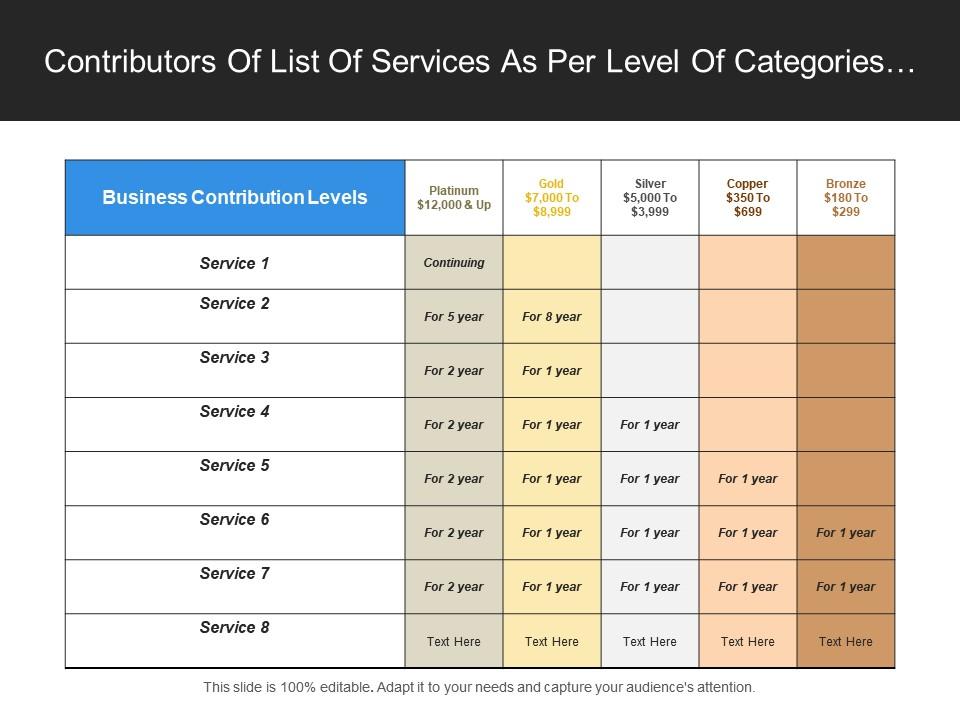
Contributors of list of services as per level of categories of platinum gold silver copper and bronze

Rating:
90%
Contributors of list of services as per level of categories of platinum gold silver copper and bronze
Slide 1 of 5
Favourites Favourites

Try Before you Buy Download Free Sample Product

Audience Impress Your
Audience
Editable 100%
Editable
Time Save Hours
of Time
The Biggest Sale is ending soon in
0
0
:
0
0
:
0
0
Rating:
90%
Presenting this set of slides with name - Contributors Of List Of Services As Per Level Of Categories Of Platinum Gold Silver Copper And Bronze. This is a five stage process. The stages in this process are Contributor, Writer, Reporter.

People who downloaded this PowerPoint presentation also viewed the following :

FAQs for Contributors of list of services as per level of categories of platinum gold silver

You're basically the middleman handling all the business logic between frontend and backend. APIs, data validation, authentication - that's your world. Think traffic controller for data flow (not super glamorous but someone's gotta do it). Performance optimization and caching strategies are huge too. Other devs will depend on your APIs working right, so reliability matters more than you'd think. Security protocols can't be an afterthought either. Oh, and document your endpoints clearly from day one - trust me on this one. Your teammates will thank you later when they're not constantly asking what each endpoint does.

Honestly, start by figuring out who you actually need to talk to regularly - product, engineering, ops, whoever. Then just reach out and set up some recurring check-ins so nobody's left guessing what's happening. I learned this the hard way, but you've gotta speak their language. Engineers want the technical details, product folks care about business impact. Don't be that person who dumps requirements and vanishes! Stick around during implementation, answer questions, give updates before things blow up. Oh and map out your key stakeholders first - makes the whole thing way less overwhelming.

Dude, you're gonna need serious problem-solving skills and patience - it's basically being a detective while people are pissed off at you lol. Communication is everything since you're constantly translating tech stuff into normal human speak. Don't sleep on documentation either, you'll be writing tickets and knowledge articles way more than expected. Active listening is clutch though - honestly half these people just want someone to actually hear them out. Time management becomes critical fast when you're bouncing between like 6 different cases. The soft skills are way harder to learn than any technical stuff, so start working on those now.

Think of service tier contributors as your early warning system - they show you which parts of your architecture are healthy vs. which ones are about to tank. Response times and error rates by tier? That's where the magic happens. You'll catch issues way before users start complaining (trust me on this one). Most teams I know don't track this stuff consistently, which is honestly kind of crazy. It's like having x-ray vision into your stack. Bottlenecks become super obvious when you can see how problems ripple through each layer.

Honestly, most people at that level get stuck dealing with fuzzy role definitions - like wait, am I coding or making big picture calls? The workload gets crazy because you're basically translating between teams all day. Technical stuff to business people, then diving deep with engineers right after. Quality vs speed pressure is real too. Oh and the stakeholder juggling act never ends lol. My take? Draw those boundaries super early. Don't feel weird about asking "what's actually priority here" when everything feels urgent. Trust me on that one.

Okay so first thing - get your SLAs nailed down and actually follow whatever processes you've documented. Most teams I've seen totally slack on monitoring, which is honestly crazy because that's how you catch stuff before it blows up. Set up those automated alerts and do regular health checks. Oh, and write good runbooks for the common issues - trust me, future you will thank past you. When things do go wrong (and they will), make sure you're doing proper post-mortems afterward. I'd start by looking at your current setup and figuring out where the biggest holes are.

Honestly, start with CI/CD stuff like Jenkins or GitHub Actions - that'll save you so much manual work. For monitoring, Datadog or New Relic are solid choices. Postman is a game-changer for API testing, seriously can't debug without it anymore. Docker containers plus Kubernetes help with scaling, though K8s has a bit of a learning curve. Infrastructure-as-code tools like Terraform are worth it once you get the hang of them. Oh, and don't sleep on documentation - Confluence or Notion keeps everyone on the same page. Pick whatever's causing you the biggest headache right now and tackle that first.

So basically you want to track adoption rates and user feedback - like are people actually using your stuff or just downloading it once? I'd keep an eye on how often your work gets rolled into bigger improvements too. Performance gains and fewer support tickets in your area are solid indicators. Honestly, engagement metrics tell you the most about whether you're making a real impact. Just throw together a simple spreadsheet to track this monthly - nothing fancy. Oh and definitely celebrate the small wins, they add up more than you'd think.

Keep your service methods light and stateless - don't bog them down with heavy processing or session storage. Cache the stuff you access constantly and go async for I/O ops when you can. Batch those database calls or write smarter queries because slow responses are the worst. Oh, and definitely handle exceptions properly while logging performance metrics - you'll want to catch bottlenecks before they bite you. Think of each call as one of thousands hitting your system at once. I'd start by profiling whatever's running slowest first.

Yeah, so service tier folks usually add like 15-30% to your timeline. Worth it though - they actually know what they're doing. Just heads up, coordination gets tricky since they're bouncing between projects. Can't always jump when you need them. There's this weird adjustment period at first where everyone's figuring out who does what and how to communicate. Kind of annoying but expected. Once they hit their stride though? Things move way faster on the technical stuff. Oh, and definitely pad your timeline early on but expect the backend work to fly by.

Honestly, just stay flexible with your skills and keep talking to the project leads regularly. Check in on requirement changes because they'll definitely happen. Build your work in chunks so you can switch gears fast - it's basically Tetris but with deadlines lol. Document everything as you go since you'll need to pivot when priorities shift. Cross-train with teammates too because you might suddenly cover their stuff. Weekly syncs help catch changes early. The whole thing's chaotic but manageable if you roll with it.

So service tiers basically let you match support quality to what people are actually paying you. Premium customers get the fast response times, dedicated channels, maybe even phone support - which honestly makes sense since they're dropping more money. Basic users still get help but through email or community forums instead. Smart way to stretch your resources without pissing everyone off. The trick is being super clear about what each tier gets upfront. Nobody likes surprises when they need help, you know? That way customers know exactly what kind of support experience they're signing up for.

Honestly, the big thing right now is AI making service orchestration way smarter - like actually intelligent resource allocation instead of just throwing more servers at problems. Edge computing's everywhere too, moving processing closer to users. Serverless is pushing everyone toward microservices and event-driven stuff, which is cool but makes debugging absolutely brutal without decent observability tools. OpenTelemetry's becoming essential for that. Also cloud costs are getting ridiculous, so sustainability metrics are finally mattering. Oh, and learn edge platforms now - that knowledge will definitely pay off. These distributed systems are wild but they're the future.

Honestly, just ditch all the tech jargon and talk about what actually matters to them - money, risk, customer happiness. Use analogies that make sense (I always compare data flow to plumbing because everyone gets that). Draw simple diagrams or show before/after scenarios. Check if they're following along by asking questions - silence usually means confusion, not agreement. The key is translating "how it works" into "why you should care." Always wrap up with concrete next steps and dates. Otherwise they'll just nod politely and nothing will happen.

Look, documentation is your lifeline when everything's on fire at 2am. You'll thank yourself later when you can't remember how that weird deployment works. Write down your configs, dependencies, troubleshooting steps - basically anything that'll save your butt when the whole team's out sick. Trust me, six months from now you won't remember any of it. Good docs catch problems during reviews too. Oh, and they make onboarding new people way less painful. Just build it into your normal routine instead of scrambling to write it after.

Ratings and Reviews

90% of 100
Review Form
Write a review
Most Relevant Reviews
  1. 100%

    by Colton Fisher

    Helpful product design for delivering presentation.
  2. 80%

    by Clifford Powell

    Use of different colors is good. It's simple and attractive.

2 Item(s)

per page: