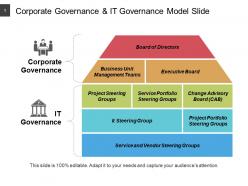
Corporate governance and it governance model slide ppt example file
Try Before you Buy Download Free Sample Product
Audience
Editable
of Time
Our Corporate Governance And It Governance Model Slide Ppt Example File team are a gifted lot. Their abilities are completely fascinating.
People who downloaded this PowerPoint presentation also viewed the following :
Corporate governance and it governance model slide ppt example file with all 5 slides:
Compare jobs with our Corporate Governance And It Governance Model Slide Ppt Example File. Give due consideration to good and bad aspects.
FAQs for Corporate governance and it governance model slide
Look, it all comes down to accountability, transparency, fairness, and responsibility. Your board needs to actually watch management instead of just nodding along to everything. Get independent directors who aren't golfing buddies with the CEO. Financial info and exec pay should be crystal clear - no hiding stuff. Risk management systems matter too, though honestly half the companies I see still screw this up somehow. The board's gotta represent shareholders but consider other stakeholders. Oh, and if you're fixing your governance? Start with board composition and independence first. That's where most problems hide.
Look, good governance basically means your company has its act together - clear rules, smart decisions, solid risk management. People trust you more when leadership's transparent and ethical. Trust leads to loyalty, which obviously helps your bottom line. Companies like Enron? Perfect example of what happens when governance goes to hell. Your investors feel confident, employees actually want to stay, customers keep coming back. Honestly, the connection's pretty direct. Want to start somewhere? Focus on getting diverse voices on your board and being more open about your financials. Makes a huge difference.
So boards are supposed to be the watchdogs keeping management in check. They handle the big stuff - hiring/firing CEOs, setting exec pay, making sure the company follows regulations and doesn't blow up from bad risks. Basically they're the buffer between shareholders and leadership. The audit process falls under them too. Honestly though, some boards are way more hands-on than others - you've probably seen companies where the board was clearly asleep at the wheel. If your company's having governance problems, I'd compare what your board's actually doing versus what good boards should be doing.
Honestly, you don't have to pick one or the other. Build ethics right into your business model from the start - way easier than trying to add it later. Companies focused on long-term value usually beat the ones chasing quarterly profits anyway (which always surprised me). Make ethics part of every big decision, be upfront with people about what you're doing, and track more than just revenue. Set up some oversight so people stay accountable. The whole "good vs profitable" thing is kind of a false choice if you play it smart.
So basically, public companies get hammered with way more regulations - SEC filings every quarter, Sarbanes-Oxley stuff, mandatory independent board members. Private companies? They can pretty much do whatever they want with their governance structure. Skip the pricey audits, no required independent directors. It's honestly a massive difference. But here's what's weird - even private companies should still think about decent governance, especially if they're eyeing an acquisition or trying to impress investors. Really depends on where your company's at right now and what you're planning for the future.
Regulatory bodies are basically corporate babysitters - they create rules companies have to follow or get slapped with penalties. SOX makes CEOs certify their financials, UK codes push for independent boards, that sort of thing. Companies can't escape disclosure requirements and audit standards either. The whole system varies by country though, which is honestly pretty annoying if you're dealing with multiple jurisdictions. But you'll see similar results everywhere: more transparency, better controls, shareholders get protected. Just always check local requirements first since they're different everywhere. Some countries are way stricter than others too.
Honestly, you need three main things: solid reporting, real stakeholder input, and oversight that actually works. Quarterly reports should tell the truth, not just pretty stories. Set up independent board committees and make your audit processes rock solid. Create ways for people to give feedback - and here's the crazy part - actually listen to what they say. Town halls help too, plus having an open-door thing going. But the real game-changer? Having actual consequences when stuff goes wrong. I mean, what's the point of accountability if nothing happens when people mess up?
So basically conflicts happen when board members or execs have split loyalties - like a director whose side business benefits from company decisions, or when leadership puts personal gain first. Honestly, most people don't even realize they're doing it half the time. Best way to handle it? Require disclosure upfront, set up independent committees, and have clear policies that force people to step aside from decisions where they're conflicted. Regular ethics training doesn't hurt either. You need written rules AND a culture that'll actually call people out when needed.
So basically when companies have terrible leadership oversight, everyone gets screwed. Your stock tanks, dividends disappear, and you're stuck with way riskier investments. But here's the thing - it doesn't stop there. These failures cause massive ripple effects that honestly freak me out sometimes. Jobs vanish, markets crash, and suddenly nobody trusts anything. Remember Enron? Yeah, that mess. Wells Fargo too. The whole economy suffers because money doesn't flow where it should and investors get spooked. My advice? Always dig into how well a company's actually run before throwing your cash at them.
Board diversity is huge for catching stuff everyone else misses. Different backgrounds mean people actually challenge ideas instead of just nodding along. You get someone who thinks differently, they'll spot risks or opportunities that a bunch of similar people would totally overlook. Plus diverse boards actually look like your customers and stakeholders - which honestly just makes sense in 2024. When I'm checking out a company's governance, board composition tells me a lot about how good their decision-making really is. Homogeneous groups? They're probably missing something important.
Board tech has come a long way - digital voting and secure portals make document sharing way smoother. AI helps spot risks early, which honestly saves so much headache later. Virtual meetings stuck around post-COVID because directors can actually participate more. Blockchain's getting into shareholder voting too. The automated compliance stuff catches problems before they blow up. Data analytics gives better oversight across the board. Don't just chase shiny new tools though - pick what actually fixes your real problems. Some companies go overboard with tech when simpler solutions work fine.
Honestly, most companies suck at this - they just do annual meetings and call it a day. Start by figuring out who your key stakeholders actually are and how they like to communicate. Set up quarterly check-ins instead of waiting a whole year. Digital platforms work great for ongoing conversations, but make it two-way - nobody wants to just listen to you talk at them. Get stakeholders involved in board committees somehow, run those materiality assessments yearly, and actually report back to your board about what people are saying. Oh, and dedicated feedback channels are clutch.
Honestly, globalization is making companies standardize their governance way more than before. ESG reporting is huge now - everyone wants those metrics. Plus you've got stakeholder capitalism taking over from the old shareholder-first model. GDPR was like the perfect example of how one region's rules spread everywhere else for privacy stuff. Board diversity isn't optional anymore either. Here's the tricky part though - if you're listed in multiple countries, you're juggling different compliance frameworks at once. Global investors expect real-time transparency and consistent reporting no matter where you operate. My advice? Start benchmarking against international standards before you have to.
Oh totally, it's like night and day between industries. Banks have insane oversight - multiple committees, endless compliance stuff, the works. Tech companies? Completely different vibe - founders keep control with those dual-class shares so they can move fast. Utilities are all about stakeholder meetings since they're basically public services (which makes sense I guess). Healthcare deals with crazy ethical requirements because, you know, people's lives. Look up governance guides for your specific industry though. What works for Goldman Sachs would probably kill a startup's speed.
Honestly, it's mostly about money and politics. SMEs don't have the budget for proper board training or dedicated governance people. Family businesses are the worst for this - try telling dad he needs formal oversight when he's been running things his way for 20 years. Super awkward. There's also way less regulatory pressure than public companies face, so why bother? My advice? Don't go crazy trying to fix everything. Start with basic board structures and clear decision-making processes. Build from there once people get comfortable with the idea.
-
Really like the color and design of the presentation.
-
Nice and innovative design.