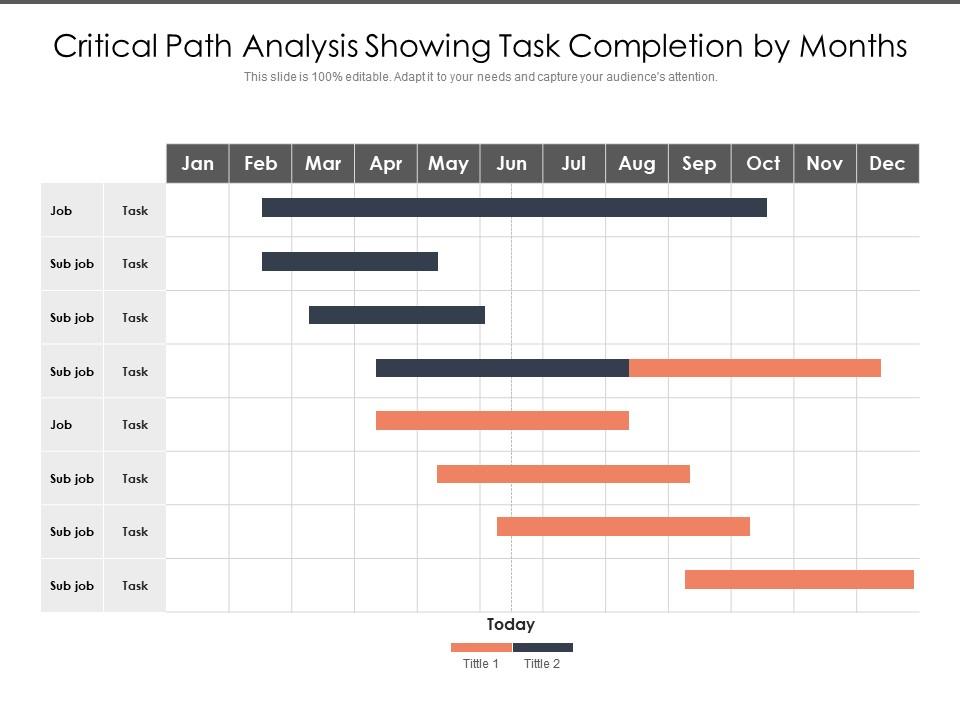
Critical path analysis showing task completion by months
Try Before you Buy Download Free Sample Product
Audience
Editable
of Time
Encourage intrepid individuals with our Critical Path Analysis Showing Task Completion By Months. Enable them to chart an independent course.
People who downloaded this PowerPoint presentation also viewed the following :
Critical path analysis showing task completion by months with all 5 slides:
Beef up your impression with our Critical Path Analysis Showing Task Completion By Months. Add extra flesh to your image.
FAQs for Critical path analysis showing task
The primary purpose of Critical Path Analysis is to identify the longest sequence of dependent tasks that determines a project's minimum completion time, enabling project managers to prioritize resources, minimize delays, and optimize scheduling. Through this methodology, organizations across industries streamline project delivery, enhance resource allocation, and maintain competitive timelines, with many finding that focusing on critical path activities significantly reduces overall project duration and costs.
You determine the critical path by calculating the earliest start and finish times for each task, then identifying the longest sequence of dependent activities from project start to completion. This involves mapping task dependencies, estimating durations, and performing forward and backward passes through the network, with project managers in construction, software development, and manufacturing finding that this systematic approach reveals schedule bottlenecks and optimizes resource allocation.
Key components of a Critical Path Analysis diagram include nodes representing project milestones, arrows showing task dependencies, duration estimates for each activity, earliest and latest start times, and the critical path itself highlighted through connected activities. These elements work together by visualizing project workflows, identifying potential bottlenecks, and enabling project managers to optimize resource allocation, ultimately delivering improved scheduling accuracy and enhanced project completion rates.
Identifying the critical path helps resource allocation by highlighting tasks that directly impact project completion, enabling managers to prioritize high-impact activities, allocate skilled personnel strategically, and minimize bottlenecks. This approach streamlines scheduling decisions across industries like construction and software development, ultimately delivering faster project completion and enhanced operational efficiency.
Microsoft Project, Primavera P6, Smartsheet, Monday.com, and Asana are widely used for Critical Path Analysis, offering automated scheduling, resource management, and timeline visualization capabilities. These platforms streamline project planning by calculating critical paths automatically, enabling real-time collaboration, and delivering comprehensive reporting features that help project managers optimize timelines and resource allocation across complex initiatives.
Critical Path Analysis enhances project scheduling by identifying essential tasks, determining project duration, and highlighting potential bottlenecks before they impact timelines. This strategic approach enables project managers to allocate resources more effectively, prioritize critical activities, and maintain realistic deadlines, with many organizations finding that systematic path analysis reduces project delays by 20-30% while improving overall delivery predictability.
Project managers face challenges including inaccurate time estimates, resource constraints, scope changes, team coordination difficulties, and software complexity when implementing Critical Path Analysis. While these obstacles can initially slow adoption, many organizations find that systematic training, stakeholder engagement, and iterative refinement ultimately deliver improved project visibility, resource optimization, and competitive scheduling advantages.
Dependencies in Critical Path Analysis are mapped through four relationship types: finish-to-start, start-to-start, finish-to-finish, and start-to-finish connections between project activities. These logical sequences enable project managers to identify task interdependencies, calculate accurate timelines, and determine resource allocation priorities, with many organizations finding that proper dependency mapping reduces project delays and enhances overall scheduling efficiency.
Critical Path Analysis can be adapted for Agile methodologies, though it requires modification from traditional waterfall approaches, focusing on sprint-level dependencies, iterative planning cycles, and flexible milestone tracking. Many software development teams and product management organizations find that hybrid approaches work effectively, combining Agile's adaptability with CPA's dependency mapping to enhance sprint planning, identify bottlenecks, and ultimately deliver more predictable iterations while maintaining Agile's responsive framework.
External factors impact the critical path by introducing delays, resource constraints, and scope changes that can shift which activities determine project duration. Weather disruptions in construction projects, supplier delays in manufacturing, or regulatory changes in pharmaceutical development can extend critical activities or create new bottlenecks, with many project managers finding that proactive risk assessment and flexible scheduling help maintain timeline integrity despite external uncertainties.
Buffer time in Critical Path Analysis serves as a protective measure against project delays, providing cushions for unexpected complications, resource constraints, and task duration variances. Many project managers strategically place buffers before critical milestones and at project completion, enabling teams to absorb minor setbacks while maintaining overall timeline integrity, ultimately delivering more predictable outcomes and reduced client dissatisfaction.
Critical Path Analysis supports risk management by identifying task dependencies, potential bottlenecks, and activities with zero slack time that could derail project timelines. Through systematic evaluation of task sequences, project managers can proactively allocate resources, develop contingency plans, and monitor high-risk activities, ultimately delivering enhanced project predictability and reduced schedule overruns.
The critical path represents the longest sequence of dependent tasks determining minimum project duration, while other paths contain slack time allowing flexibility in scheduling. Non-critical paths can experience delays without affecting overall timeline, whereas critical path delays directly impact project completion, with many project managers finding that focusing resources on critical activities while leveraging float in alternative paths optimizes efficiency.
The critical path should be revisited weekly during active project phases, with additional reviews triggered by scope changes, resource adjustments, or significant delays. Through regular monitoring and dynamic scheduling tools, project managers can identify emerging bottlenecks, reallocate resources proactively, and maintain timeline integrity, with many organizations finding that frequent reassessment ultimately delivers improved project outcomes and stakeholder confidence.
Techniques to shorten the critical path include crashing (adding resources to accelerate tasks), fast-tracking (performing sequential activities in parallel), resource reallocation, scope reduction, and outsourcing critical activities. These methods enable project managers to compress timelines by optimizing resource deployment and workflow sequences, with many organizations finding that strategic combinations of these approaches deliver faster project completion while maintaining quality standards.
No Reviews