Cross Functional Team Performance Model Managing Cross Functional Teams

Rating:
80%
Cross Functional Team Performance Model Managing Cross Functional Teams
Slide 1 of 6

or

Favourites Favourites

Try Before you Buy Download Free Sample Product

Audience Impress Your
Audience
Editable 100%
Editable
Time Save Hours
of Time
The Biggest Sale is ending soon in
0
0
:
0
0
:
0
0
Rating:
80%
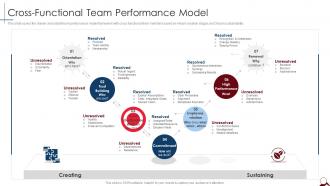
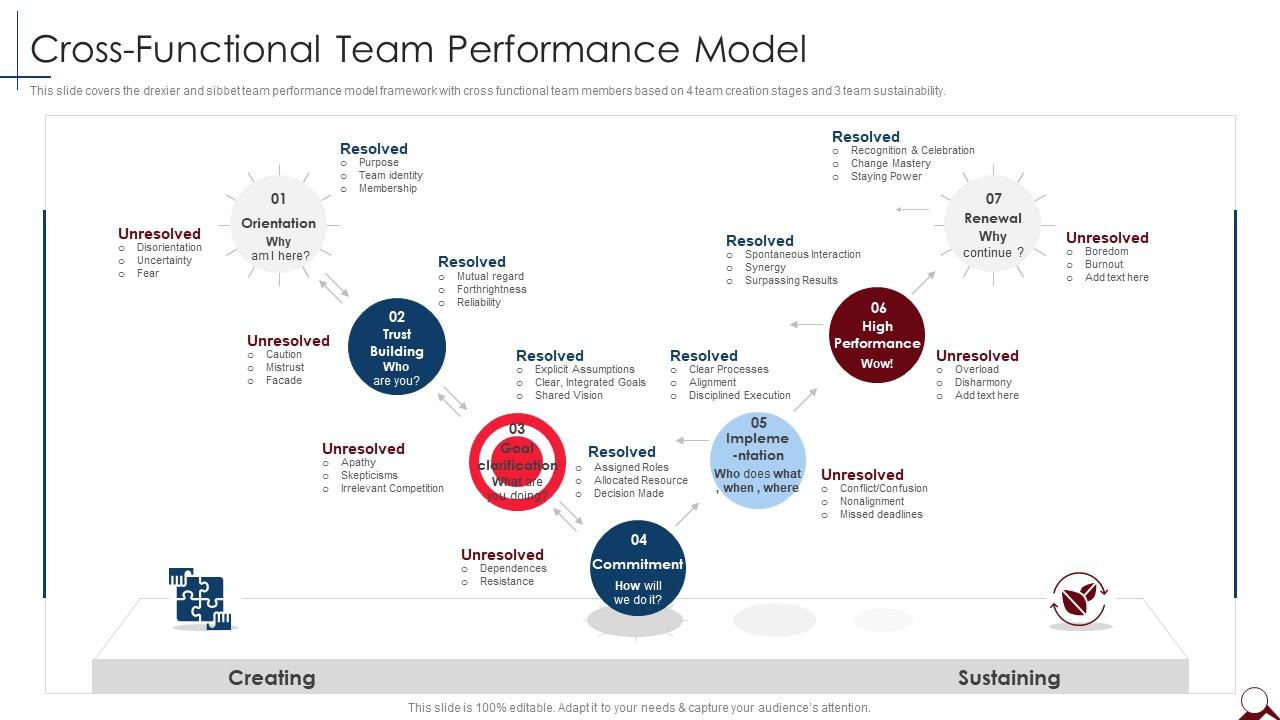
This slide covers the drexier and sibbet team performance model framework with cross functional team members based on 4 team creation stages and 3 team sustainability. Present the topic in a bit more detail with this Cross Functional Team Performance Model Managing Cross Functional Teams. Use it as a tool for discussion and navigation on Cross Functional Team Performance Model. This template is free to edit as deemed fit for your organization. Therefore download it now.
FAQs for Cross Functional Team Performance Model Managing

Effective cross-functional team performance models include clear role definitions, shared accountability frameworks, standardized communication protocols, performance metrics alignment, and collaborative decision-making processes. These components streamline coordination by eliminating silos, enhancing transparency, and accelerating project delivery, with many organizations finding that strategic integration ultimately delivers faster innovation cycles and competitive advantage.

Communication strategies within cross-functional teams can be optimized through regular structured meetings, shared digital collaboration platforms, clear role definitions, standardized reporting protocols, and cross-departmental liaison assignments. These approaches streamline information flow by eliminating silos, establishing consistent touchpoints, and creating transparency across departments, with many organizations finding that strategic communication frameworks ultimately deliver faster project completion and enhanced team alignment.

Leadership plays a pivotal role by establishing clear vision, facilitating communication across departments, and removing organizational barriers that hinder collaboration. Effective leaders in cross-functional environments create alignment between diverse team members, resolve conflicts between competing priorities, and ensure resource allocation supports collective goals, ultimately delivering enhanced innovation and faster project completion across organizations.

Performance metrics for cross-functional teams should combine individual contributions, collaborative outcomes, and project milestones, including communication effectiveness, goal alignment, and delivery timelines. These assessments enable organizations to measure both technical achievements and team integration, with many companies finding that balanced scorecards tracking customer satisfaction, process efficiency, and innovation output ultimately deliver stronger cross-functional performance insights.

Cross-functional teams commonly face communication barriers, conflicting priorities, unclear accountability, resource allocation disputes, and varying work styles across departments. These challenges often stem from different organizational cultures and competing deadlines, with many organizations finding that establishing clear governance structures, shared metrics, and regular alignment sessions significantly improves collaboration and ultimately delivers better project outcomes.

Diversity within cross-functional teams significantly enhances performance by bringing varied perspectives, specialized expertise, and innovative problem-solving approaches that reduce groupthink and blind spots. Through strategic combination of different backgrounds, skills, and experiences, organizations achieve more creative solutions, faster decision-making, and improved market understanding, ultimately delivering competitive advantage and stronger business outcomes.

Methods to foster cross-functional collaboration include structured communication protocols, shared project management platforms, regular interdisciplinary workshops, cross-training initiatives, and collaborative goal-setting frameworks. These approaches streamline coordination by breaking down silos, enhancing mutual understanding, and aligning diverse expertise toward common objectives, with many organizations finding that strategic pairing of complementary skills ultimately delivers faster innovation and improved project outcomes.

Conflict can be managed through structured communication protocols, regular feedback sessions, clear role definitions, and collaborative problem-solving frameworks that address root causes rather than symptoms. When teams establish transparent decision-making processes and conflict resolution procedures, organizations find that diverse perspectives become strategic advantages, ultimately delivering enhanced innovation, faster project completion, and stronger team cohesion across departments.

Best practices for setting clear goals in cross-functional teams include establishing shared objectives with measurable outcomes, defining individual role responsibilities and deliverables, creating transparent communication protocols, and implementing regular milestone checkpoints. These approaches streamline collaboration by aligning diverse expertise toward common targets, minimizing role confusion, and enabling continuous progress tracking, with many organizations finding that structured goal-setting frameworks ultimately deliver faster project completion and enhanced team accountability.

Technology tools facilitate better performance tracking in cross-functional teams by providing unified dashboards, real-time analytics, automated reporting systems, collaborative workspaces, and integrated project management platforms. These solutions enable managers to monitor progress across departments seamlessly, identify bottlenecks quickly, and measure outcomes transparently, with many organizations finding that centralized tracking ultimately delivers enhanced accountability and strategic alignment.

Aligning cross-functional priorities requires establishing shared objectives through collaborative goal-setting sessions, implementing regular communication rhythms with structured updates, and creating transparency around each function's constraints and timelines. Organizations like pharmaceutical companies and financial institutions find success using priority matrices and cross-departmental workshops, ultimately delivering unified project outcomes while maintaining functional expertise and accountability.

Cross-functional teams accelerate innovation by combining diverse expertise, perspectives, and skill sets from different departments, enabling rapid problem-solving and creative solutions. Through collaborative brainstorming, shared knowledge transfer, and integrated decision-making, organizations streamline product development cycles, reduce time-to-market, and enhance competitive positioning, with many companies finding that cross-departmental collaboration delivers breakthrough innovations and sustainable growth advantages.

Organizations can expect enhanced collaboration, accelerated project delivery, improved innovation, reduced silos, and better resource allocation from implementing a structured cross-functional team performance model. These frameworks enable faster decision-making, streamlined communication, and more diverse problem-solving approaches, with companies in sectors like technology and healthcare finding that structured models ultimately deliver higher productivity and competitive advantage.

Feedback loops can be integrated through regular retrospectives, real-time performance dashboards, peer evaluation systems, stakeholder input sessions, and continuous goal adjustment mechanisms. These systems enable teams to identify bottlenecks, enhance collaboration patterns, and optimize resource allocation across functions, with many organizations finding that structured feedback cycles ultimately deliver faster project completion and improved cross-departmental alignment.

Essential training opportunities include communication skills workshops, collaborative problem-solving sessions, cross-departmental knowledge sharing, conflict resolution training, and agile methodology courses. These programs enhance team performance by breaking down silos, improving interpersonal dynamics, and building shared understanding across functions, with many organizations finding that structured development initiatives significantly accelerate project delivery and innovation outcomes.

Ratings and Reviews

80% of 100
Review Form
Write a review
Most Relevant Reviews
  1. 80%

    by Deandre Munoz

    Been using SlideTeam for some time now…can’t imagine why I wasted all that time in front of the screen trying to make the perfect presentation.
  2. 80%

    by Donn Hart

    Great product with effective design. Helped a lot in our corporate presentations. Easy to edit and stunning visuals.

2 Item(s)

per page: