Cultural awareness training ppt powerpoint presentation file templates cpb
Try Before you Buy Download Free Sample Product
Audience
Editable
of Time
Our Cultural Awareness Training Ppt Powerpoint Presentation File Templates Cpb are topically designed to provide an attractive backdrop to any subject. Use them to look like a presentation pro.
People who downloaded this PowerPoint presentation also viewed the following :
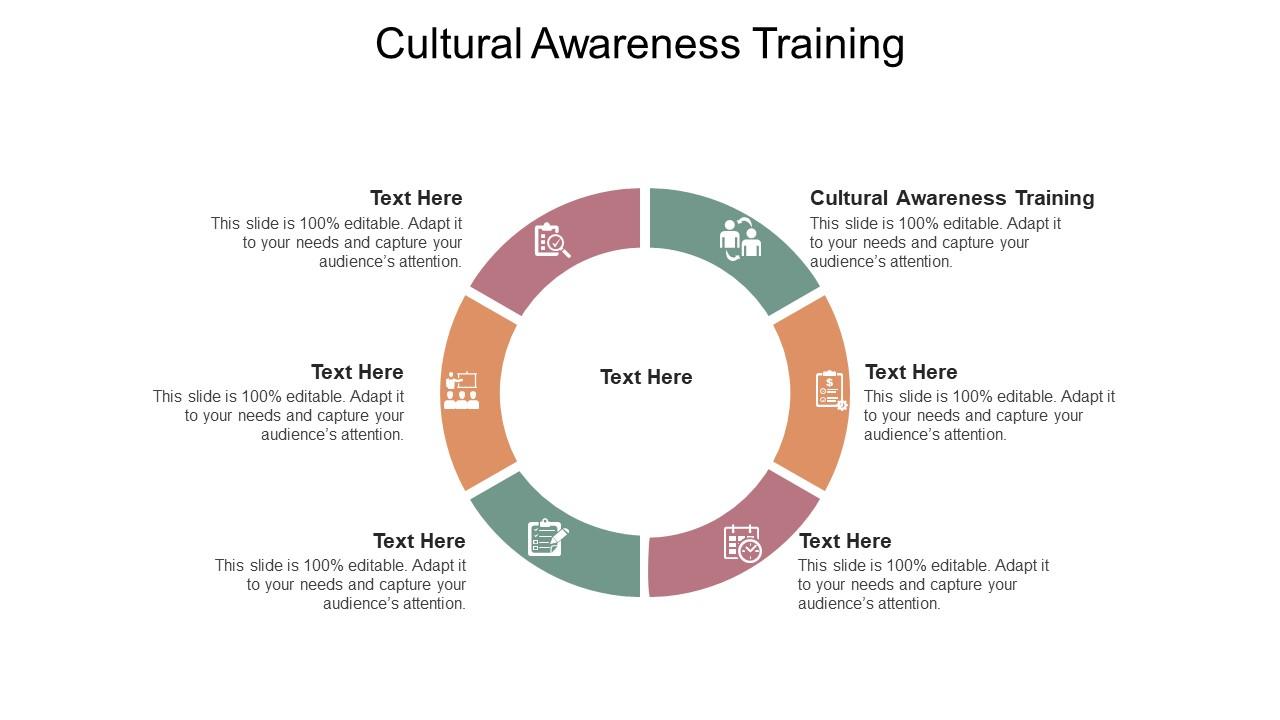
Cultural awareness training ppt powerpoint presentation file templates cpb with all 2 slides:
Use our Cultural Awareness Training Ppt Powerpoint Presentation File Templates Cpb to effectively help you save your valuable time. They are readymade to fit into any presentation structure.
FAQs for Cultural awareness training ppt powerpoint presentation
Effective cultural awareness training includes unconscious bias recognition, cross-cultural communication skills, cultural competency frameworks, inclusive leadership development, and global business etiquette understanding. These components work together by enhancing team collaboration, reducing workplace conflicts, and improving customer relationships, with many organizations finding that comprehensive programs ultimately deliver stronger employee engagement and competitive advantage in increasingly diverse markets.
Cultural awareness training enhances workplace diversity and inclusion by fostering cross-cultural understanding, reducing unconscious bias, improving communication across diverse teams, and creating more inclusive decision-making processes. Through structured programs, organizations streamline collaboration between multicultural employees, enhance customer relationships in global markets, and ultimately deliver stronger team performance and employee retention, with many companies finding significantly improved workplace harmony.
Common challenges include resistance to change, inadequate leadership support, one-size-fits-all approaches, limited budget allocation, and measuring effectiveness. Organizations often struggle with engaging diverse learning styles, addressing unconscious bias, and creating sustainable behavioral change, while balancing comprehensive content with time constraints, ultimately requiring strategic commitment and customized approaches to deliver meaningful cultural transformation.
Cultural awareness training can be tailored by incorporating industry-specific scenarios, communication protocols, and regulatory requirements that reflect each sector's unique challenges. For example, healthcare training focuses on patient interactions across cultures, while financial services emphasizes culturally sensitive investment discussions, ultimately delivering improved client relationships and competitive advantage in diverse markets.
Leadership plays a pivotal role by modeling inclusive behaviors, allocating resources for comprehensive training programs, and establishing accountability measures for cultural awareness outcomes. Through visible commitment and strategic investment, leaders create organizational environments where diversity training translates into measurable results, with many companies finding that executive sponsorship significantly enhances program effectiveness and employee engagement across all levels.
Virtual training platforms enhance cultural awareness programs by delivering interactive simulations, real-time feedback, and personalized learning paths that adapt to individual progress and cultural contexts. These platforms enable organizations to scale training across global teams while providing immersive scenarios, virtual cultural exchanges, and data-driven insights, ultimately improving cross-cultural communication and reducing workplace misunderstandings.
**INPUT**: What metrics can be used to measure the success of cultural awareness training initiatives? **OUTPUT**: Cultural awareness training success can be measured through employee engagement scores, cross-cultural collaboration metrics, retention rates among diverse teams, incident reduction reports, and leadership diversity assessments. These measurements enable organizations to track behavioral changes, communication improvements, and workplace inclusivity outcomes, with many companies finding that comprehensive measurement approaches ultimately deliver enhanced team performance and competitive advantage in global markets. [Word count: 60]
Cultural awareness training enhances customer service by teaching employees to understand diverse communication styles, cultural preferences, buying behaviors, and service expectations across different markets. This knowledge enables representatives to adapt their approach effectively, build stronger rapport with international clients, and avoid cultural missteps, ultimately delivering more personalized experiences and increased customer satisfaction in global business environments.
Cultural awareness training addresses unconscious bias by exposing hidden assumptions, teaching inclusive communication techniques, and providing frameworks for recognizing cultural differences in decision-making processes. Through interactive scenarios and self-reflection exercises, organizations enhance team collaboration, reduce workplace conflicts, and improve talent retention, with many companies finding that structured programs ultimately deliver more equitable hiring practices and stronger cross-cultural partnerships.
Organizations can access diverse training tools including interactive workshops, virtual reality simulations, cultural competency assessments, e-learning platforms, and cross-cultural communication modules. These resources enhance employee understanding through immersive scenarios, real-world case studies, and ongoing feedback mechanisms, with many companies finding that comprehensive cultural training programs ultimately improve team collaboration, reduce workplace conflicts, and strengthen global business relationships.
Organizations create safe spaces by establishing clear ground rules for respectful dialogue, encouraging active listening, and emphasizing learning over judgment during cultural awareness training sessions. Facilitators can use structured discussion formats, anonymous feedback mechanisms, and small group activities that allow participants to share experiences gradually, ultimately building trust and psychological safety that enables meaningful cross-cultural understanding and organizational inclusivity.
Cultural awareness training delivers significant long-term benefits for employee retention and satisfaction by fostering inclusive environments, reducing workplace conflicts, and enhancing cross-cultural collaboration. These programs streamline communication barriers, minimize cultural misunderstandings, and create psychological safety, with many organizations finding that employees feel more valued and engaged, ultimately reducing turnover costs while building stronger, more cohesive teams.
Storytelling enhances cultural awareness training by presenting authentic personal narratives, historical contexts, and real workplace scenarios that illustrate cultural nuances and perspectives. Through narrative-based learning, organizations create emotional connections and memorable experiences that traditional lectures cannot achieve, with many companies finding that story-driven training significantly improves cross-cultural communication and reduces workplace misunderstandings.
Best practices in cultural awareness training include immersive simulation exercises, cross-cultural mentorship programs, storytelling workshops, interactive case studies, and reverse culture shock preparation sessions. Organizations in multinational corporations, healthcare systems, and educational institutions increasingly find that combining experiential learning with peer-to-peer knowledge sharing delivers enhanced team collaboration and improved customer relationships across diverse markets.
Cultural awareness training can be evaluated through employee feedback surveys, behavioral assessments, incident tracking, and cross-cultural collaboration metrics, while updates should incorporate emerging global trends, demographic shifts, and evolving workplace dynamics. Organizations increasingly use data-driven approaches, partnering with cultural consultants and leveraging employee resource groups to ensure training remains current, ultimately delivering enhanced team cohesion and competitive advantage in diverse markets.
-
Unique and attractive product design.
-
Colors used are bright and distinctive.
-
Easily Understandable slides.