Customer complaint feedback ppt slide
Try Before you Buy Download Free Sample Product
Audience
Editable
of Time
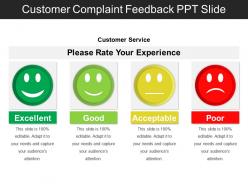
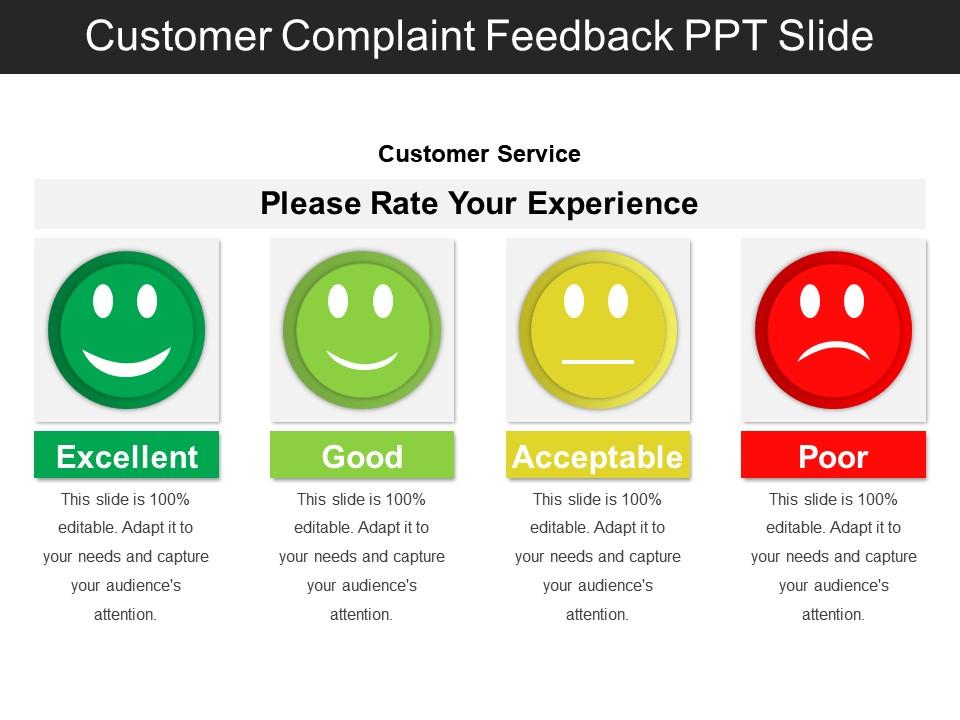
Introducing Customer Complaint Feedback PPT Slide. Take the assistance of this PowerPoint presentation template and generate a report of the customer’s review of your products. Using the PPT template, you can highlight the features that provide service and support to the clients. You can illustrate the various types of consumer complaints with the help of this PowerPoint presentation template. There are generally four categories such as excellent, good, acceptable, and deficient that rates the experience of a customer, thus mention it using PPT slide. If you want to showcase the problems that lead to the dissatisfaction of consumers, then use our professionally designed PowerPoint presentation template. The PowerPoint presentation template contains high-grade icons with which you can make your presentation even more engaging. Using the PPT slide, you can explain about the online complaint management system in which a customer can review the product on online channels. Therefore, download this ready-to-use PowerPoint presentation template and gain your customer’s confidence.
People who downloaded this PowerPoint presentation also viewed the following :
Customer complaint feedback ppt slide with all 5 slides:
Encourage a charitable approach with our Customer Complaint Feedback Ppt Slide. They help compassion develop.
FAQs for Customer complaint
Common presentation design complaints include unclear messaging and poor visual hierarchy, inconsistent branding and color schemes, overcrowded slides with excessive text, low-quality images and graphics, and inadequate customization for specific audiences. These issues often stem from rushed timelines or inexperienced designers, with many organizations finding that investing in professional design templates and clear brand guidelines significantly reduces client dissatisfaction while enhancing presentation effectiveness.
Presentation templates minimize customer complaints by ensuring consistent visual standards, professional layouts, brand alignment, and polished aesthetics across all client communications. Through standardized design elements, businesses reduce formatting errors, eliminate amateur-looking presentations, and deliver cohesive brand experiences, with many organizations finding that template usage significantly decreases revision requests and enhances client satisfaction.
Customer feedback plays a crucial role in identifying design gaps, content needs, usability issues, and market trends that directly inform template development priorities. Through systematic feedback analysis, organizations can enhance visual appeal, streamline user experience, and develop industry-specific solutions, with many finding that customer-driven improvements significantly increase template adoption rates and overall user satisfaction.
Companies should handle template usability complaints by implementing systematic feedback collection, conducting user experience audits, and providing immediate alternative solutions or tutorials. This approach enables organizations to identify common pain points, streamline template designs, and enhance customer satisfaction, while ultimately delivering improved products and stronger client relationships through responsive service.
Effective strategies include maintaining comprehensive compatibility testing protocols, creating detailed software requirement documentation, offering alternative format options, providing step-by-step troubleshooting guides, and establishing dedicated technical support channels. These approaches streamline resolution by addressing root causes, minimizing user frustration, and ensuring seamless template functionality, with many organizations finding that proactive compatibility measures significantly reduce complaint volumes while enhancing customer satisfaction.
Customer complaints significantly influence presentation template development by identifying design flaws, usability issues, formatting problems, and missing features that users encounter regularly. These insights enable template creators to enhance functionality, streamline layouts, and add requested elements like industry-specific graphics or accessibility features, ultimately delivering more user-centric designs that reduce friction and improve presentation effectiveness across organizations.
Key indicators include increasing complaint volumes, longer resolution times, repetitive issues across multiple touchpoints, declining satisfaction scores, and negative feedback patterns. These warning signs often emerge when templates lack personalization, contain outdated information, or fail to address specific customer needs, with many organizations finding that rigid template structures ultimately hinder rather than enhance customer experiences.
Social media enables comprehensive complaint tracking through hashtag monitoring, brand mentions, direct message management, sentiment analysis tools, and engagement metrics evaluation. Through proactive social listening platforms, organizations can identify template-related issues quickly, respond publicly to demonstrate transparency, and implement feedback loops for product improvements, ultimately transforming complaints into valuable customer insights and enhanced template offerings.
Preventative measures include comprehensive template testing, user feedback integration, clear documentation, intuitive design validation, and phased rollout strategies. These approaches streamline the release process by identifying potential issues early, enhancing user experience through iterative improvements, and minimizing friction points, with many organizations finding that proactive quality assurance ultimately delivers higher customer satisfaction and reduced support overhead.
Effective communication significantly enhances customer satisfaction by demonstrating empathy, providing clear explanations of resolution steps, and maintaining transparent timelines throughout the process. When representatives actively listen and respond promptly, customers feel valued and heard, with many organizations finding that this approach transforms complaints into opportunities for stronger loyalty and trust.
Timely responses to customer complaints significantly enhance brand loyalty by demonstrating respect, accountability, and commitment to customer satisfaction. When companies respond quickly, customers feel valued and heard, with studies showing that businesses resolving complaints within 24 hours retain 95% more customers, ultimately building stronger relationships and competitive advantage.
User-generated content reveals common template complaints through reviews, forums, and feedback highlighting issues like limited customization, poor mobile compatibility, and inadequate design variety. These insights enable template providers to prioritize updates, develop targeted solutions, and create more user-centric designs, ultimately delivering improved customer satisfaction and competitive advantage in the presentation marketplace.
Data analytics can examine complaint patterns, identify root causes, track resolution times, analyze sentiment trends, and predict future issues through historical data mining. Through text analytics and machine learning, businesses streamline complaint categorization, enhance response strategies, and improve product development, with many retail and financial services companies finding that predictive insights ultimately reduce complaint volumes while delivering faster customer resolutions.
Best practices include active listening techniques, product knowledge mastery, empathy-driven communication, solution-focused problem-solving, and escalation protocols for complex issues. These training approaches streamline resolution processes by equipping teams with technical expertise, communication skills, and customer retention strategies, with many organizations finding that well-trained support staff significantly enhance customer satisfaction and reduce complaint recurrence rates.
Businesses can encourage constructive complaints by creating accessible feedback channels like dedicated hotlines, online forms, and in-person opportunities, while training staff to respond empathetically and professionally. By implementing clear escalation processes, offering incentives for detailed feedback, and demonstrating how complaints drive improvements, companies build trust and transform dissatisfied customers into loyal advocates.
-
Presentation Design is very nice, good work with the content as well.
-
Graphics are very appealing to eyes.