Customer lead management process map with qualification criteria

Customer lead management process map with qualification criteria
Slide 1 of 2
Favourites Favourites

Try Before you Buy Download Free Sample Product

Audience Impress Your
Audience
Editable 100%
Editable
Time Save Hours
of Time
The Biggest Sale is ending soon in
0
0
:
0
0
:
0
0
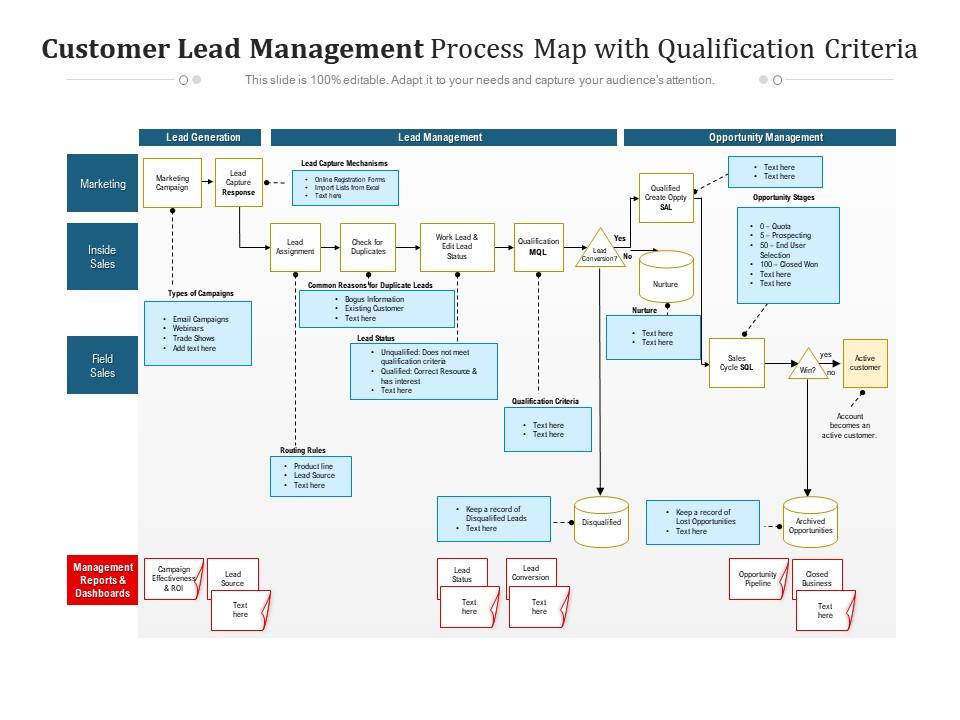
Presenting this set of slides with name Customer Lead Management Process Map With Qualification Criteria. The topics discussed in these slides are Lead Generation, Lead Management, Opportunity Management, Marketing, Inside Sales, Field Sales. This is a completely editable PowerPoint presentation and is available for immediate download. Download now and impress your audience.

Content of this Powerpoint Presentation

Description:

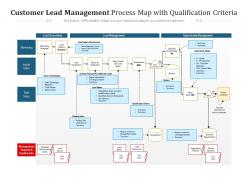
The image is a PowerPoint slide that illustrates a detailed Customer Lead Management Process Map with Qualification Criteria. This process map is designed to guide users through the steps of handling customer leads from generation to potential conversion into active customers.
The process is broken down into several key stages:

1. Lead Generation:

This is the first stage where leads are generated through various marketing campaigns such as email campaigns, webinars, and trade shows. The leads are captured in response to these marketing efforts.

2. Lead Management:

Once leads are generated, they are assigned, checked for duplicates, and evaluated against qualification criteria to determine if they can be classified as Marketing Qualified Leads (MQLs). Common reasons for duplicate leads, such as bogus information or existing customers, are also considered.

3. Opportunity Management:

Qualified leads are then managed as opportunities. They go through different opportunity stages, such as contact, prospecting, end-user, and closed-won. Leads that do not qualify are either nurtured for future opportunities or disqualified.

4. Sales Cycle:

If the opportunity is viable, it enters the sales cycle. Success in this stage results in the lead becoming an "Active Customer."

5. Management Reports & Dashboards:

The final stage involves the analysis and reporting of the campaign's effectiveness and lead conversion rates. This information is used to optimize future lead management processes.
The flowchart uses a combination of rectangular and diamond shapes to denote processes and decision points, with arrows indicating the flow of the process. The color coding helps to distinguish between different parts of the process, such as lead generation, management, and opportunity management.

The slide also includes editable text boxes where specific details can be filled in to tailor the process to the user’s organization. Management dashboards are highlighted as a tool for monitoring and managing the overall process.

This type of process map is crucial for sales teams to systematically track and enhance their lead management activities. It can be presented by Sales Managers or Marketing Managers to their teams, upper management, or during cross-departmental meetings to ensure everyone is aligned with the company's lead management strategy. The structured approach outlined in the slide helps organizations maximize the potential of their sales pipeline and improve conversion rates.

Use cases:

The Customer Lead Management Process Map slide is a versatile tool that can be adapted for use across a multitude of industries. The slide’s focus on managing and qualifying leads is a fundamental aspect of the sales and marketing functions in most sectors. Here’s how it might be used in different industries:

1. Technology and Software

Use: For managing software trial sign-ups, webinar attendees, or inquiries from a website.

Presenter: Sales Manager or Marketing Manager.

Audience: Sales and marketing teams, customer success teams, product development teams.

2. Real Estate:

Use: To track potential property buyers from initial inquiry through to purchase.

Presenter: Real Estate Broker or Lead Manager.

Audience: Real estate agents, agency staff, property developers.

3. Finance and Insurance:

Use: For following up on leads for financial products, insurance policies, or investment services.

Presenter: Financial Advisor or Insurance Sales Lead.

Audience: Sales agents, brokerage firm members, customer service teams.

4. Healthcare:

Use: To manage patient inquiries, referrals, and to follow up on potential new patients for various healthcare services.

Presenter: Practice Manager or Patient Coordinator.

Audience: Healthcare providers, administrative staff, marketing personnel.

5. Retail and E-commerce:

Use: For tracking customer interest from online inquiries, newsletter sign-ups, or loyalty programs.

Presenter: E-commerce Manager or Customer Relationship Manager.

Audience: Customer support teams, digital marketing teams, store managers.

6. Education:

Use: To handle inquiries from prospective students, manage applications, and enrollment processes.

Presenter: Admissions Officer or Enrollment Manager.

Audience: Admissions team, marketing department, education counselors.

7. Manufacturing and B2B Services:

Use: For B2B lead management, from trade show contacts to inquiries about products or services.

Presenter: Business Development Manager or Account Manager.

Audience: Sales teams, partner companies, internal management.

FAQs for Customer lead management process map

Honestly, most people overthink this. You'll need four things: something to capture leads (forms, landing pages), a way to score them so you're not chasing garbage prospects, automated nurturing sequences, and decent analytics. The scoring thing trips everyone up though - like, what actually makes someone worth your time? Your CRM needs to tie it all together or stuff gets lost. Oh, and your marketing and sales teams better have clear handoffs or they'll just blame each other when leads die. I'd start by looking at what you've got now and fixing the biggest mess first.

Ok so basically you'll want to score leads on two things - fit and intent. Check their company size, industry, budget to see if they actually make sense for your product. Then track what they're doing on your site. Someone requesting a demo is way hotter than someone who just read a blog post and left, obviously. I'd prioritize the leads with high scores in both areas first - that's where your time pays off. Create something simple to track this stuff and check monthly to see what's actually working. Honestly took me way too long to figure this out when I started.

So basically automation takes care of all the boring repetitive tasks - capturing leads from your site, scoring them, sending follow-ups, routing the good ones to sales. I used to waste hours updating lead info manually and honestly it was such a pain. Now workflows just nurture leads with the right content until they're ready to buy. Everything gets tracked automatically too which is nice. My advice? Start simple with lead capture and basic follow-ups first. You can always add more fancy stuff later once you get the hang of it.

Track your conversion rates at each funnel stage first - that's where you'll catch the biggest leaks. Response time to leads matters way more than people think. Cost per lead and lead-to-customer conversion are obvious ones. Sales cycle length shows if you're actually moving people through efficiently. Honestly, lead quality beats volume every single time, so measure how many actually fit your ideal customer profile. Oh and definitely track ROI by lead source - I've seen companies waste crazy money on channels that don't convert. Start there and you'll find your bottlenecks pretty quick.

Dude, get a CRM - it'll save your sanity. Right now you're probably scrambling to remember who you called when, but with CRM software everything gets tracked automatically. It scores your leads based on how they behave and sends follow-up reminders so nothing falls through the cracks. Honestly, the pipeline view alone is worth it because you can see exactly where each prospect is at. Some people think it's overkill but trust me, once you're juggling 20+ leads you'll thank yourself. Map out how you currently handle leads first, then pick something that automates the boring repetitive tasks.

Dude, the speed thing is huge - if you're not hitting up leads within like an hour, you're basically toast. Most companies treat every lead exactly the same too, which is insane when you think about it. Set up some kind of scoring system so you know who's actually hot. Oh, and the nurturing part? Total disaster zone for most places. They just abandon anyone who doesn't buy immediately. Your sales and marketing people probably hate each other too, right? That creates this whole mess where leads just disappear into thin air. Honestly, just fix your follow-up game and add some lead scoring - you'll see a massive difference.

Oh this is actually easier than you'd think! Start with those lead magnets - free guides, webinars, whatever makes people want to give you their email. Facebook and LinkedIn ads with built-in forms are gold because nobody has to bounce around to different sites. Once you've got leads, just be real with them. Comment on their stuff, share useful industry tips (not sales pitches), and use retargeting so you stay on their radar. Instagram Stories polls work surprisingly well too - honestly didn't expect that when I first tried it. Build actual relationships instead of pushing your product right away, then guide them over when they're actually ready to buy.

Honestly, start by figuring out who your best customers actually are - like really dig into what they have in common. Then ditch those garbage lead sources that keep bringing you time-wasters. Your messaging needs to hit their specific pain points, not some generic BS. Better qualifying questions on your forms help too. I'd focus on where your good customers actually spend time - maybe that's LinkedIn, maybe industry events, or just old-school referrals. Oh and definitely test different landing pages because sometimes tiny changes make a huge difference. It's basically reverse-engineering what already works.

Dude, you HAVE to segment your leads - seriously, it's a game changer for conversions. Start with the basics like company size, industry, their role, plus how they're actually behaving on your site and with emails. Where'd they come from? What stage are they at in buying? I know a team that saw their close rates jump 30% just from doing this properly. Honestly, even simple segmentation crushes the spray-and-pray approach. Begin with maybe 3-4 buckets, then get fancier as you learn what works. Don't overcomplicate it right out the gate though.

Here's how I handle follow-ups: Hit them back within 24 hours, then space it out at 3 days, 1 week, and 2 weeks. I know that feels like overkill, but honestly most people are just swamped and need multiple reminders. Don't send those boring "just checking in" messages - reference something specific from your chat or their situation. Switch up how you reach out too - email one time, LinkedIn the next, maybe a quick call. Each follow-up should give them something useful, not just ask for their time. Oh, and definitely set those CRM reminders or you'll forget half your prospects.

So basically you create stuff people actually want to read - blog posts, videos, whatever - and they find you instead of you chasing them down. Way better than cold calling random people, trust me. You can put your best content behind a signup form to grab their email. Think of it like... you're solving their problems first, then they're way more interested in buying from you later. The trick is making different content for people who are just browsing vs. those ready to purchase. It's honestly pretty smart when you map it out right.

Honestly, switch up your whole approach - try LinkedIn or even old-school direct mail instead of hammering email. Personalized videos work great but yeah, they're kinda tedious to make. Here's the thing though: stop pushing for the sale. Share industry stuff they'd actually care about, invite them to webinars, send resources that fix their real problems. Also check if anything's changed since you last talked - companies pivot all the time. Just hit them with something like "hey, how's that [specific issue] going?" and see what they say back.

Your existing customers are gold mines for lead prioritization, honestly. Ask recent buyers what made them pull the trigger - those same pain points probably exist in your current prospects. I've seen companies completely flip their lead scoring just from one brutal customer survey (the angry ones tell you the most). Short surveys about their buying journey work best. Then you can map those insights to your pipeline and focus on leads showing similar signals. Oh, and those happy customer stories? Perfect for nurturing campaigns. Sometimes the obvious stuff works.

B2B lead management is such a nightmare compared to B2C, honestly. You're not just convincing one person anymore - there's like 5-7 people in every buying committee now. Sales cycles drag on forever, sometimes over a year. Each stakeholder needs different content too, which is exhausting to create. The research phase alone kills me - buyers spend months googling before they'll even hop on a call with you. You'll need solid lead scoring to figure out who's actually serious. Map out everyone's role first, then build nurture sequences for each stage. It's way more work but the deals are obviously bigger.

Honestly, data analytics is a game changer for figuring out which lead sources actually convert and spotting buying signals early. Track email opens, website visits, and conversion rates by source from the start. You'll see which content hits and catch leads going cold before they're gone. The engagement patterns tell you way more than guessing ever will - though I still trust my gut sometimes too lol. Best part? You can adjust your messaging and timing based on real numbers instead of just hoping something works. Start basic, then dig deeper as you go.

Ratings and Reviews

0% of 100
Review Form
Write a review
Most Relevant Reviews

No Reviews