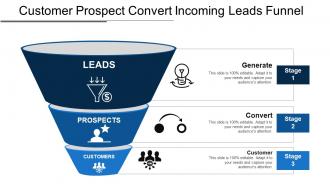
Customer prospect convert incoming leads funnel
Try Before you Buy Download Free Sample Product
Audience
Editable
of Time
Hand out hints on how to improve with our Customer Prospect Convert Incoming Leads Funnel. It will encourage enterprising ideas.
People who downloaded this PowerPoint presentation also viewed the following :
Customer prospect convert incoming leads funnel with all 5 slides:
All the details get amply highlighted by our Customer Prospect Convert Incoming Leads Funnel. It is genuinely data friendly.
FAQs for Customer prospect convert
Okay so the basic stages are awareness, interest, consideration, intent, and conversion. Though honestly every company calls them something different which drives me nuts. You get people to notice you exist first. Then they get curious about what you're selling. After that they start comparing you to competitors - this is where demos and pricing requests happen. Finally they buy. The whole point is matching your content to where they are mentally. Don't pitch someone who just heard of you yesterday, you know? I always look at where people bail out of the process because that shows you exactly what's broken.
Track your conversion rates at every stage - lead capture through closed deals. Get attribution tracking set up so you know which channels actually bring quality leads, not just random volume (learned that one the hard way). Cost per lead, lead-to-opportunity rate, time to conversion - those are your money metrics. Don't stress about individual months though. Look at trends over time instead. First step? Audit where you're tracking stuff now. Most people can't even see where leads drop off, which is honestly where the gold is hiding.
Honestly, start with tracking your conversion rates at each stage - leads to MQLs, MQLs to SQLs, then SQLs to actual customers. Time to conversion matters too. Lead quality scoring is clutch because some leads are just way better than others, you know? Watch how fast people move through your funnel and where they're dropping off the most. That's where your bottlenecks are hiding. Oh, and definitely compare lifetime value to what you're spending to get each customer - that ratio can be brutal if you're not paying attention. Get the stage-by-stage stuff locked down first, then add the fancy metrics later.
So content marketing is all about giving people the right stuff based on where they are in deciding to buy from you. Blog posts and social media get people's attention first. Then you've got the tricky middle part - that's where ebooks, webinars, and case studies really shine because you're building trust and solving their actual problems. Honestly, this stage makes or breaks most campaigns. Finally, product demos and testimonials help close the deal. The whole trick is matching content to their headspace - you don't want to demo software to someone who just figured out they even have a problem, you know?
Think of customer segmentation like actually knowing your audience instead of just throwing stuff at the wall. Someone who just found your site needs totally different content than that person who's been lurking and downloading all your resources, you know? I'd start by figuring out your 3-4 main customer types first. Map out what each group actually cares about. Your messaging hits way harder when it's tailored to where people are in their journey. Honestly, it's the difference between decent engagement and leads that actually convert.
Honestly, A/B testing is a game changer for this stuff. Test different headlines, buttons, form layouts - whatever your leads actually click on. Pick one thing at a time though, otherwise you won't know what worked. I'd start with wherever you're losing the most people since that's gonna move the needle most. The cool thing is you get real data instead of just guessing (no more arguing about button colors lol). Just don't jump to conclusions too fast - wait until you've got enough results to actually mean something before you make it permanent.
Honestly? Most people screw up by asking for way too much info upfront. Those long forms are conversion killers - nobody has patience for that anymore. Then they let leads just sit there without following up, which is insane because you've got maybe 48 hours before they go cold. Generic email blasts are another huge mistake. People can smell those templated messages from a mile away. Also - and this might sound obvious but I see it constantly - not having clear next steps mapped out for each part of your funnel. My advice? Look at where you're losing the most people first and fix that.
So automation tools take care of all that boring repetitive stuff while you focus on actually making sales. Email sequences nurture your leads automatically. They score people based on how they're behaving on your site. Plus you get alerts when someone's actually ready to buy - which is honestly pretty sweet. The best part? It runs 24/7, so you won't lose those random weekend leads anymore because nobody got back to them fast enough. You can set up follow-ups, segment people by what they're interested in, even send personalized content based on which pages they hit. I'd start with email automation though - that's where you'll see the biggest jump in conversions.
You've gotta tailor your approach based on where people are in the buying process. Early-stage folks just want to learn stuff - blog posts, webinars, industry trends work great. Once they're comparing options, hit them with case studies and product demos. Bottom-funnel people need the personal touch: custom proposals, trials, actual conversations. The biggest mistake? Being pushy way too early. I see this constantly and it's painful to watch. Segment your email lists by stage, then set up different nurture flows for each group. Honestly makes such a difference once you get it dialed in properly.
Dude, you'll see like 10-30% better conversions when you actually personalize stuff for prospects. Makes them feel heard, you know? Nobody wants another boring sales email that could've been sent to literally anyone. Use whatever data you've got - their company size, industry, what they clicked before - and customize your landing pages and emails around that. Honestly, even just tweaking subject lines makes a huge difference. Start there and work your way up to fancier stuff. When people feel like you get their specific problems, they're way more likely to bite.
Dude, follow-up is where the magic happens - you can bump conversion rates 20-80% easy. Most people need like 5-12 touches before they buy anything, but sales teams usually quit after 2-3 tries. Such a waste. Don't just send "checking in" emails though. Actually add value each time. Switch it up - email one day, call the next, maybe hit them on LinkedIn. For big prospects, I've even seen direct mail work (sounds old school but whatever). The trick is being persistent without being that annoying person. Set up some kind of system so you don't forget anyone. Trust me, consistency beats everything else.
Social proof is honestly a game changer for conversions. People see testimonials or "5,000+ customers served" and suddenly they're way less skeptical about buying from you. It's just human nature - we trust stuff more when we know others have tried it first. I always tell people to stick testimonials right by their pricing or checkout buttons. Case studies work great too, though they take more effort to put together. The psychology behind it is pretty simple: nobody wants to be the first person to take a risk. When you show that real customers are happy, conversions usually jump up fast.
Honestly, most CTAs suck because they're way too vague. Skip "Learn More" - that tells me absolutely nothing. Instead, use action words like "Get," "Download," or "Start." You'll want to add some urgency too, like "limited spots" or whatever makes sense for your thing. Always tell people what they're actually getting out of it. Make the button pop visually - contrasting colors work great. Keep it short though. I made this mistake once where I wrote like three lines on a button and nobody clicked it lol. Test different versions because your audience might be weird and like something totally different than you'd expect.
Start by setting up tracking on your funnel stages - trust me, you'll be shocked at where people actually bail out. Check your conversion times, lead sources, and how users behave on different pages. The drop-off points usually tell the whole story. Once you've got that data, segment your leads by behavior patterns so you can actually personalize your messaging. A/B test everything based on what you're seeing. I spent way too much time guessing before I started doing this properly. Focus on fixing your biggest leak first, then work your way down.
Honestly, it depends so much on your industry. B2B SaaS companies usually have these long, complicated funnels with tons of touchpoints - makes sense since people don't just impulse-buy software. E-commerce is way more direct and quick. Finance and healthcare? Ugh, they've got all these compliance hoops to jump through, so there's extra trust-building steps. Real estate is completely different - those cycles are insanely long and it's all about relationships. You'll want to match whatever buying behavior is normal in your space. I'd honestly just stalk 3-4 competitors who are crushing it and see how they structure theirs.
-
Unique design & color.
-
Great designs, Easily Editable.