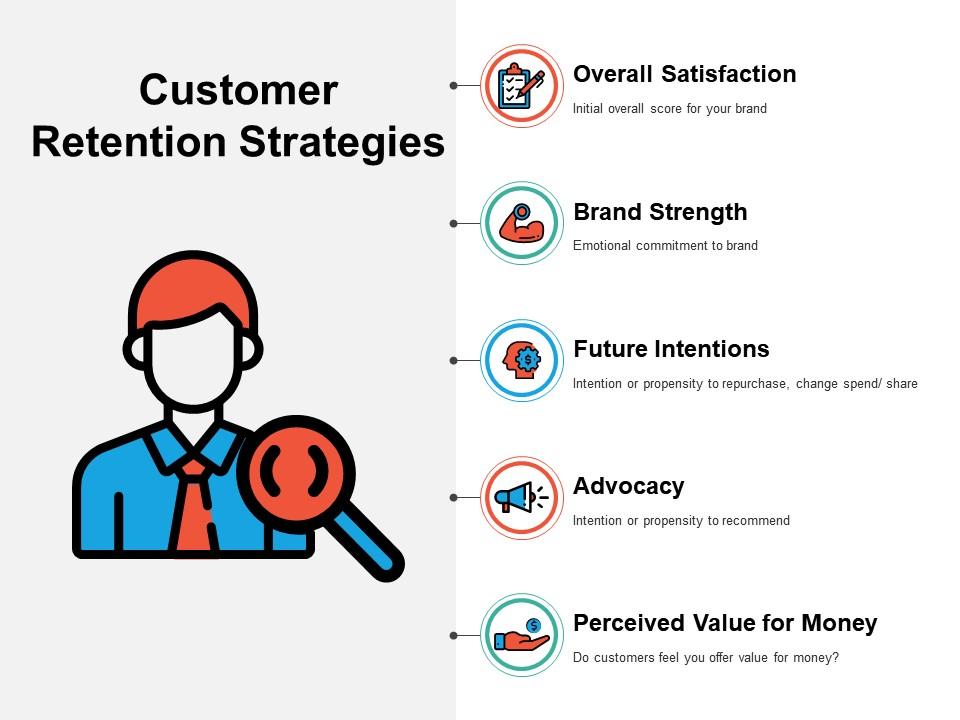
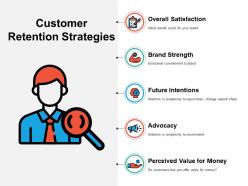
Customer retention strategies ppt powerpoint presentation pictures
Try Before you Buy Download Free Sample Product
Audience
Editable
of Time
The harder the test the better we get. Our Customer Retention Strategies Ppt Powerpoint Presentation Pictures will rise to any challenge.
People who downloaded this PowerPoint presentation also viewed the following :
Customer retention strategies ppt powerpoint presentation pictures with all 5 slides:
Our Customer Retention Strategies Ppt Powerpoint Presentation Pictures ensure that they keep coming back. Their appetites will get a boost.
FAQs for Customer retention strategies ppt
**INPUT**: What are the most effective customer engagement strategies to increase retention? **OUTPUT**: Effective customer engagement strategies include personalized communication, loyalty programs, proactive customer support, regular feedback collection, and omnichannel experiences. These approaches enhance retention by building stronger relationships, anticipating needs, and delivering consistent value, with many retail and financial services organizations finding that strategic engagement ultimately reduces churn while increasing customer lifetime value. **Word count: 54 words**
Personalization enhances customer loyalty by delivering tailored experiences, targeted recommendations, customized communications, and individualized service interactions that resonate with specific customer preferences and behaviors. Through advanced analytics and customer data platforms, businesses across retail, hospitality, and financial services create deeper emotional connections, increase purchase frequency, and reduce churn rates, ultimately delivering sustained competitive advantage.
Customer feedback serves as the foundation for effective retention strategies by identifying pain points, revealing improvement opportunities, and understanding customer expectations and preferences. Through systematic feedback collection and analysis, businesses can personalize experiences, address service gaps, and proactively resolve issues, with many organizations finding that responsive feedback implementation significantly reduces churn while enhancing customer loyalty and long-term value.
Businesses can measure customer retention success through key metrics including retention rate, customer lifetime value, churn rate, repeat purchase frequency, and Net Promoter Score. These indicators work together by tracking behavioral patterns, revenue impact, and satisfaction levels, with many organizations finding that combining quantitative data with qualitative feedback delivers comprehensive insights into long-term customer loyalty and profitability.
Customer retention technologies include CRM systems, marketing automation platforms, predictive analytics tools, chatbots, and loyalty management software. These solutions enhance retention by personalizing customer interactions, automating targeted campaigns, and predicting churn risks, with many retail and financial services organizations finding that integrated approaches deliver improved customer lifetime value and significantly reduced acquisition costs.
Loyalty programs maximize customer retention through personalized rewards, tiered membership levels, experiential benefits, gamification elements, and seamless digital integration across touchpoints. Retailers like Starbucks and airlines demonstrate this by combining points-based systems with exclusive experiences and mobile convenience, ultimately delivering enhanced customer lifetime value while creating emotional connections that significantly reduce churn rates.
Companies identify at-risk customers through predictive analytics, behavioral tracking, engagement scoring, purchase pattern analysis, and customer feedback monitoring. These technologies enable organizations to detect declining activity, reduced spending, or satisfaction drops early, allowing proactive interventions like personalized offers, targeted support, or retention campaigns, ultimately reducing churn rates and preserving valuable customer relationships.
High-quality customer service significantly boosts retention rates by building trust, resolving issues promptly, and creating positive experiences that encourage repeat business. Companies with exceptional service teams often see retention rates increase by 20-30%, with industries like banking, telecommunications, and retail finding that responsive, personalized support transforms occasional customers into loyal advocates, ultimately delivering sustained revenue growth.
Customer onboarding is crucial for retention strategies as it establishes initial customer success, reduces early churn, and builds long-term loyalty through proper product adoption. Effective onboarding programs streamline user experiences, minimize confusion, and accelerate time-to-value, with many businesses finding that structured onboarding processes increase customer lifetime value and significantly improve retention rates.
Successful customer retention initiatives include Amazon Prime's membership model, Starbucks' loyalty program, Netflix's personalized recommendations, Sephora's tiered rewards system, and Zappos' exceptional customer service approach. These strategies enhance customer lifetime value by creating emotional connections, delivering personalized experiences, and providing tangible benefits, with many organizations finding that strategic retention programs significantly outperform acquisition-focused marketing investments.
Content marketing improves customer retention by delivering valuable educational resources, personalized communications, and consistent brand engagement across multiple touchpoints. Through strategic content like tutorials, industry insights, and customer success stories, businesses strengthen relationships, reduce churn rates, and increase lifetime value, with many companies finding that regular, relevant content transforms one-time buyers into loyal advocates.
Re-engaging lapsed customers involves personalized outreach campaigns, exclusive win-back offers, surveys to understand departure reasons, targeted email sequences, and loyalty program incentives. These strategies work by addressing specific concerns, demonstrating value improvements, and offering compelling reasons to return, with many businesses finding that personalized approaches and exclusive offers significantly improve reactivation rates.
Customer retention strategies vary significantly across industries based on customer behavior, purchase frequency, and relationship dynamics. While subscription-based businesses focus on engagement and value demonstration, retail emphasizes loyalty programs and personalized experiences, and financial services prioritize trust-building and advisory relationships, with many organizations finding that industry-specific approaches deliver significantly higher retention rates than generic strategies.
Key customer retention metrics include customer lifetime value, churn rate, repeat purchase rate, net promoter score, and customer satisfaction scores. These metrics work together by revealing retention patterns, identifying at-risk segments, and measuring loyalty depth, with many organizations finding that tracking multiple metrics simultaneously delivers more accurate insights and enables strategic retention improvements.
Cross-departmental collaboration enhances customer retention by aligning sales, marketing, support, and product teams around unified customer insights, shared retention metrics, and coordinated touchpoint strategies. This strategic integration enables seamless customer experiences, faster issue resolution, and proactive retention interventions, with many organizations finding that collaborative approaches deliver significantly higher retention rates and customer lifetime value.
No Reviews