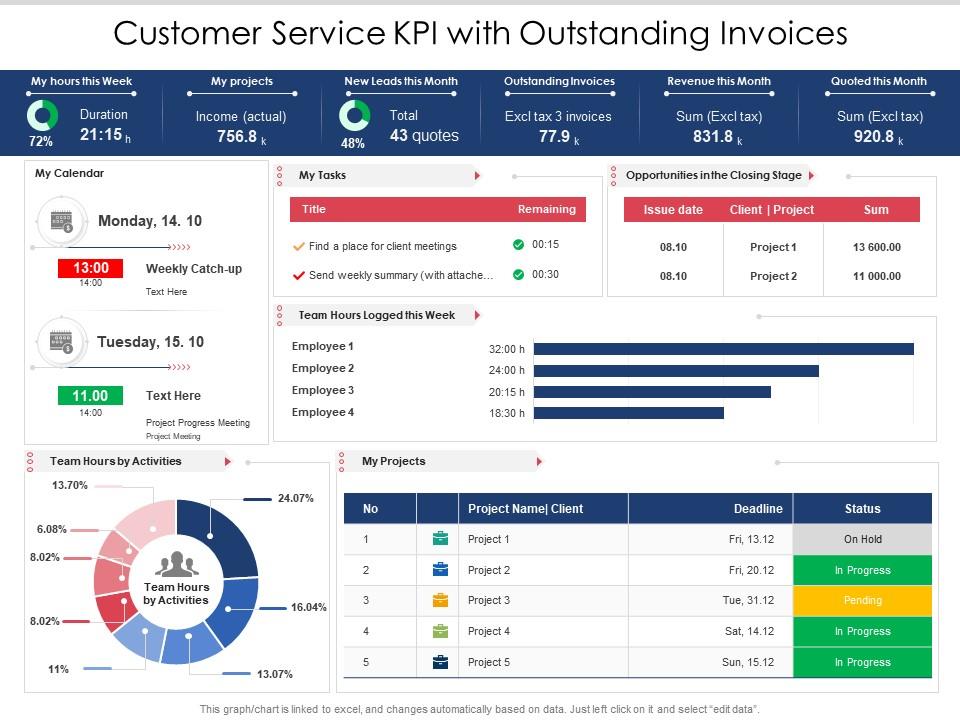
Customer service kpi with outstanding invoices
Try Before you Buy Download Free Sample Product
Audience
Editable
of Time
Our Customer Service KPI With Outstanding Invoices are topically designed to provide an attractive backdrop to any subject. Use them to look like a presentation pro.
People who downloaded this PowerPoint presentation also viewed the following :
Customer service kpi with outstanding invoices with all 2 slides:
Use our Customer Service KPI With Outstanding Invoices to effectively help you save your valuable time. They are readymade to fit into any presentation structure.
FAQs for Customer service kpi
Essential customer service KPIs include first call resolution rate, average response time, customer satisfaction scores, net promoter score, and ticket volume trends. These metrics streamline service optimization by identifying bottlenecks, measuring satisfaction levels, and tracking resolution efficiency, with many organizations finding that monitoring these KPIs ultimately delivers faster service responses and enhanced customer experiences.
NPS integrates into customer service KPIs by linking survey responses to specific service interactions, tracking scores across different touchpoints, and correlating ratings with resolution times and agent performance metrics. This strategic combination enables organizations to identify service gaps, optimize agent training programs, and enhance customer experiences, with many companies finding that NPS-driven insights ultimately deliver improved retention rates and competitive advantage.
First Response Time serves as a critical indicator of customer service responsiveness, directly impacting customer satisfaction, retention rates, and brand perception. It measures how quickly support teams acknowledge initial customer inquiries across channels like email, chat, and social media. Organizations with faster response times, particularly in e-commerce and financial services, often experience higher customer loyalty and competitive advantage, while delayed responses can escalate issues and damage relationships.
Businesses can leverage CSAT by analyzing response patterns, identifying service gaps, tracking resolution times, and correlating scores with specific touchpoints or agent performance. Through systematic CSAT analysis, organizations streamline training programs, enhance customer interactions, and optimize service delivery processes, with many companies finding that regular CSAT monitoring ultimately delivers improved retention rates and competitive advantage.
Customer service representative performance metrics include first-call resolution rates, average handle time, customer satisfaction scores, response time accuracy, and call quality assessments. These measurements enable organizations to streamline service delivery, enhance customer experiences, and optimize resource allocation, with many companies finding that balanced scorecards combining efficiency and satisfaction metrics ultimately deliver improved retention and competitive advantage.
Measuring customer effort score (CES) impacts service improvement initiatives by identifying friction points, streamlining processes, and prioritizing optimization efforts based on actual customer experiences. Organizations using CES data can redesign workflows, reduce resolution times, and eliminate unnecessary steps, with many companies finding that lower effort scores directly correlate with increased customer loyalty and operational efficiency.
Setting realistic customer service KPI targets requires analyzing historical performance data, benchmarking against industry standards, considering seasonal variations, and aligning with available resources and technology capabilities. These practices enable organizations to establish achievable yet challenging goals, with many companies finding that gradual target increases, regular review cycles, and team input ultimately deliver sustainable performance improvements and enhanced customer satisfaction across all service channels.
Companies can analyze customer service KPI trends through historical data comparison, dashboard visualizations, statistical trend analysis, and seasonal pattern identification, while establishing baseline metrics for meaningful benchmarks. Through advanced analytics platforms, organizations track resolution times, satisfaction scores, and response rates across quarters, identifying improvement opportunities and resource allocation needs, ultimately enabling data-driven decisions that enhance service quality and operational efficiency.
Customer retention rates correlate strongly with service quality KPIs through first-call resolution rates, response times, and customer satisfaction scores, as these metrics directly impact customer experience and loyalty. Organizations with higher service quality consistently see improved retention, with companies in telecommunications, banking, and retail finding that enhanced service delivery reduces churn while strengthening long-term customer relationships.
Customer service KPIs align with business objectives through strategic metrics selection, cross-departmental collaboration, and outcome-focused measurement that directly connects service performance to revenue, retention, and growth targets. By integrating customer satisfaction scores with sales conversion rates, tying resolution times to operational efficiency goals, and linking retention metrics to lifetime value calculations, organizations create measurable pathways between service excellence and business success.
Customer service KPI tracking tools include Zendesk, Salesforce Service Cloud, Freshdesk, HubSpot Service Hub, and Microsoft Dynamics 365. These platforms streamline performance monitoring by automating data collection, providing real-time dashboards, and generating comprehensive analytics reports, with many organizations finding that integrated solutions deliver enhanced operational efficiency and significantly improved customer experience insights.
Qualitative feedback enhances quantitative KPIs by providing context behind the numbers, revealing customer emotions, motivations, and specific pain points that metrics alone cannot capture. Through customer interviews, surveys, and social media monitoring, organizations uncover why satisfaction scores fluctuate, enabling targeted improvements that ultimately deliver better service experiences and stronger customer relationships.
SLA compliance significantly impacts customer service KPIs by enhancing response times, resolution rates, customer satisfaction scores, and retention metrics. When organizations consistently meet their SLAs, they deliver predictable service quality, reduce escalations, and build customer trust, with many companies finding that strong SLA performance ultimately drives competitive advantage and operational efficiency.
Customer service KPIs significantly influence employee satisfaction by providing clear performance expectations, recognition opportunities, and career development pathways through measurable achievements. When properly implemented, these metrics enable teams to celebrate successes, identify improvement areas, and foster collaborative problem-solving, with many organizations finding that balanced KPI frameworks ultimately enhance both employee engagement and service quality.
E-commerce businesses should prioritize digital-specific KPIs like cart abandonment rates, website conversion rates, online customer acquisition costs, and email response times, while traditional retail focuses more on foot traffic and in-store conversion metrics. These digital KPIs enable online retailers to optimize user experience, streamline checkout processes, and enhance customer journey mapping, ultimately delivering faster problem resolution and improved customer retention in an increasingly competitive digital marketplace.
-
Excellent products for quick understanding.
-
Designs have enough space to add content.
-
Nice and innovative design.
-
Great designs, really helpful.
-
The content is very helpful from business point of view.