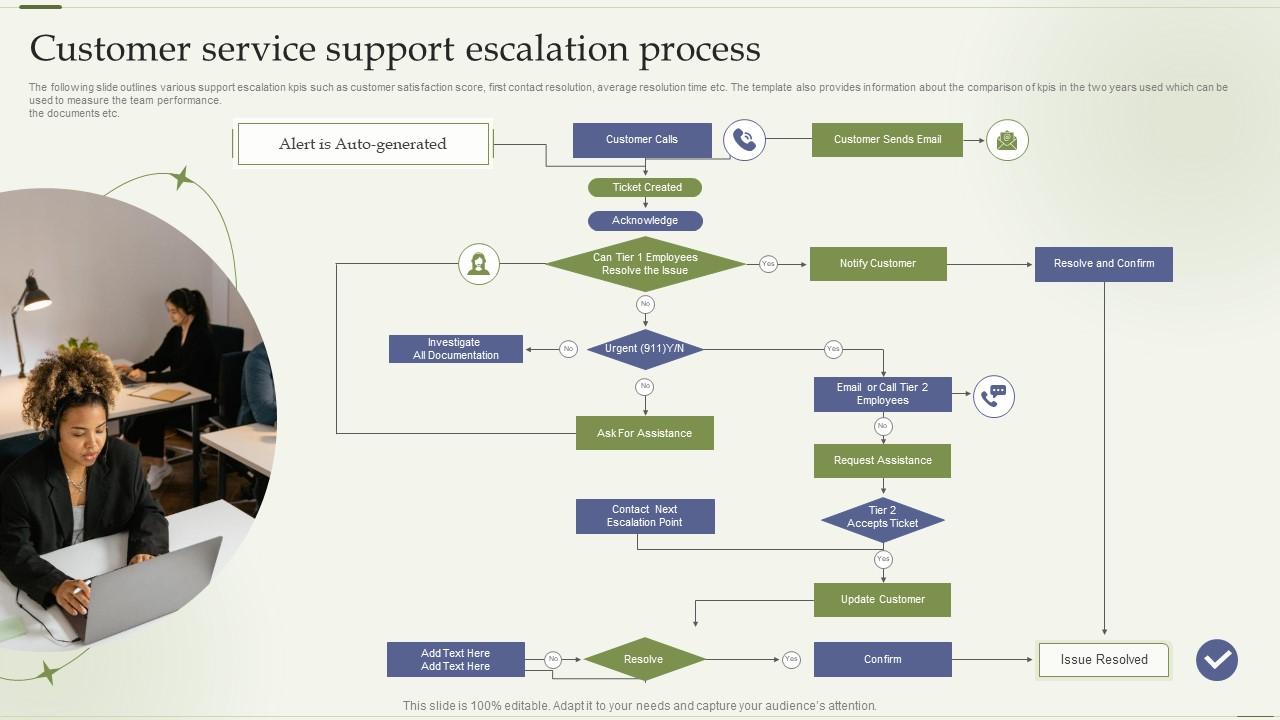
Customer Service Support Escalation Process
Try Before you Buy Download Free Sample Product
Audience
Editable
of Time
The following slide outlines various support escalation kpis such as customer satisfaction score, first contact resolution, average resolution time etc. The template also provides information about the comparison of kpis in the two years used which can be used to measure the team performance the documents etc.
People who downloaded this PowerPoint presentation also viewed the following :
Customer Service Support Escalation Process with all 6 slides:
Use our Customer Service Support Escalation Process to effectively help you save your valuable time. They are readymade to fit into any presentation structure.
FAQs for Customer Service
Key indicators for customer service escalation include repeated unresolved complaints, high-value customer dissatisfaction, legal or regulatory concerns, complex technical issues, and requests beyond standard policy limits. These escalation triggers enable organizations to preserve customer relationships, minimize revenue loss, and maintain brand reputation, with many companies finding that proactive escalation ultimately delivers faster resolutions and enhanced customer loyalty.
Businesses can train representatives through scenario-based simulations, active listening workshops, de-escalation techniques, product knowledge intensives, and empathy-building exercises. These comprehensive programs enable agents to manage frustrated customers, resolve complex issues quickly, and transform negative experiences into positive outcomes, with many organizations finding that well-trained teams significantly reduce escalation rates while enhancing customer loyalty.
Empathy serves as a critical de-escalation tool, helping staff understand customer emotions, validate concerns, and build trust during tense interactions. It can be cultivated through active listening training, role-playing exercises, emotional intelligence workshops, and regular coaching sessions, with many customer service teams finding that empathetic responses significantly reduce complaint resolution times and improve satisfaction scores.
Best practices for documenting customer interactions include recording specific issue details, customer contact information, previous resolution attempts, communication timestamps, and any promises made. This comprehensive documentation enables escalated teams to understand context immediately, avoid repeating questions, and provide faster resolution, with many customer service organizations finding that detailed records reduce escalation time by significantly improving handoff efficiency.
CRM systems enhance customer service escalation by centralizing customer data, automating workflow routing, and providing real-time visibility into case status and history. Through integrated dashboards and intelligent routing algorithms, support teams can seamlessly transfer complex issues to specialized agents while maintaining context, ultimately delivering faster resolution times and improved customer satisfaction across all service channels.
Key metrics include first-call resolution rates, escalation volume trends, average resolution times, customer satisfaction scores post-escalation, and escalation-to-closure ratios. These measurements enable organizations to identify bottlenecks, optimize resource allocation, and enhance service delivery, with many companies finding that tracking these indicators ultimately delivers faster resolution times and improved customer experiences.
Effective escalation policy communication involves creating clear documentation accessible through multiple channels, conducting regular employee training sessions, and establishing transparent customer-facing resources like help centers and service agreements. Through consistent messaging across all touchpoints, organizations enable faster issue resolution, reduce customer frustration, and empower employees with defined procedures, ultimately delivering improved service experiences and operational efficiency.
Escalation paths vary significantly across channels, with phone support offering immediate supervisor transfers, email following structured ticket routing through multiple service tiers, and social media requiring rapid public response protocols with specialized teams. These channel-specific approaches enable organizations to maintain consistency while adapting to each platform's unique demands, ultimately delivering faster resolution times and better customer experiences across all touchpoints.
Companies can prevent escalations through proactive monitoring, comprehensive staff training, clear communication protocols, robust feedback systems, and early intervention processes. These strategies enable organizations by identifying potential issues quickly, empowering frontline staff with resolution authority, and maintaining transparent customer communication, with many retail and financial services companies finding significantly reduced complaint volumes.
A well-defined escalation process improves customer satisfaction by ensuring faster resolution, transparent communication, and appropriate expertise allocation at each stage, preventing issues from deteriorating while maintaining customer confidence. Through structured escalation protocols, organizations streamline complaint handling, reduce response times, and deliver consistent service quality, with many companies finding that systematic escalation ultimately enhances customer loyalty and retention.
Businesses face challenges including inconsistent escalation protocols, inadequate staff training, poor cross-departmental communication, delayed response times, and lack of comprehensive customer history tracking. These issues can be overcome by implementing standardized escalation procedures, providing specialized training for senior representatives, establishing clear communication channels between departments, and utilizing integrated CRM systems that enable faster resolution, ultimately delivering improved customer satisfaction and reduced churn rates.
Cultural differences significantly impact escalated service expectations through varying communication styles, hierarchy preferences, authority relationships, and conflict resolution approaches. While Western customers often prefer direct communication and quick resolutions, customers from high-context cultures may expect formal protocols and relationship-building, with many global organizations finding that culturally-adapted escalation processes ultimately deliver higher satisfaction and stronger customer retention.
Feedback plays a crucial role in identifying bottlenecks, reducing resolution times, and improving customer satisfaction within escalation procedures. Through systematic analysis of customer complaints, agent insights, and resolution outcomes, organizations can streamline workflows, enhance training protocols, and optimize resource allocation, ultimately delivering faster service delivery and stronger customer relationships.
Collaboration between departments improves escalation processes by streamlining communication channels, establishing clear handoff protocols, and creating shared visibility into customer issues. Through integrated platforms and cross-functional teams, organizations accelerate resolution times, reduce customer frustration, and enhance service quality, with many companies finding that unified departmental workflows ultimately deliver faster responses and stronger customer relationships.
Successful escalation resolutions include offering personalized compensation beyond expectations, having senior executives personally address concerns, providing exclusive access to new products or services, implementing customer-suggested improvements, and creating ongoing direct communication channels. These strategic approaches transform negative experiences into trust-building opportunities, with many companies finding that properly resolved escalations generate stronger customer loyalty and positive word-of-mouth than initial perfect service experiences.
-
Their products can save your time, effort and money. What else you need. All in one package for presentation needs!
-
Enough space for editing and adding your own content.