
Cyber Security Incident Report To Enhance Efficiency

Rating:
100%
Cyber Security Incident Report To Enhance Efficiency
Slide 1 of 6
Favourites Favourites

Try Before you Buy Download Free Sample Product

Audience Impress Your
Audience
Editable 100%
Editable
Time Save Hours
of Time
The Biggest Sale is ending soon in
0
0
:
0
0
:
0
0
Rating:
100%
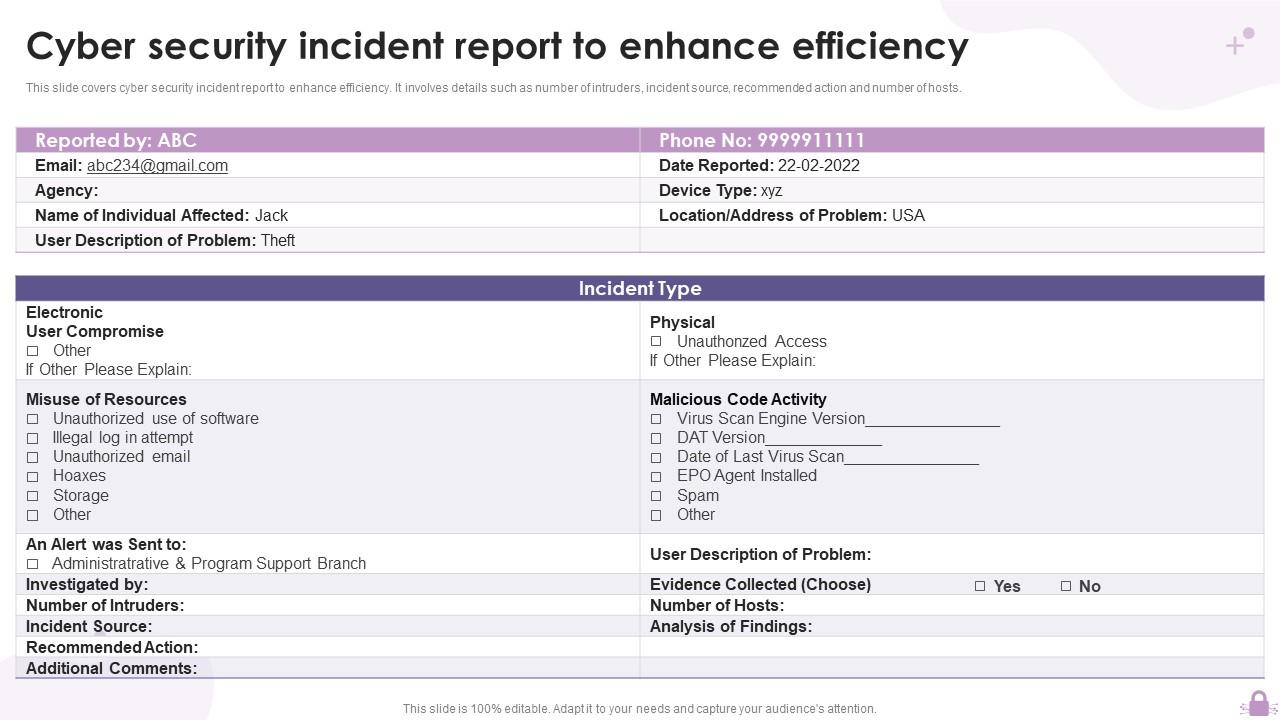
This slide covers cyber security incident report to enhance efficiency. It involves details such as number of intruders, incident source, recommended action and number of hosts. Presenting our well structured Cyber Security Incident Report To Enhance Efficiency. The topics discussed in this slide are Cyber Security, Incident Report, Enhance Efficiency. This is an instantly available PowerPoint presentation that can be edited conveniently. Download it right away and captivate your audience.
FAQs for Cyber Security Incident Report

Honestly, ransomware's the scariest one right now - they literally lock up all your files until you pay them. Phishing emails are everywhere too, and people still click on sketchy links way too often. Plus there's all kinds of malware that can steal your data or let hackers sneak into your network. Social engineering's getting worse too, where they just call up your employees and trick them directly. Super annoying but effective. Start with training your team to spot fake emails - seriously, half the battle is just teaching people what to look for. And get your backup situation sorted out. Those two things will stop most attacks honestly.

Honestly, most of this stuff is pretty basic but people skip it anyway. Two-factor auth on everything, auto-updates turned on, and teach your team to spot phishing emails - that's where I'd start. Most hackers aren't some genius breaking into your system, they're just waiting for someone to click a bad link. Password managers and decent antivirus run like $10/month per person. Oh, and back everything up to the cloud regularly. If something does happen, you'll want a simple plan so people don't just panic and make it worse.

Dude, training your employees is honestly the best thing you can do for cybersecurity. Most data breaches happen because someone clicks a sketchy link or gets fooled by a phishing email - it's crazy how often that happens. Regular training turns your team into your first line of defense. Hackers are getting super sneaky with their tactics these days, but a well-trained employee can spot stuff that security software totally misses. I'd start with those fake phishing tests every month and basic security workshops. Trust me, you'll see a huge difference in how vulnerable your company is.

Honestly, AI is a game-changer for cybersecurity stuff. Your team won't have to manually dig through tons of alerts anymore - the algorithms spot real threats automatically and flag them right away. Behavioral analysis is where it really shines though. It figures out what normal network activity looks like, then catches anything weird immediately. You can set it up for email security or network monitoring pretty easily. Oh, and it does predictive threat intelligence too, which is pretty cool. I'd start with just one area first - don't try to do everything at once or you'll go crazy.

Okay so definitely mix uppercase, lowercase, numbers and symbols - shoot for 12+ characters. I totally fell for thinking "P@ssw0rd123" was genius until I found out hackers break those instantly lol. You'll want different passwords for everything, which sounds insane but password managers like Bitwarden save your life here. They create random ones and store them. Skip the obvious stuff - birthdays, your dog's name, whatever. Oh and turn on two-factor authentication wherever you can. I'd start with the big ones first - email, bank accounts, work stuff.

Look, cybersecurity regs are a huge upfront cost - you're hiring compliance people, installing new security stuff, documenting everything like crazy. Total headache honestly. But the alternative is worse. GDPR fines can be 4% of your entire global revenue, and healthcare breaches? We're talking millions in HIPAA penalties on average. The weird thing is customers actually trust you more when you're compliant, so it can help business too. My advice? Figure out which regulations hit your industry first, then map out a plan to tackle them one by one.

Honestly, the stuff that's actually working against APTs right now is pretty interesting. AI-powered detection is huge - machine learning can catch weird behavioral patterns way before traditional tools even know what's happening. XDR platforms are probably your best bet to start with since they pull data from everywhere and give you the full picture. Zero-trust architecture is smart too, basically assumes you're already compromised (which, let's be real, you probably are). Oh, and deception tech is kind of brilliant - sets up honeypots to trap attackers. I'd definitely look into XDR first though, seems like the most practical move for most environments.

Honestly, start with the basics - get everyone on VPN and force multi-factor authentication. I can't stress this enough, MFA saves your butt constantly. Then make sure all devices have decent endpoint protection, even personal laptops if people are using those for work. Patches matter too, so stay on top of updates. Oh, and train your team regularly on spotting phishing emails because people click on the weirdest stuff sometimes. I'd audit what you've got now first though - figure out where you're most vulnerable and tackle those gaps. Remote security isn't rocket science but you can't half-ass it either.

Okay so first thing - shut everything down that's been hit and stop any data bleeding out. Figure out what got taken and how many people we're talking about. Write down every step because you'll need that paper trail later. I know it's crazy stressful but just go one thing at a time. Call your legal people, notify whoever you have to legally, and get those affected customers in the loop. Change every password that might've been touched - honestly, probably change more than you think you need to. Oh and set up like a group chat or something for your team so nobody's working in the dark.

Honestly, old-school antivirus is pretty hit or miss now. It'll catch the obvious stuff and known threats, but hackers have upped their game big time. Most antivirus just looks for signatures of malware it already knows about - which is useless when new variants drop constantly. Zero-day exploits and fileless attacks? Yeah, they slip right through. But don't toss it completely! You need it as part of a bigger security setup with endpoint detection and behavior monitoring. Oh, and train your team too - half the breaches happen because someone clicked something they shouldn't have.

Okay so here's the deal - you're still on the hook for your data even when it lives in someone else's cloud. Your provider needs to meet whatever regs you do (GDPR, HIPAA, all that fun stuff). The shared responsibility thing is where it gets messy though. Like, they handle some security stuff, you handle others. Honestly took me forever to figure out who does what with encryption and access controls. I'd start by checking their compliance certs first, then figure out if those actually cover what you need. Oh and don't forget about audit logging - that one trips people up.

Honestly, start with the basics - how fast you catch threats and respond to them. Track successful vs blocked attacks too. Phishing test results are huge since your employees are basically the front line. Oh, and vulnerability patching speed matters way more than people think. Penetration testing gives you the real deal on whether your defenses actually work. Business continuity during incidents is another big one - can you keep running when stuff hits the fan? Don't go crazy with metrics though. Pick maybe 3-5 that actually matter for your company and check them monthly.

Dude, you absolutely need an incident response plan. When hackers hit, your team will just scramble around like headless chickens without one. Seriously, I've seen it happen - people waste hours figuring out basic stuff while the attack spreads. It's like having a fire drill but nobody knows where the exits are. A good plan cuts response time way down and limits how much damage they can do. Oh, and regulators love seeing you're prepared. Just don't forget to actually test the thing regularly. I swear, most companies write these plans then let them collect dust until it's too late.

So basically these scammers are total mind games experts. They'll pretend to be your boss or IT guy, then hit you with fake "URGENT!!!" pressure so you panic and don't think straight. Or they play on wanting to help people - honestly pretty manipulative stuff. The whole point is skipping past all your passwords and security by messing with your emotions instead. Quick tip though: just pause whenever someone's asking for login info or personal stuff. Even if it seems legit! Doesn't matter how rushed they make it sound - real emergencies can wait 30 seconds for you to double-check.

Honestly, AI attacks are getting crazy sophisticated - both offensive and defensive sides. Zero-trust isn't optional anymore, especially since remote work's here to stay. Quantum threats are still years away but you should probably start thinking about crypto strategies now. Supply chain attacks keep getting worse too. Multi-cloud setups are making security way more complex than it needs to be sometimes. My advice? Jump on AI security training ASAP and push hard for zero-trust if your company's dragging their feet. Those skills will seriously set you apart career-wise.

Ratings and Reviews

100% of 100
Review Form
Write a review
Most Relevant Reviews
  1. 100%

    by James Lewis

    Easy to use and customize templates. Helped me give a last minute presentation.
  2. 100%

    by Cyrus Ellis

    Perfect template with attractive color combination.

2 Item(s)

per page:







