Daily or weekly work log update

Daily or weekly work log update
Slide 1 of 5
Favourites Favourites

Try Before you Buy Download Free Sample Product

Audience Impress Your
Audience
Editable 100%
Editable
Time Save Hours
of Time
The Biggest Sale is ending soon in
0
0
:
0
0
:
0
0
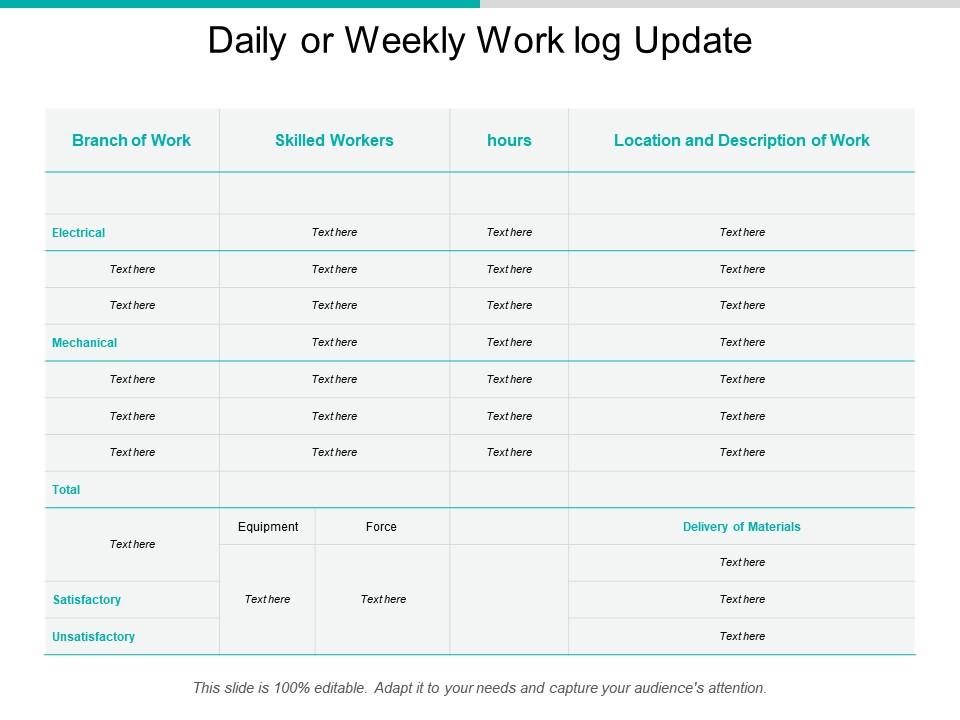
Presenting this set of slides with name Daily Or Weekly Work Log Update. The topics discussed in these slides are Weekly Progress Reports, Weekly Performance Reports, Weekly Progress Tracking. This is a completely editable PowerPoint presentation and is available for immediate download. Download now and impress your audience.

People who downloaded this PowerPoint presentation also viewed the following :

FAQs for Daily or weekly

Effective work log updates include task completion status, time allocation details, milestone achievements, challenges encountered, and next-step priorities. These components streamline project management by enhancing team transparency, enabling better resource allocation, and facilitating proactive problem-solving, with many organizations finding that structured updates ultimately deliver improved accountability and faster project delivery.

Presentation templates enhance work log clarity by standardizing formats, organizing information hierarchically, emphasizing key metrics, and creating visual consistency across updates. These structured frameworks enable teams to quickly identify project progress, resource allocation, and timeline adjustments, while reducing preparation time and ensuring stakeholders receive comprehensive, professional updates that facilitate faster decision-making and improved project oversight.

Work log updates benefit from clear formatting that includes consistent date stamps, descriptive task headers, bullet-pointed progress items, time allocations, and priority indicators. These structured approaches enhance team communication by enabling quick scanning, facilitating project tracking, and streamlining status reviews, with many organizations finding that standardized formats ultimately deliver improved accountability and faster decision-making across departments.

Work log updates should be conducted daily or at minimum every 2-3 days to maintain consistent project momentum, track progress accurately, and identify potential roadblocks early. This regular cadence enables project managers to streamline communication, enhance team coordination, and deliver timely course corrections, with many organizations finding that frequent updates ultimately accelerate project delivery and improve stakeholder transparency.

Work log updates for stakeholders should prioritize progress against key milestones, resource allocation changes, risk assessments, budget variance reports, and timeline adjustments. These data points enable stakeholders to make informed decisions by providing comprehensive project visibility, identifying potential bottlenecks early, and ensuring strategic alignment, with many organizations finding that regular, data-driven updates significantly enhance project outcomes and stakeholder confidence.

Visuals from presentation templates can be integrated through screenshots of key charts, graphs, and infographics that illustrate project progress, milestone achievements, and performance metrics. These visual elements enhance work log clarity by transforming complex data into digestible formats, with many project managers finding that visual updates improve stakeholder engagement and decision-making speed.

**INPUT**: What strategies can be used to summarize complex projects in work log updates? **OUTPUT**: Effective summarization strategies include milestone-based reporting, risk-impact categorization, stakeholder-specific highlights, progress percentage tracking, and exception-based updates focusing on deviations. These approaches streamline communication by emphasizing critical deliverables, budget variations, and timeline shifts, with many project managers finding that structured templates and visual dashboards ultimately enhance transparency while reducing reporting overhead.

Team dynamics significantly influence work log structure through communication preferences, collaboration patterns, accountability levels, and reporting hierarchies within organizations. Cross-functional teams often require detailed progress tracking and dependency mapping, while autonomous teams favor streamlined updates focusing on outcomes, with many organizations finding that transparent, regular updates enhance coordination and reduce project bottlenecks.

Key productivity metrics in work logs include time allocation per task, completion rates, quality scores, deadline adherence, and resource utilization patterns. These measurements enable organizations to streamline workflows, identify bottlenecks, and optimize team performance, with many companies finding that consistent tracking ultimately delivers enhanced operational efficiency and strategic resource allocation across departments.

Accountability through work log updates requires establishing clear review cycles, setting measurable milestones, and implementing automated tracking systems that flag delays or incomplete tasks. Organizations enhance follow-up by conducting regular progress meetings, assigning specific ownership for each logged item, and creating escalation protocols, with many teams finding that transparent logging systems ultimately deliver improved project completion rates and stronger team performance.

Tools that streamline work log updates include time tracking software like Toggl, project management platforms such as Asana and Monday.com, automated logging systems, and integrated dashboard solutions. These technologies enhance productivity by reducing manual entry, providing real-time visibility, and enabling seamless collaboration, with many organizations finding that automated systems deliver faster reporting and improved accuracy.

Challenges and setbacks should be communicated transparently with specific details, root causes, impact assessment, and proposed solutions or mitigation strategies. This approach enables managers to provide targeted support, facilitates collaborative problem-solving, and maintains project visibility, with many organizations finding that honest communication ultimately accelerates resolution and strengthens team accountability.

Feedback enables continuous improvement of work log updates by identifying gaps in documentation, clarifying unclear entries, and highlighting missed critical information. Through regular feedback from supervisors, team members, and stakeholders, organizations streamline their logging processes, enhance accuracy, and ultimately deliver better project transparency and accountability, with many teams finding that structured feedback loops significantly improve work quality.

Work log updates become more engaging through narrative techniques like progress storytelling, challenge-resolution frameworks, visual milestone mapping, and outcome-focused reporting that transforms routine updates into compelling business narratives. These approaches help teams contextualize achievements within broader project goals, with many organizations finding that storytelling-enhanced logs improve stakeholder engagement, team motivation, and strategic alignment while delivering clearer project visibility.

Emerging trends in work log documentation include automated time tracking through AI-powered tools, real-time collaboration platforms, mobile-first applications, integration with project management systems, and predictive analytics for resource planning. These technologies streamline reporting by eliminating manual data entry, enhancing transparency across teams, and delivering actionable insights, with many organizations finding that automated workflows significantly improve accuracy while reducing administrative overhead.

Ratings and Reviews

0% of 100
Write a review
Most Relevant Reviews

No Reviews